
IAF chief VR Chaudhari discusses past & future of Indian defence forces | Full statement
Air Chief Marshal Vivek Ram Chaudhari, at the Republic Summit 2023, set the goal of India gaining superiority not only in air but also in space.
- Republic Summit
- 12 min read

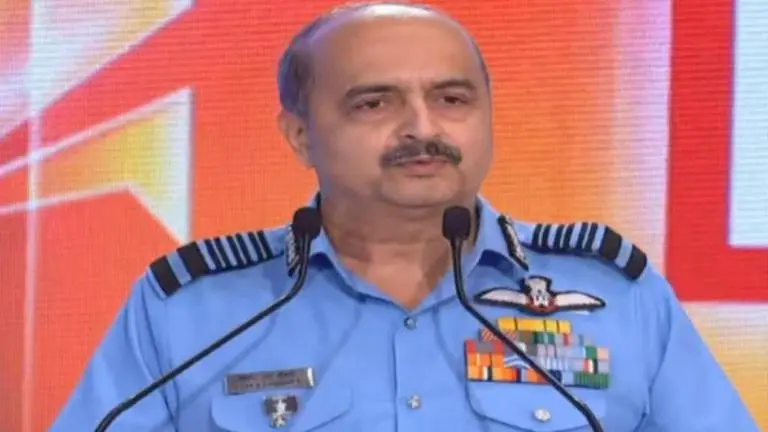
All three chiefs of the Indian Army, Air Force and the Navy attended the Republic Summit 2023 where they shared their insights into the present and the future of India's defence forces and capabilities. While Chief of the Naval Staff, Admiral R. Hari Kumar reflected on the growth of the Navy, Chief of Army Staff General Manoj Pande spoke on the prospects of the Army's transformation. Air Chief Marshal Vivek Ram Chaudhari of the IAF, on the other hand, set the goal of India gaining superiority not only in air but also in space. Below is VR Chaudhari's full statement.
Air Chief Marshal VR Chaudhari's full statement:
A “TIME OF TRANSFORMATION”. In the words of the Hon’ble PM- “We have less time, but immense capabilities. We have difficult targets, but great courage. We have the goal to climb the mountains, but we will transcend even the skies.”
Good Afternoon, Ladies and Gentlemen. It is indeed a pleasure for me to be here to deliver the Summit Key Note Address and talk about India’s growth trajectory and where we see India and the Indian Air Force in the year 2047, almost twenty five years from now.
Let me first take you all 25 years back in time to 1998. I was a senior Sqn Ldr flying Mig 29s in Adampur. India carried out nuclear tests in Pokhran, and many nations imposed sanctions on us. Mobile phones were a distant dream and we were still using conventional dial-up phones. India’s GDP was 421 Billion US Dollars. The internet was just about coming into India and was quite a luxury. Data storage on floppy disks was a big technological leap. If I remember correctly, inland letters and postcards were still being used by a majority of Indians and e-mails were yet to take off. This flashback to 1998 will allow us to better comprehend the kind of leap that technological advances will take in the next 25 years within the rubric of Moore’s law of course. Not to forget, we are all 25 years older and yet have adapted to modern technology seamlessly. From our grandparents to grandchildren, we are all on the same Whatsapp group and communicate freely and efficiently.
Advertisement
The fact that technology grows exponentially, and not linearly, will mean that the next 25 years would witness an even greater growth, the contours of which may be difficult to predict very accurately at this stage. However, it is certain by 2047, when our nation completes 100 years of independence, we would be looking at a very different India, possibly one of the largest economies in the world, possibly a world leader in many fields and definitely a power to reckon with.
So, I asked myself what does it take for a country to be reckoned with and what are the attributes required. One such attribute could be reaching a dominant position characterized by ability to exert influence or project power on a global scale. This is done through the combined means of economic, military, technological, political and cultural strength as well as diplomatic and soft power influence. We are the fifth largest economy in the world and by estimated growth rates we are well on the way to becoming the third largest economy in the next decade.
Advertisement
We are already the most populous country in the world. Interestingly, the window of demographic dividend opportunity available from 2005-06 to 2055-56 is longer than any other country in the world. This bulge in the working age population is a window that we must exploit. Our economic progress, political stability and diplomatic deftness has put us at the centre stage and announced to the world that India has arrived. Added to this is the combined military might of the armed forces of India. We have the second largest Army, the eighth largest Navy and the fourth largest Air Force in the world. Let me now focus on the Indian Air Force. IAF completed 90 years last October, and I will speak about where we stand and what we need to do to transform into a modern Air and Space Force when we celebrate our centenary.
The Indian Air Force, as a highly technological and capital intensive force, will mirror the trajectory of our nation’s progress. No other field has seen such a rapid transformation in technology as aerospace power has seen in the last 120 years of its existence. Evolution from a small biplane to a proliferation of space based systems, is just a mere glimpse of things we can expect in the future. The challenge is going to be indigenous 3 design, development and production of future capability. Development of the next generation of aircraft, weapon systems and equipment will call for an ‘all of nation’ approach because no single entity will have the resources or the knowledge base to develop future battle-ready technology.
We therefore need to focus more on Research and Development with an aim to manufacture on our own rather than relying on minor indigenisation of foreign products. The government has been very supportive to this cause and has taken giant steps in supporting Indian companies and academia with necessary policy formulation and by providing a conducive environment. I have no doubt in my mind that our industry partners, MSMEs and academia will give full impetus in realizing India’s aspiration of achieving strategic autonomy or Atmanirbharta in defence production.
Besides, futuristic technology, we will also need innovative means to sustain, maintain and upgrade our existing platforms and equipment. While a few of our legacy fleets would have been phased out by 2047, the majority of our current fleets will still be in service. Developments in technology and the success of our Indian defence manufacturers will play a major role in shaping the inventory and capability of the IAF of 2047. When we look at India@100 years, we are not only looking at preventing our adversaries from gaining technological asymmetry over us but also at developing the asymmetry in our favour across all domains.
Earlier, technological advances resulted in incremental up-gradation of existing platforms in terms of range, weapon delivery accuracy and sophistication. Today, path breaking technologies, Artificial Intelligence, Robotics and Autonomous Systems, Battlefield of Things (BoTs) and Internet of Things (IoTs) are knocking at the doors of defence production. The application of these technologies in the aerospace industry has the potential to entirely transform the way wars will 4 be prosecuted. While it is heartening to see the growth in our indigenous defence production capability, we need to incorporate and infuse these technologies in our future projects. This will enable us to produce cutting edge platforms, weapons, sensors, and networks essential to fight and win a future war.
Future warfare would be hybrid in nature and the spectrum of conflict will be spread across all domains spanning from conventional to sub-conventional, kinetic to non-kinetic and lethal to non-lethal. Development of capabilities across the full spectrum of conflict with a special focus on multi-domain operations is the need of the hour. Glimpses of things on the anvil can be seen in the ongoing Russia-Ukraine conflict. We need to accept the fact that tomorrow’s wars cannot be fought with yesterday’s mind-set.
What we need to understand is that airpower has the capability to deter, defend and if required punish the adversary in a conflict. Even at the lower end of the spectrum, during NWNP and peacetime situations, IAF has been and will continue to contribute effectively in the pursuit of our national objectives. IAF's response during various calamities like floods, earthquakes and the COVID pandemic both within our borders and in the region, contributed towards India's growing eminence in the world order.
IAF has the unique capability of undertaking independent strategic operations as well as operations coordinated with other services and arms of the national security apparatus. We understand the imperative nature of joint planning and execution in future wars and are keen on integrating the efforts of the three services. We have recently updated and revised the Doctrine of IAF to keep it relevant for the next decade. The next step would be to use our doctrines and well trained manpower to evolve employment philosophies and Concepts of Operations. This would require joint planning 5 and joint execution of plans. No single service can win wars on its own and this holds good even for the future.
In the fog of war, there is a need to get as clear a picture as possible of the battle space and intentions of the adversary. This would give a high degree of flexibility to the commander at the operational level to make dynamic changes and shape the battlespace. This ability will rely on highly secure and efficient networks that integrate sensors, decision makers and the shooters. Our network centric capability seamlessly fuses all elements of war-fighting to create a very high level of shared battle space awareness. The key components of this capability are all interconnected in the loop. Sensors such as Radars, Surveillance platforms, AWACS, and Satellites; the shooters, both manned & unmanned and the decision makers who control the air battle at all levels have to remain fully networked. We are actively pursuing development of niche technologies in the field of space-based capabilities, Data Linking and AI based Decision Support Systems to shorten the sensor to shooter loop and for making the targeting cycle highly responsive.
Conflicts in the last few decades have clearly established without doubt, the pre-eminence of Aerospace Power as the Instrument of Choice for almost all operational contingencies. The tactical advantage that ‘high ground’ offers is a must-achieve criteria even today. In this aspect, aerospace power provides that high ground and the ability to bypass fielded forces to hit targets in great depths with speed and precision. In more recent time, Space has been increasingly exploited as it provides the ultimate high ground where the nation’s forces can operate with near impunity. The accrued ability to see and comprehend the enemy’s disposition and design provides a commander with an ability to decide and act quickly.
Easy accessibility of high end technology is also posing new challenges to the conventional forces. Harassment through the use of drones in the Middle East, use of drones alongside fighter aircraft in Azerbaijan-Armenia conflict and extensive use of armed drones in the ongoing Russia-Ukraine conflict are all indicative of things to come in the future. We have also doctrinally included drone usage in our scheme of operations to benefit from some of the exclusive attributes of these platforms. At the same time, we are pursuing unmanned combat systems and their integration with manned fighter platforms in what is known as manned-unmanned teaming.
We have laid out a roadmap to add new capabilities and harness modern technology, making technological innovation an integral part of our security apparatus. This thought has initiated a process of reequipping, retraining and remodelling of our security infrastructure. A potent Air Force of the future will be characterized by aspects of persistent presence, multi role capability, rapid deployment, spectrum dominance, centricity of information management, precision targeting and rapid innovation for creating asymmetry. The unique combination of developing capabilities, operational concepts and technological opportunities has created a situation where air power will play a very crucial role to overcome rapid changes in the character and conduct of war.
Last, but definitely not the least, is the importance of the man and woman behind the machine. Multiskilling our personnel has become the need of the hour to enable them to take decisions spanning the vast spectrum of operations that we are likely to undertake. A lean and mean force equipped to handle more than its own core competency is the need of the hour in tomorrow’s technologically intensive battlespace.
India has the capability and more importantly, the will, to respond at a level that we deem appropriate and to impose our own escalation matrix. We the men and women in uniform are the cutting edge of that response. Therefore, it is imperative that we keep that edge as sharp and lethal as possible.
When you think of the Air Force, I am sure you visualize fast jets, huge transport aircraft or nimble helicopters. I do foresee the AF equipped with indigenous platforms like variants of the LCA, the AMCA, the LCH & the IMRH. But what lies beyond these assets are the enablers and enhancers of our capability. We are looking at secure communications through Operational Data Links powered by 5th and 6th generation SDRs and redundant networks. We are looking at post-Quantum cryptography compatible equipment, along with miniaturised EW systems. We are seeking multiple satellite based and airborne networks along with significant capability in ISR through space based assets.
All this can only be made possible if we the users work in synergy with the researchers and developers, manufacturers- both Government and private and the aerospace industry. And when I say “WE”, I don’t mean the Indian Air Force alone. A joint and integrated plan of action with the Indian Army and the Indian Navy with a synergistically orchestrated procurement plan is the way forward to leverage the optimum potential of our armed forces.
Ladies & Gentlemen, Transformation is an ongoing process that appears to be ordinary, when, in fact, something extraordinary is actually taking place. On that note, I would like to wish all participants of this “TIME OF TRANSFORMATION” summit the very best. I am sure the discussions and brainstorming that takes place here will produce ideas and concepts that will take India where it deserves and needs to be in 2047. Thank You and Jai Hind!