
Artemis III Delayed Again: Why NASA’s Moon Mission Has Slipped to Late 2027
NASA's Artemis III mission is delayed again, with a launch now set for late 2027. Technical issues with lunar landing systems from SpaceX and Blue Origin, plus challenges in cryogenic fuel storage and Orion's heat shield, contribute to setbacks.
- Science News
- 2 min read

;'%3e%3cpath%20d='m8,15.99c4.41,0,7.99-3.58,7.99-7.99S12.41,0,8,0,0,3.59,0,8s3.58,7.99,7.99,7.99Z'%20style='stroke:%23fff;%20stroke-miterlimit:10;%20stroke-width:.02px;'/%3e%3cpath%20d='m3.08,3.37l3.82,5.11-3.84,4.15h.87l3.37-3.64,2.72,3.64h2.94l-4.04-5.39,3.58-3.87h-.86l-3.1,3.35-2.5-3.35h-2.94Zm1.27.64h1.35l5.97,7.99h-1.35l-5.97-7.99Z'%20style='fill:%23fff;'/%3e%3c/g%3e%3c/svg%3e)


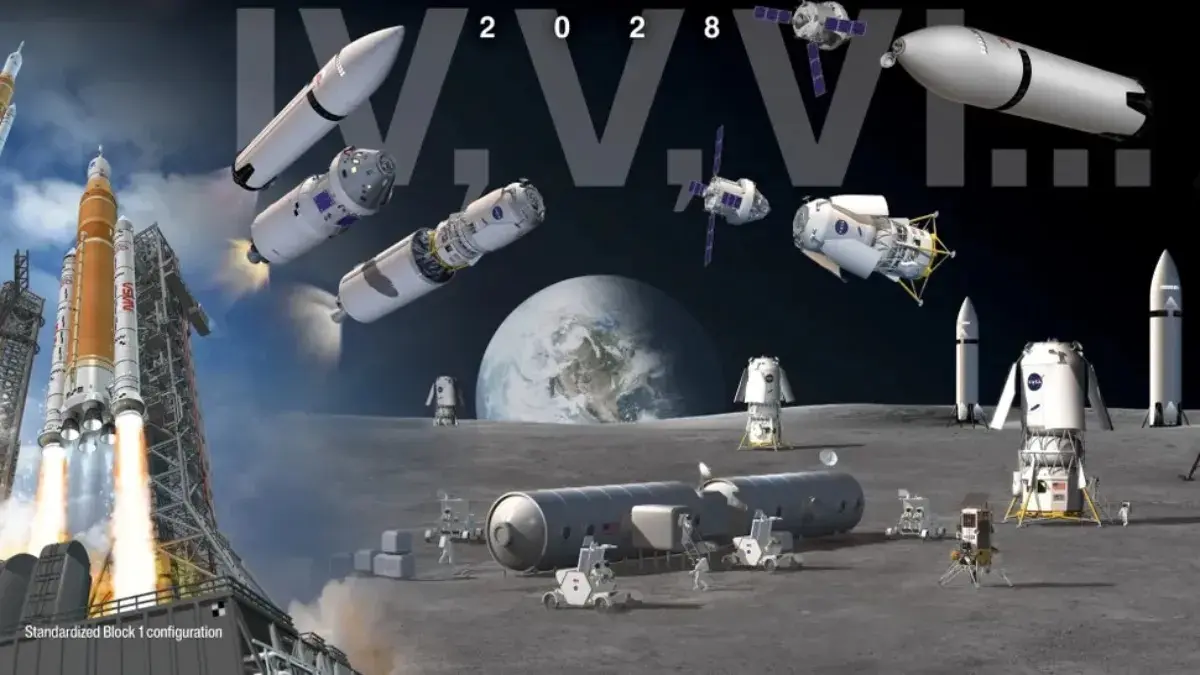
New Delhi: NASA’s ambitious Artemis III mission - aimed at paving the way for astronauts to return to the Moon - has been pushed back once again, with the launch now expected no earlier than late 2027 as the US space agency grapples with technical challenges, spacecraft readiness issues, and delays involving its commercial partners.
The updated timeline marks another setback for NASA’s Artemis programme, which seeks to land astronauts near the Moon’s south pole for the first time since the Apollo era.
According to reports, the primary reason behind the delay is the additional time required for testing and certifying critical lunar landing systems being developed by private companies, including SpaceX and Blue Origin.
NASA’s Artemis III mission will no longer attempt an immediate Moon landing. Instead, the mission is now expected to focus on testing rendezvous and docking operations in Earth orbit between NASA’s Orion spacecraft and commercial lunar landers.
Advertisement
A major hurdle remains the development of the Human Landing Systems (HLS), particularly SpaceX’s Starship-based lunar lander and Blue Origin’s Blue Moon lander. Both systems still require extensive testing before NASA can certify them for carrying astronauts.
The report also highlighted challenges linked to cryogenic fuel storage and in-space refueling - technologies essential for future Moon missions but yet to be fully demonstrated in orbit. Since the landers use supercooled propellants that naturally boil off over time, multiple refueling launches and fuel-transfer tests will be necessary before a crewed lunar mission can proceed safely.
Advertisement
Apart from lander-related delays, NASA has also continued working through issues involving the Orion spacecraft’s heat shield, which experienced unexpected wear during the uncrewed Artemis I mission in 2022.
Engineers found that trapped gases within the Avcoat heat shield material caused portions of the outer layer to crack and chip during Earth re-entry.
Although NASA has said the issue would not have endangered astronauts, the agency has modified Orion’s re-entry trajectory and made engineering adjustments to reduce risks for future missions.
NASA’s Artemis campaign has already faced multiple delays over the years. In December 2024, the agency shifted Artemis II to 2026 and Artemis III to mid-2027 following concerns surrounding Orion’s life-support systems and heat shield performance.
Despite the latest setback, NASA officials remain hopeful that astronauts could still land on the Moon in 2028 if upcoming tests are completed successfully and commercial landers become operational on time.