
Astronomers Spot the Most Powerful Cosmic Ring Ever Seen - And It’s Unlike Anything We Know
Astronomers and citizen scientists have uncovered the largest, most mysterious cosmic radio ring ever seen, twice the size of our galaxy, with intersecting rings that challenge what we know about black holes and galaxies. Discover the bizarre cosmic phenomenon lighting up the universe!
- Science News
- 3 min read

;'%3e%3cpath%20d='m8,15.99c4.41,0,7.99-3.58,7.99-7.99S12.41,0,8,0,0,3.59,0,8s3.58,7.99,7.99,7.99Z'%20style='stroke:%23fff;%20stroke-miterlimit:10;%20stroke-width:.02px;'/%3e%3cpath%20d='m3.08,3.37l3.82,5.11-3.84,4.15h.87l3.37-3.64,2.72,3.64h2.94l-4.04-5.39,3.58-3.87h-.86l-3.1,3.35-2.5-3.35h-2.94Zm1.27.64h1.35l5.97,7.99h-1.35l-5.97-7.99Z'%20style='fill:%23fff;'/%3e%3c/g%3e%3c/svg%3e)


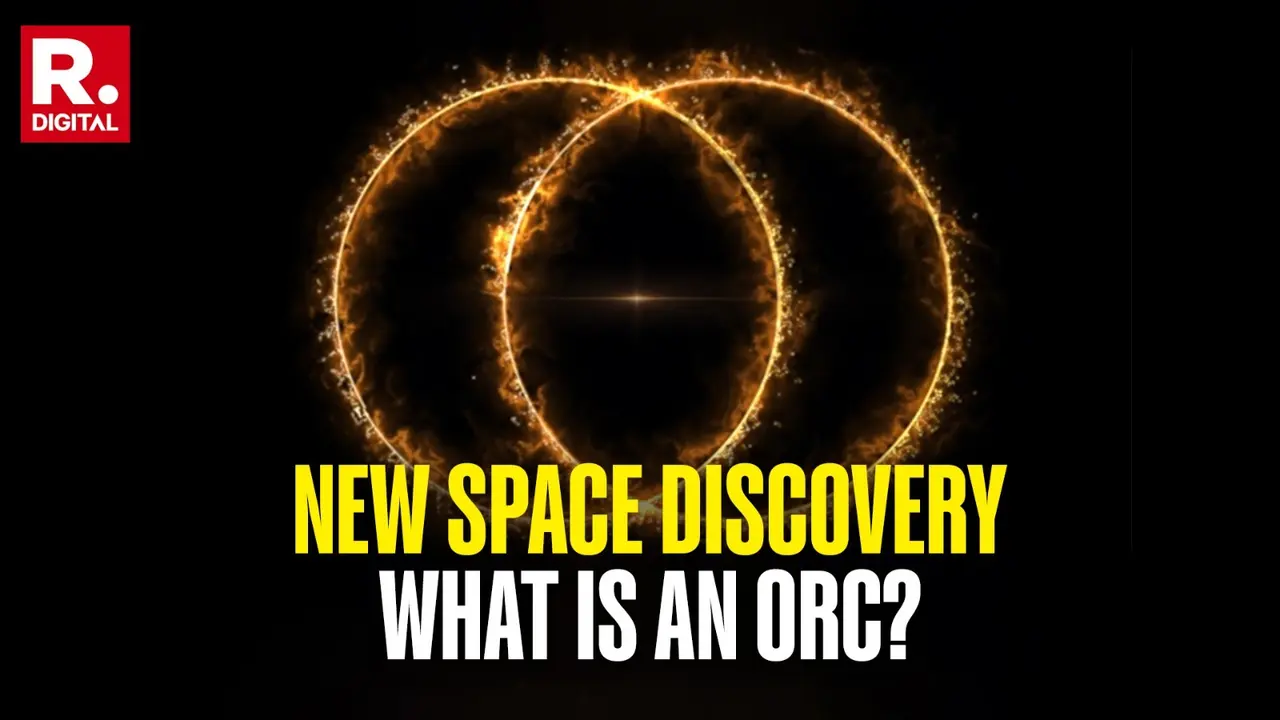
New Delhi: Astronomers have stumbled upon a cosmic riddle so strange and spectacular that it could rewrite what we know about galaxies and black holes. The most powerful and most distant “odd radio circle” (ORC) ever detected has just been discovered, thanks not to artificial intelligence, but to human eyes.
First detected only six years ago, ORCs are among astronomy’s newest mysteries: vast, ghostly rings of radio light surrounding galaxies, visible only to radio telescopes. To put their size into perspective--most stretch 10 to 20 times larger than our Milky Way. Their origin? Still up for debate. Some theories suggest violent shockwaves from colliding supermassive black holes. Others point to galactic superwinds blowing through the cosmos.
Now, a team led by the University of Mumbai has spotted a record-breaking specimen, named RAD J131346.9+500320. Found at a redshift of ~0.94- when the universe was only half as old as it is today-- it is the most distant and most powerful ORC known. Even more baffling: it has two intersecting rings of light, only the second such case ever seen.
“This work shows how professional astronomers and citizen scientists together can push the boundaries of discovery,” said Dr. Ananda Hota, founder of the RAD@home Astronomy Collaboratory, the citizen-science platform behind the find.
Advertisement
And this wasn’t just any telescope job. The discovery relied on LOFAR--the Low-Frequency Array, the world’s most sensitive radio telescope for low frequencies, a European-wide network of hundreds of thousands of antennas. LOFAR allows scientists to peer deep into the early universe, into an era before the first stars and galaxies fully formed.
But the Mumbai team didn’t stop at just one strange object. Alongside the record-breaking ORC, they found two other cosmic giants unlike anything in our textbooks:
Advertisement
- RAD J122622.6+640622, a galaxy nearly three million light-years wide (25 times the Milky Way), where one of its powerful jets bends dramatically and blows a glowing radio ring 100,000 light-years across.
- RAD J142004.0+621715, stretching 1.4 million light-years, flaunting a similar radio ring and a bizarre pair of asymmetric jets.
What ties them together? All three live in enormous galaxy clusters weighing 100 trillion Suns, cosmic cities of galaxies where extreme plasma jets from black holes smash into million-degree hot gas, sculpting these eerie rings.
“These discoveries show ORCs and radio rings are not isolated curiosities, they’re part of a bigger family of exotic plasma structures shaped by black hole jets, winds, and their environments,” said co-author Dr. Pratik Dabhade of the National Centre for Nuclear Research in Warsaw.
Perhaps most exciting is who found them. Not machines. Not algorithms. But sharp-eyed citizen scientists, scanning the skies with passion and patience.
And this may just be the beginning. With next-generation telescopes like the Square Kilometre Array (SKA) and upcoming optical surveys such as DESI and the Rubin Observatory’s LSST, astronomers expect an avalanche of ORC discoveries in the coming years.
For now, though, this strange double-ringed cosmic giant stands as a dazzling reminder: the universe still has secrets it’s not ready to give up easily.