
Updated 5 August 2025 at 15:03 IST
August 5, 2025 is Earth’s Shortest Day Yet- What’s Causing It?
On paper, Earth takes exactly 86,400 seconds and that’s 24 hours to complete one full rotation. But in reality, it’s not always that precise.
- Science News
- 2 min read

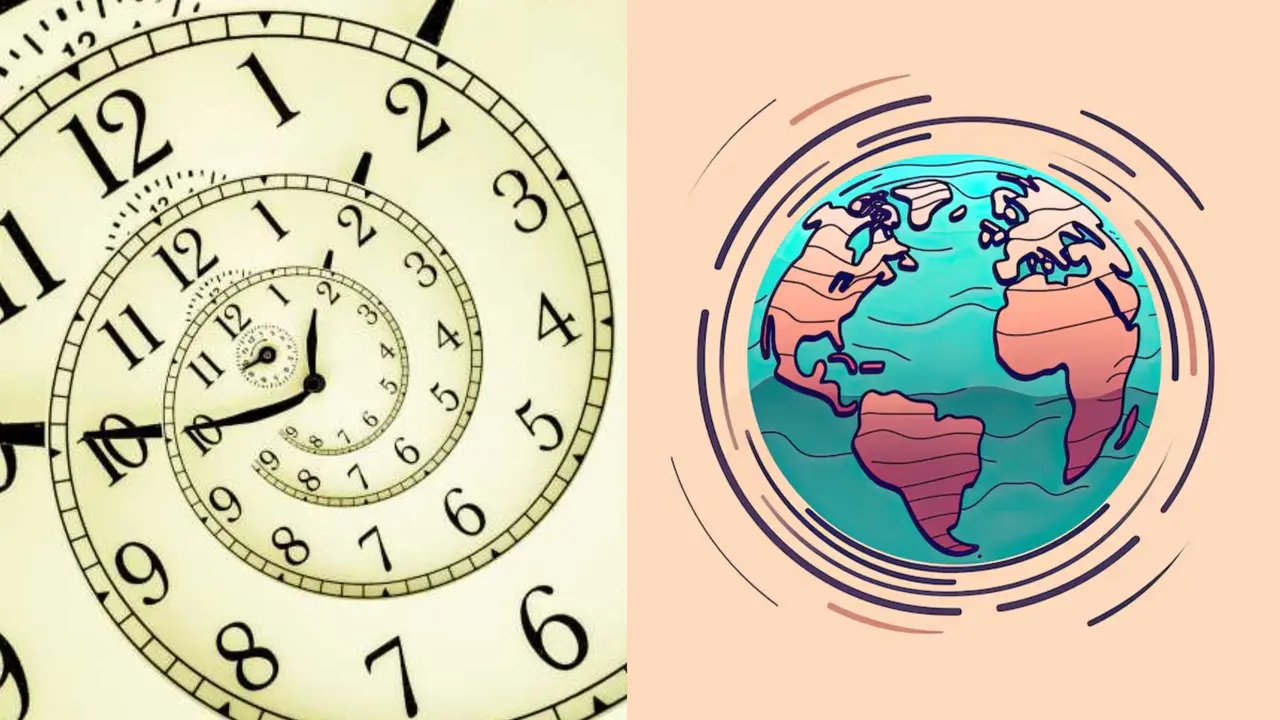
If you’re stuck somewhere, constantly checking your watch and feeling like time is crawling, here’s a twist of cosmic irony: today, August 5, is expected to be the shortest day on Earth ever recorded. That’s right - our planet is actually spinning a bit faster today, shaving off a tiny sliver of time from the usual 24 hours. Unfortunately, that won’t get you out of that awkward meeting or long commute any quicker.
Earth’s Timekeeping Is Not As Perfect As You Think
On paper, Earth takes exactly 86,400 seconds and that’s 24 hours to complete one full rotation. But in reality, it’s not always that precise. Tiny variations in the planet’s spin mean each day might be just a smidge longer or shorter than that 86,400-second benchmark.
How small are we talking? Milliseconds. One millisecond (ms) equals 0.001 seconds which is about 1/100th the time it takes to blink. To detect such minuscule changes, scientists rely on atomic clocks, which have been tracking Earth’s rotational speed since the 1950s. The difference between the actual length of a day and the standard 86,400 seconds is known as the Length of Day (LOD).
Earth Has Been Speeding Up
Scientists have discovered that before 2020, the fastest recorded day was July 19, 2020, when Earth finished its spin 1.47 milliseconds early. That record has since been broken repeatedly. The shortest day on record so far was July 5, 2024, when Earth rotated 1.66 milliseconds faster than normal.
Advertisement
Now, scientists predict that August 5, 2025, could come very close potentially reaching -1.51 ms, based on recent estimates.
Why Is Earth Spinning Faster?
That’s the big mystery. Scientists are still trying to figure it out. “Nobody expected this. The cause of this acceleration is not explained,” Dr. Leonid Zotov from Moscow State University told timeanddate.com. “Ocean and atmospheric models don’t account for it. Most likely, it’s something happening deep inside the planet.”
Advertisement
That “something” could be changes in Earth’s molten core, or shifts in mass within the crust, oceans, or atmosphere. But the science isn’t settled yet. The current events are in contradiction to the previous predictions that suggested Earth might slow down in 2024. That didn’t happen. And while Dr. Zotov now believes we’ve likely reached the peak of the acceleration, he adds: “Sooner or later, Earth will decelerate.” But until then, Earth’s spin remains unpredictable and today, it’s just a bit faster than usual.
Published By : Priya Pathak
Published On: 5 August 2025 at 15:03 IST