
China Launches Shenzhou-21 Mission With Astronauts And Mice To Tiangong Space Station
China successfully launches Shenzhou-21 spaceship with 3 astronauts and 4 mice to Tiangong space station.
- Science News
- 3 min read

;'%3e%3cpath%20d='m8,15.99c4.41,0,7.99-3.58,7.99-7.99S12.41,0,8,0,0,3.59,0,8s3.58,7.99,7.99,7.99Z'%20style='stroke:%23fff;%20stroke-miterlimit:10;%20stroke-width:.02px;'/%3e%3cpath%20d='m3.08,3.37l3.82,5.11-3.84,4.15h.87l3.37-3.64,2.72,3.64h2.94l-4.04-5.39,3.58-3.87h-.86l-3.1,3.35-2.5-3.35h-2.94Zm1.27.64h1.35l5.97,7.99h-1.35l-5.97-7.99Z'%20style='fill:%23fff;'/%3e%3c/g%3e%3c/svg%3e)


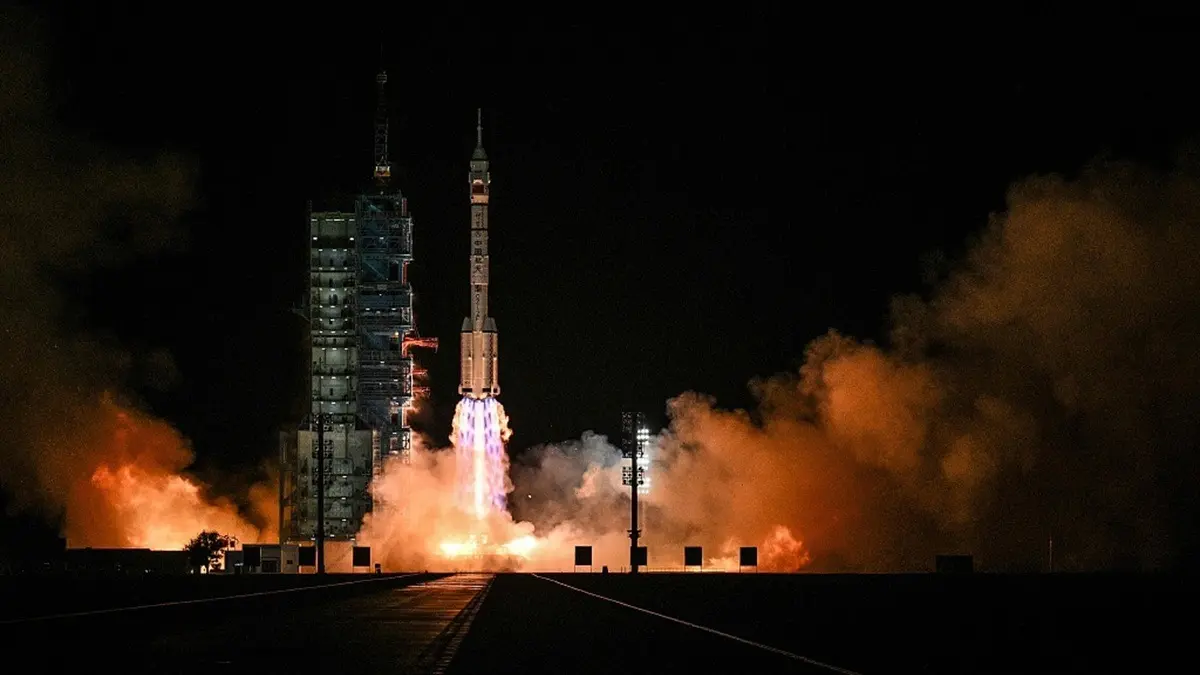
Beijing: China has successfully launched the Shenzhou-21 spaceship, carrying three astronauts and four mice to the country's orbiting space station, Tiangong. The spacecraft lifted off from the Jiuquan Satellite Launch Center in northwest China on Friday at 11.44 pm local time, registering another feat in China's ambitious space program.
The three-member crew, comprising pilot and mission commander Zhang Lu, engineer Wu Fei, and payload specialist Zhang Hongzhang, will stay on the space station for approximately six months, conducting extensive scientific and applied projects in biotechnology, aerospace medicine, materials science, and other areas. Wu Fei (32) is China's youngest astronaut to join a spaceflight, while Zhang Hongzhang, a researcher in new energy and materials, brings valuable expertise to the mission.

The crew's mission objectives include an in-orbit crew rotation with the Shenzhou-20 crew, conducting space science and application experiments, performing extravehicular activities, and managing cargo transfers. The astronauts will also welcome the Tianzhou-10 cargo spacecraft and the Shenzhou-22 crewed spaceship during their stay. Notably, the crew plans to turn the space station into a ‘utopia’ by practicing tai-chi, gardening, and appreciating poetry.
The Shenzhou-21 mission is not only about the astronauts, but four mice are also on board, making them the first small mammals to be taken to the Chinese space station. The mice will be monitored to study the effects of weightlessness and confinement on their behavioural patterns, providing valuable insights into space adaptation and emergency responses. According to Han Pei, an engineer at the Chinese Academy of Sciences, this experiment will help master key technologies for breeding and monitoring small mammals in space.
Advertisement
The Chinese officials stated that China's space program is a source of enormous national pride, showcasing the country's technological advancements over the past two decades. Since launching its first crewed mission in 2003, China has become a major player in space exploration, with plans to land an astronaut on the moon by 2030. Zhang Jingbo, spokesperson for the China Manned Space Agency, emphasised the country's resolve to the goal, stating, "Our fixed goal of China landing a person on the moon by 2030 is firm."
The Tiangong space station, entirely Chinese-built after the country was excluded from the International Space Station (ISS), has been instrumental in establishing China as a major force in space exploration.
Advertisement
Notably, China's space program is controlled by the People's Liberation Army (PLA), the military branch of the ruling Communist Party.
China is also reportedly collaborating with Pakistan to select two Pakistani astronauts for training, with plans to send one of them on a short-term mission to the space station as a payload expert.