
Cosmic Owl: A Rarest Of Rare, Space Morphology Captured By NASA Telescope | Stunning Pics
NASA’s James Webb Telescope captures the "Cosmic Owl," a rare galactic formation resembling an owl’s face. See stunning images.
- Science News
- 3 min read

;'%3e%3cpath%20d='m8,15.99c4.41,0,7.99-3.58,7.99-7.99S12.41,0,8,0,0,3.59,0,8s3.58,7.99,7.99,7.99Z'%20style='stroke:%23fff;%20stroke-miterlimit:10;%20stroke-width:.02px;'/%3e%3cpath%20d='m3.08,3.37l3.82,5.11-3.84,4.15h.87l3.37-3.64,2.72,3.64h2.94l-4.04-5.39,3.58-3.87h-.86l-3.1,3.35-2.5-3.35h-2.94Zm1.27.64h1.35l5.97,7.99h-1.35l-5.97-7.99Z'%20style='fill:%23fff;'/%3e%3c/g%3e%3c/svg%3e)


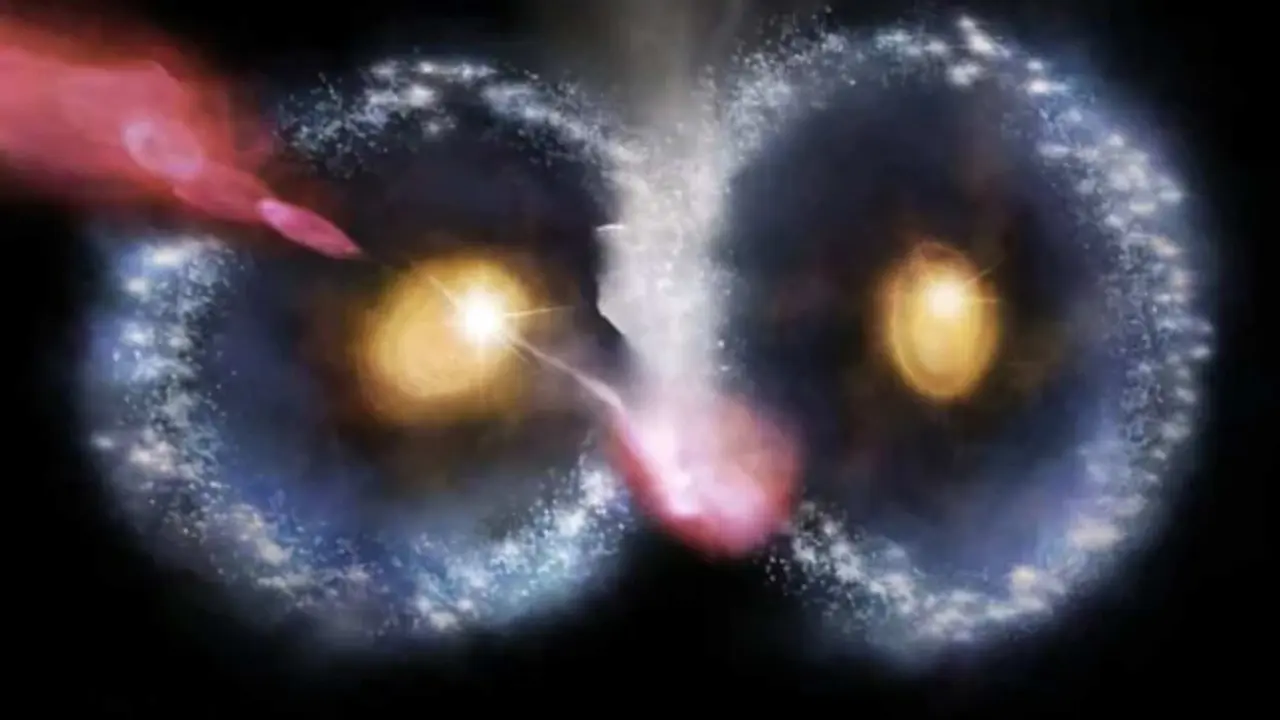
In a breathtaking image captured by the James Webb Space Telescope (JWST), scientists have identified the rarest of rare cosmic structures: the “Cosmic Owl.”
This majestic pattern consists of two overlapping bright rings like giant owl eyes crowned by a dramatic “beak” formed by colliding galaxies. Located in the COSMOS field, this celestial marvel sits a staggering 11 billion light-years away.
But what exactly is the Cosmic Owl? Curious to see this breathtaking celestial marvel? Keep scrolling to explore more.
What is the Cosmic Owl?

The Cosmic Owl is an extraordinary cosmic structure that bears an uncanny resemblance to an owl’s face. This unique formation comes from the collision of two rare ring galaxies, each about 26,000 light-years wide roughly a quarter the size of our Milky Way galaxy.
Advertisement
At the heart of each ring lies a supermassive black hole, also known as an Active Galactic Nucleus (AGN), which forms the “eyes” of the owl.
One of these black holes is spewing out a powerful radio jet that collides with the surrounding gas, creating a "beak" region filled with intense cosmic activity.
Advertisement
When Was the Cosmic Owl Discovered?
The discovery of the Cosmic Owl was made in June 2025, thanks to the advanced imaging capabilities of the James Webb Space Telescope (JWST). In collaboration with the Atacama Large Millimeter/submillimeter Array (ALMA) and the Very Large Array (VLA), JWST’s high-resolution images allowed researchers to uncover this fascinating galactic collision in the COSMOS field, an area of the sky already known for its wealth of deep-space phenomena.
Lead researcher Mingyu Li, a doctoral student at Tsinghua University, noted that the structure “immediately stood out” due to the impressive resolution of JWST’s instruments.
Cosmic Owl: Formed 38 Million Years Ago, Seen Today
The collision that created the Cosmic Owl actually took place around 38 million years ago, but due to the vast distances between us and the galaxies involved, the light from this event only reaches us now.
Galaxies undergo such collisions over millions to hundreds of millions of years, meaning the cosmic encounter still appears in the present. Despite the collision occurring millions of years ago, the resulting cosmic structure remains a visually striking example of galaxy evolution.
Where Can We See the Majestic Cosmic Owl?
While you can't view the Cosmic Owl in the night sky, you can enjoy its stunning images captured by JWST on several platforms.
Official NASA and ESA websites host detailed views of this cosmic spectacle.
Why is the Cosmic Owl Significant for Astronomical Research?
The Cosmic Owl is not just a beautiful image, it's also a natural laboratory for studying various processes in galaxy formation.
The collision of these two galaxies has created a "beak" region, where intense star formation is occurring due to the compression of molecular gas from both shockwaves and the powerful radio jet launched by one of the black holes.
This discovery is a valuable opportunity to study how galaxy collisions, supermassive black holes (AGN activity), and gas compression contribute to rapid star formation in the early universe.
It also offers new clues about the role that supermassive black holes play in the growth of galaxies and the evolution of the universe.