
Updated 12 January 2026 at 05:46 IST
Countdown Begins: ISRO's PSLV-C62 Mission Set To Launch Today
India to kick off 2026 with the PSLV-C62 launch, carrying EOS-N1 and 15 co-passenger satellites into polar sun-synchronous orbit, showcasing ISRO's space tech advancements.
- Science News
- 3 min read

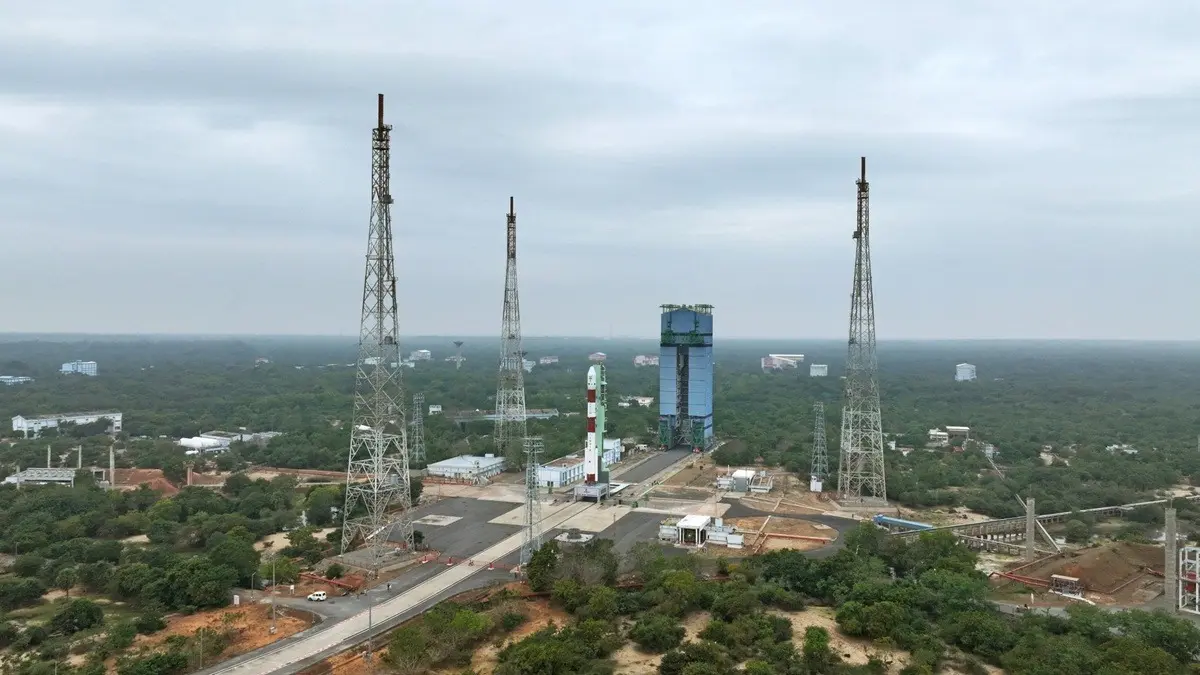
India's space journey for 2026 is set to begin with a bang as the Indian Space Research Organisation (ISRO) prepares to launch the Polar Satellite Launch Vehicle (PSLV) C62 from Sriharikota. ISRO's highly-anticipated mission is one of India's most trusted launch systems, reinforcing the country's steady pace in space operations. The PSLV-C62 is scheduled to lift off at 10.18 am from the first launch pad at the Satish Dhawan Space Centre, carrying the Earth observation satellite ‘Anvesha’, also known as EOS-N1, along with 15 co-passenger satellites.
According to experts, the PSLV-C62 mission is another example of India's growing capabilities in space technology, with the launch vehicle having a proven track record of successfully deploying satellites across various orbits and mission profiles. "This launch vehicle is one of the most reliable ones in the world," said BR Guruprasad, Director of Jawaharlal Nehru Planetarium, describing the importance of the PSLV's legacy. He asserted that the PSLV has been instrumental in India's space programme, having launched iconic missions such as Chandrayaan-1, Mangalyaan, and Aditya-L1.
India's space agency ISRO, with the PSLV-C62 launch, is set for another time to showcase its advancements in space technology by carrying the EOS-N1 satellite into a polar sun-synchronous orbit, enabling consistent lighting conditions for imaging and data collection.
PSLV-C62 Mission Profile
The PSLV-C62 will carry the EOS-N1 satellite, developed by the Defence Research and Development Organisation (DRDO), into a polar sun-synchronous orbit, around a few hundred km above the Earth's surface. The satellite is designed for strategic purposes, including border surveillance, terrain analysis, and environmental monitoring. "It will be the 64th launch of the Polar Satellite Launch Vehicle. This vehicle is going to take a satellite called Anvesha, EOS-N1, an Earth observation satellite, into a polar sun-synchronous orbit," explained BR Guruprasad.
Advertisement
As per further information, the PSLV-C62 will also carry 15 co-passenger satellites, including eight projects by Indian firms and five technical, mapping, and communication payloads from Brazil, an Earth observation satellite built jointly by the UK and Thailand, a technology demonstration satellite from Nepal, and a Kestrel Initial Technology Demonstrator (KID) from Spain and France.
Further, the KID capsule, developed by a Spanish startup, is a prototype of a re-entry vehicle and will be the last co-passenger satellite to be injected during the mission. After its in-orbit phase, it is slated to re-enter Earth's atmosphere and splash down in the South Pacific Ocean, contributing data critical for the development of future re-entry systems.
Advertisement
The space experts asserted that the total flight time for the mission is around 108 minutes, with the EOS-N1 satellite separating from the rocket after 18 minutes, travelling at a velocity of 7608.7 metres per second. The launch is expected to be registered as another milestone for India's space programme in space exploration.
Published By : Abhishek Tiwari
Published On: 12 January 2026 at 05:46 IST