
Everything's A Matter of Perspective: Is Earth Orbiting Below or Above Us? NASA's New Post Invokes Reactions
NASA has shared a unique view of earth as seen from space with a thoughtful observation saying everything's a matter of perspective.
- Science News
- 2 min read

;'%3e%3cpath%20d='m8,15.99c4.41,0,7.99-3.58,7.99-7.99S12.41,0,8,0,0,3.59,0,8s3.58,7.99,7.99,7.99Z'%20style='stroke:%23fff;%20stroke-miterlimit:10;%20stroke-width:.02px;'/%3e%3cpath%20d='m3.08,3.37l3.82,5.11-3.84,4.15h.87l3.37-3.64,2.72,3.64h2.94l-4.04-5.39,3.58-3.87h-.86l-3.1,3.35-2.5-3.35h-2.94Zm1.27.64h1.35l5.97,7.99h-1.35l-5.97-7.99Z'%20style='fill:%23fff;'/%3e%3c/g%3e%3c/svg%3e)


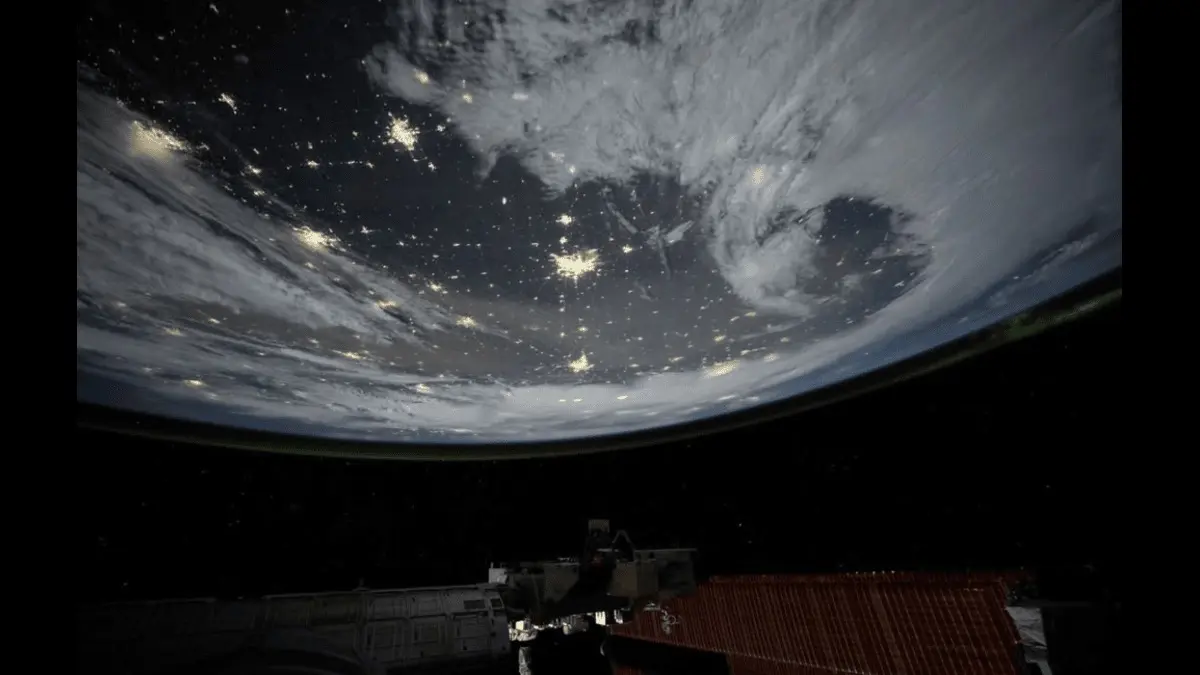
NASA has shared an image of earth from Space with a thoughtful observation saying everything's a matter of perspective as the view from the International Space Station unveiled a never before sight of the our planet.
Sharing the capture on Instagram, NASA said that in a low Earth orbit, everything's a matter of perspective. Depending on how you're floating, the Earth may appear to be orbiting below—or it could be above you.
NASA said the astronaut took this photo from the cupola aboard the International Space Station on March 15, 2025, as city lights and drifting clouds passed overhead. The space agency shared the post a day ago.
When Astronaut Don Pettit took this photo, the station was orbiting about 261 miles (420 km) over the state of Kansas. The photo showed city lights dot the cloudy Midwestern landscape as a wispy aurora dances above Earth's horizon.
Advertisement
In the bottom foreground is the Kibo laboratory module's Exposed Facility, an external research platform, and the orbital outpost's main solar arrays.
In another post, NASA shared useful information for stargazers and cosmic enthusiasts about upcoming celestial events in the current month April including passing planets, the Lyrid meteor shower, and a vast collection of stars called a globular cluster.
Advertisement
- Space explorers would be able to grab a view of Jupiter and the Moon shining together in the western sky throughout the month.
- In the evenings, one can see Mars overhead towards the southern sky.
- Space enthusiasts will also be able to witness Venus during the early morning hours.
- On April 21 and morning 22, one could view shooting stars as they pass through the Lyrid meteor shower.
- Throughout April, stargazers can view globular cluster M3 using binoculars or a small telescope.