
Finland’s Onkalo Repository: The World’s First Nuclear Waste Tomb Nears Operation- Why It's A Game Changer?
The primary goal of the Onkalo project is to create a "passive" safety system that requires no human intervention or monitoring once the vault is eventually closed.
- Science News
- 3 min read

;'%3e%3cpath%20d='m8,15.99c4.41,0,7.99-3.58,7.99-7.99S12.41,0,8,0,0,3.59,0,8s3.58,7.99,7.99,7.99Z'%20style='stroke:%23fff;%20stroke-miterlimit:10;%20stroke-width:.02px;'/%3e%3cpath%20d='m3.08,3.37l3.82,5.11-3.84,4.15h.87l3.37-3.64,2.72,3.64h2.94l-4.04-5.39,3.58-3.87h-.86l-3.1,3.35-2.5-3.35h-2.94Zm1.27.64h1.35l5.97,7.99h-1.35l-5.97-7.99Z'%20style='fill:%23fff;'/%3e%3c/g%3e%3c/svg%3e)


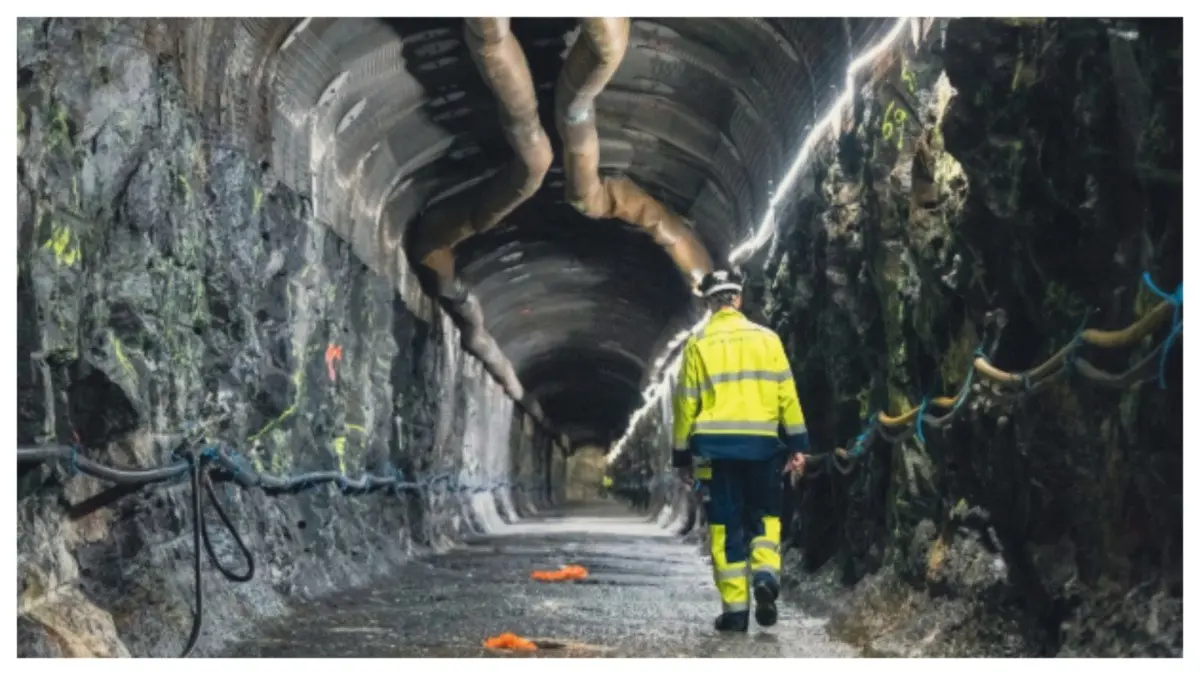
New Delhi: Finland is poised to make history as it prepares to open the Onkalo spent nuclear fuel repository, the world’s first permanent geological disposal site for high-level radioactive waste.
Located on the island of Olkiluoto, this engineering feat is designed to isolate nuclear fuel from humanity and the environment for at least 100,000 years.
A Final Resting Place for Radioactive Waste
The facility, named “Onkalo”- which is Finnish for "small cave" or “cavity”- has been under construction since 2004. Built into 1.9-billion-year-old stable granite bedrock, the repository reaches depths of over 400 meters, far beneath the Baltic Sea coastline.
The disposal process relies on the "KBS-3" method:
Advertisement
Encapsulation: Spent nuclear fuel rods are placed into corrosion-resistant copper canisters.
Sealing: These canisters are then buried in individual holes drilled into the bedrock and packed with water-absorbing bentonite clay, which acts as a protective buffer.
Advertisement
Isolation: Once a disposal tunnel is filled, it is sealed with steel-reinforced concrete plugs.
Ensuring Safety Across Millennia
The primary goal of the Onkalo project is to create a "passive" safety system that requires no human intervention or monitoring once the vault is eventually closed.
By depositing the waste deep within the Earth's crust, authorities aim to prevent any release of radioactive material into groundwater or the atmosphere for thousands of millennia- the time required for the waste to decay to levels comparable to natural uranium ore.
"Basically, it needs to be safe forever," noted Lauri Parviainen, a chemist with Posiva, the company managing the site.
Current Status and Outlook
As of June 2026, the facility is in the final stages of regulatory approval. Posiva has completed successful testing and trials, and officials are currently awaiting final assessments from the Finnish Radiation and Nuclear Safety Authority (STUK).
The repository is expected to begin receiving its first shipments of spent fuel by the end of 2026 or early 2027.
While other nations like France and Sweden are pursuing similar underground storage projects, Finland is set to be the first to reach operational status. The project has largely garnered public and local support in Eurajoki, a municipality home to roughly 9,000 people and several of Finland’s existing nuclear reactors.
Why It Matters?
For decades, the global nuclear industry has relied on interim, surface-level storage for spent fuel, which requires ongoing maintenance and carries risks of sabotage or environmental exposure.
Onkalo represents a major shift toward long-term responsibility. While critics remain concerned about the uncertainties of geologic safety over such vast timescales, experts and governments worldwide are looking to the Finnish model as the "least bad" and most secure solution for the permanent disposal of the world’s most hazardous waste.
The site is currently planned to operate for approximately 100 years, though its capacity could be expanded if Finland opts to build additional nuclear reactors.
Once the facility reaches its capacity, it will be permanently sealed, leaving the radioactive legacy of the nuclear age safely tucked away in the deep, ancient rock of the Finnish crust.