
First Of 2026: ISRO's PSLV-C62 Mission With 15 Satellites, DRDO's Anvesha Lifts Off From Sriharikota | WATCH
The PSLV has completed 63 missions so far, carrying landmark payloads such as Chandrayaan-1, the Mars Orbiter Mission and Aditya-L1. This mission marks the 64th flight of PSLV, India’s most reliable and successful launch vehicle.
- Science News
- 5 min read

;'%3e%3cpath%20d='m8,15.99c4.41,0,7.99-3.58,7.99-7.99S12.41,0,8,0,0,3.59,0,8s3.58,7.99,7.99,7.99Z'%20style='stroke:%23fff;%20stroke-miterlimit:10;%20stroke-width:.02px;'/%3e%3cpath%20d='m3.08,3.37l3.82,5.11-3.84,4.15h.87l3.37-3.64,2.72,3.64h2.94l-4.04-5.39,3.58-3.87h-.86l-3.1,3.35-2.5-3.35h-2.94Zm1.27.64h1.35l5.97,7.99h-1.35l-5.97-7.99Z'%20style='fill:%23fff;'/%3e%3c/g%3e%3c/svg%3e)


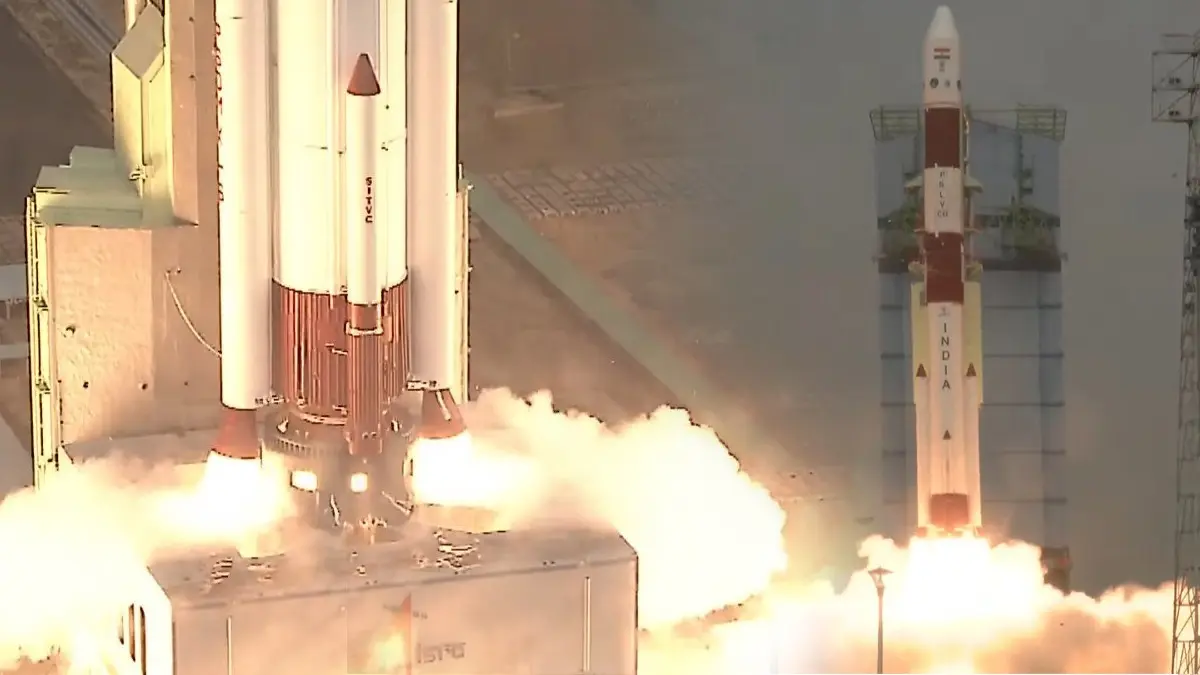
New Delhi: Marking its first launch of the year, the Indian Space Research Organisation, in a historic feat, launched Polar Satellite Launch Vehicle (PSLV) C62 from Satish Dhawan Space Centre in Sriharikota on Monday, January 12.
ISRO's highly-anticipated mission, carrying the 'Anvesha'/EOS-N1 satellite and 15 other satellites into the sun-synchronous polar orbit (SSO), is one of India's most trusted launch systems, reinforcing the country's steady pace in space operations.
The mission is being carried out by NewSpace India Limited and represents the ninth dedicated commercial mission to build and launch an Earth Observation satellite.
For the first time, a single Indian private company, Dhruva Space, based in Hyderabad, is contributing seven satellites to the mission.
Advertisement
Chaitanya Dora Surapureddy, CFO and Co-founder of Dhruva Space, said "We launched four satellites that we have built, three for customers and one for us, and we also help other companies with part of the integration of the satellite onto the rocket. Essentially, a total of nine of our systems, which we have built, are going onto the rocket. So, quite exciting that that's a good number."
"The satellites that we launched are all for low data rate communication. Amateur radio operators can utilise it towards that, and also a good demonstration for these satellites, and also for low data rate communication that can be done," he added.
Advertisement
The PSLV meanwhile has completed 63 missions so far, carrying landmark payloads such as Chandrayaan-1, the Mars Orbiter Mission and Aditya-L1. This mission marks the 64th flight of PSLV, India’s most reliable and successful launch vehicle.
When Did it lift-off?
The PSLV-C62 lifted off at 10.18 am from the first launch pad at the Satish Dhawan Space Centre, carrying the Earth observation satellite ‘Anvesha’, also known as EOS-N1, along with 15 co-passenger satellites.
PSLV-C62 mission
Jawaharlal Nehru Planetarium Director, B. R. Guruprasad stated "It will be the 64th launch of the Polar Satellite Launch Vehicle. This vehicle is going to take a satellite called Anvesha, EOS-N1, an Earth observation satellite, into a polar sun-synchronous orbit, probably a couple of hundred kilometres above the Earth's surface."
The Indian Space Research Organisation (ISRO) in a post on X had stated earlier, "The Launch of PSLV-C62 Mission is scheduled on 12 January 2026 at 10:17 hrs IST from First Launch Pad (FLP), SDSC SHAR, Sriharikota."
According to experts, the PSLV-C62 mission is another example of India's growing capabilities in space technology, with the launch vehicle having a proven track record of successfully deploying satellites across various orbits and mission profiles.
"This launch vehicle is one of the most reliable ones in the world," said BR Guruprasad, describing the importance of the PSLV's legacy. He asserted that the PSLV has been instrumental in India's space programme, having launched iconic missions such as Chandrayaan-1, Mangalyaan, and Aditya-L1.
PSLV-C62 Mission Profile
The PSLV-C62 carries the EOS-N1 satellite, developed by the Defence Research and Development Organisation (DRDO), into a polar sun-synchronous orbit, around a few hundred km above the Earth's surface. The satellite is designed for strategic purposes, including border surveillance, terrain analysis, and environmental monitoring.
As per further information, the PSLV-C62 also carries 15 co-passenger satellites, including eight projects by Indian firms and five technical, mapping, and communication payloads from Brazil, an Earth observation satellite built jointly by the UK and Thailand, a technology demonstration satellite from Nepal, and a Kestrel Initial Technology Demonstrator (KID) from Spain and France.
Further, the KID capsule, developed by a Spanish startup, is a prototype of a re-entry vehicle and will be the last co-passenger satellite to be injected during the mission. After its in-orbit phase, it is slated to re-enter Earth's atmosphere and splash down in the South Pacific Ocean, contributing data critical for the development of future re-entry systems.
The space experts asserted that the total flight time for the mission is around 108 minutes, with the EOS-N1 satellite separating from the rocket after 18 minutes, travelling at a velocity of 7608.7 metres per second.
BlueBird Block-2 communication satellite
Earlier, on December 24, ISRO successfully launched the BlueBird Block-2 communication satellite for the United States' AST SpaceMobile. The satellite was successfully placed in orbit, and the mission was declared a success.
The launch took place from the Satish Dhawan Space Station in Sriharikota, Andhra Pradesh, at 8:55 AM IST.
The 43.5 metre tall rocket supported by two S200 solid boosters lifted off majestically at 8:55 am from the second launch pad at this spaceport, situated about 135 km east of Chennai.
ISRO’s BlueBird Block-2 Mission can turn out to be gamechanger in terms of mobile connectivity as the satellite is intended to deliver 4G and 5G connectivity directly to smartphones in regions lacking terrestrial networks.
In its earlier missions, LVM3 successfully launched Chandrayaan-2, Chandrayaan-3, and two OneWeb missions carrying 72 satellites. The previous launch of LVM3 was the LVM3-M5/CMS-03 mission, which was successfully accomplished on November 2 this year.