
From Moonshot to Sunshot: How PM Modi’s 75th Birthday Finds India Reaching for the Skies
The images of ISRO scientists celebrating, and Modi beaming in front of television cameras, became symbols of a nation that refused to be left behind.
- Science News
- 3 min read

;'%3e%3cpath%20d='m8,15.99c4.41,0,7.99-3.58,7.99-7.99S12.41,0,8,0,0,3.59,0,8s3.58,7.99,7.99,7.99Z'%20style='stroke:%23fff;%20stroke-miterlimit:10;%20stroke-width:.02px;'/%3e%3cpath%20d='m3.08,3.37l3.82,5.11-3.84,4.15h.87l3.37-3.64,2.72,3.64h2.94l-4.04-5.39,3.58-3.87h-.86l-3.1,3.35-2.5-3.35h-2.94Zm1.27.64h1.35l5.97,7.99h-1.35l-5.97-7.99Z'%20style='fill:%23fff;'/%3e%3c/g%3e%3c/svg%3e)


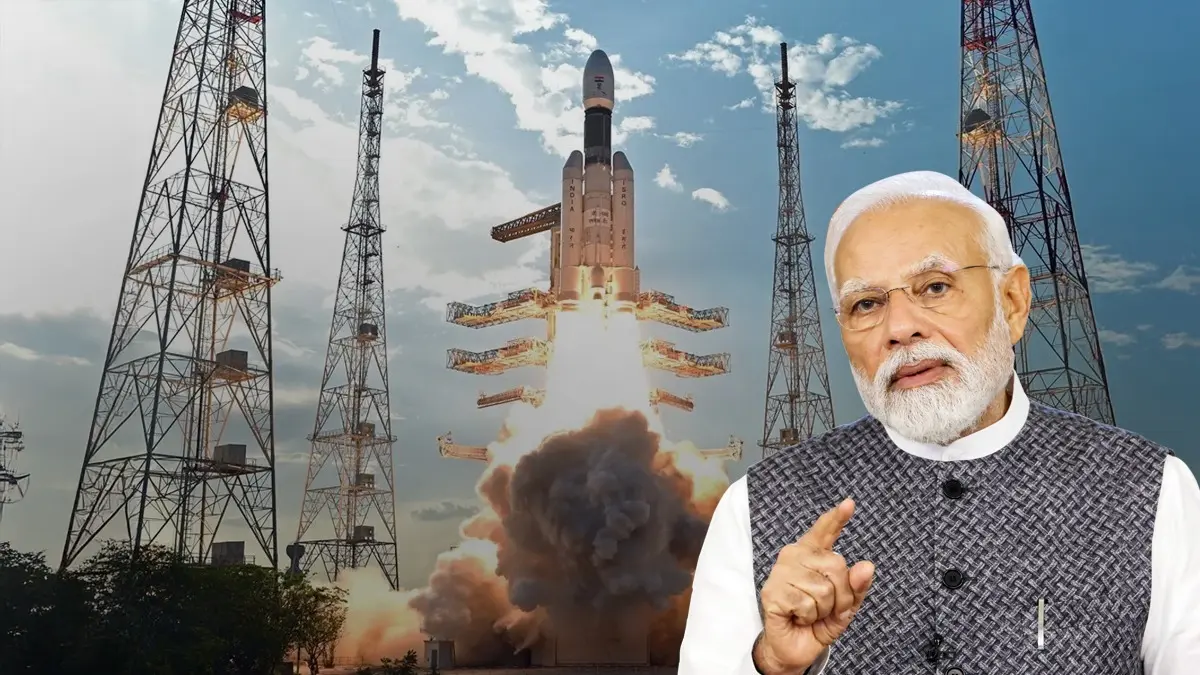
On the morning of September 17, as Narendra Modi turns 75, the story of his tenure is not just being written in Parliament or at election rallies. From the dusty skies of the Sriharikota plains to the Sun-watching spacecraft 1.5 million kilometres away, it is inscribed in the sky. His leadership is exemplified by India's space journey, which began modestly and with caution.
A Late Start, A Faster Pace
India was a latecomer to the space race. By the time ISRO sent its first rocket into orbit in 1969, the United States had already planted its flag on the Moon. However, India has made tremendous strides in the past decade to catch up. With ISRO's stellar performance, Modi took office as prime minister in 2014. Among the greatest was the Mangalyaan expedition, which achieved Mars at a far lower expense than Western efforts. What changed under Modi was not just ambition but also visibility.
Where earlier launches came and went quietly, the Prime Minister put them at the centre of national conversation. His decision to open the sector to private firms and start-ups marked a turning point, breaking ISRO’s monopoly and inviting entrepreneurial energy into a once-closed arena.
Chandrayaan’s Redemption
India's strength was most evident during the period between 2019 and 2023. Tragically, the lander of Chandrayaan-2 collapsed during descent, ending the mission. Four years later, Chandrayaan-3 accomplished what its predecessor had failed to do. It made a soft landing close to the Moon's south pole, an area uncharted by any nation. India made history by becoming the first asian country to delve into that challenging sector and the fourth country overall to do it.
Advertisement
The images of ISRO scientists celebrating, and Modi beaming in front of television cameras, became symbols of a nation that refused to be left behind.
From the Moon to the Sun
India’s ambitions did not stop at lunar soil. In 2023, ISRO launched Aditya-L1, the country’s first mission dedicated to studying the Sun. Parked in a special orbit at the Lagrange Point 1, the spacecraft now observes solar storms and space weather without interruption. It was a clear signal that India is no longer satisfied with catching up; it now wants to lead in frontier science.
Advertisement
The Road Ahead
Next on the horizon is Gaganyaan, India’s first human spaceflight programme. If successful in 2027, it will make India the only fourth country to send a human into space after the Soviet Union, the US and China.
Further down the line lies an even bolder plan of building an Indian space station by the 2030s. Add to this international collaborations like NISAR with NASA, and India’s role in global space exploration is no longer peripheral.
A Legacy Written in the Stars
At 75, Modi’s governance will be remembered for many things - politics, policies, polarisation - but one of its lasting imprints is likely to be space. His tenure coincided with a moment when India stopped seeing the skies as distant and began treating them as its own frontier.