
‘India’s Bahubali Scales the Skies’: ISRO Successfully Launches India's Heaviest Communication Satellite CMS-03
The satellite would strengthen the Navy's space-based communications and maritime domain awareness capabilities. GSAT-7R will provide robust telecommunication coverage across the Indian Ocean Region.
- Science News
- 6 min read

;'%3e%3cpath%20d='m8,15.99c4.41,0,7.99-3.58,7.99-7.99S12.41,0,8,0,0,3.59,0,8s3.58,7.99,7.99,7.99Z'%20style='stroke:%23fff;%20stroke-miterlimit:10;%20stroke-width:.02px;'/%3e%3cpath%20d='m3.08,3.37l3.82,5.11-3.84,4.15h.87l3.37-3.64,2.72,3.64h2.94l-4.04-5.39,3.58-3.87h-.86l-3.1,3.35-2.5-3.35h-2.94Zm1.27.64h1.35l5.97,7.99h-1.35l-5.97-7.99Z'%20style='fill:%23fff;'/%3e%3c/g%3e%3c/svg%3e)


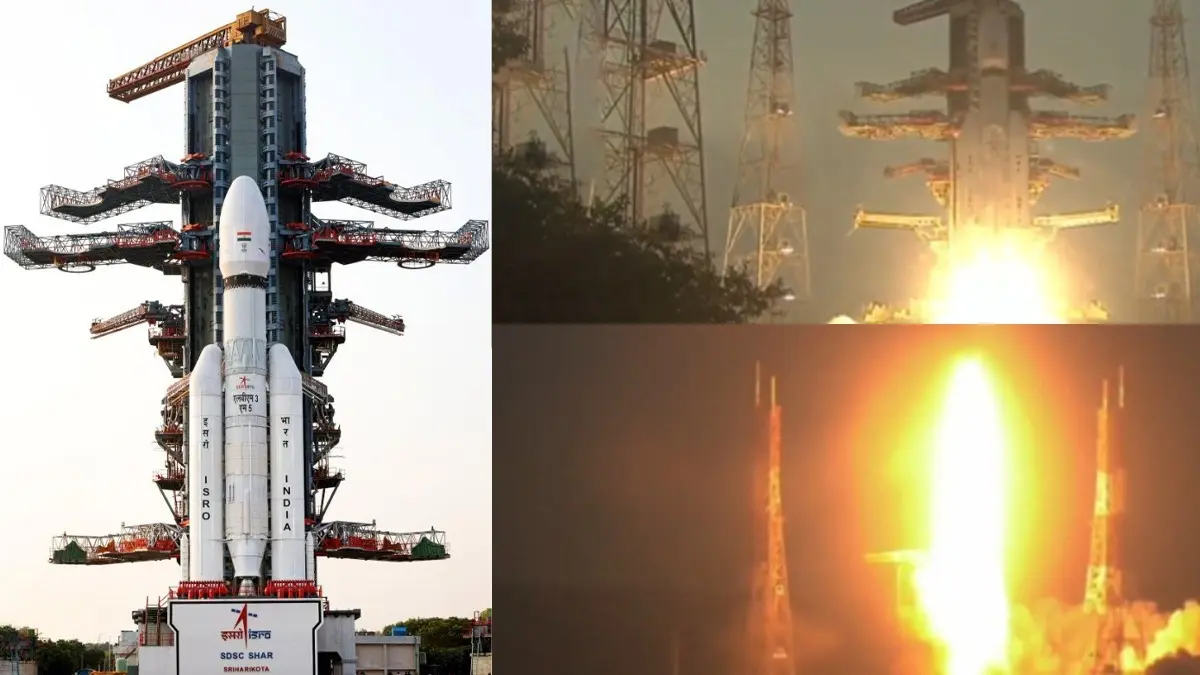
Sriharikota: Indian Space Research Organisation (ISRO) has launched the Indian Navy's GSAT-7R (CMS-03) communication satellite on Sunday at 5.26 pm.
The indigenously designed and developed satellite has been launched from the Satish Dhawan Space Centre in Sriharikota.
In a post on X, ISRO wrote, “Liftoff! #LVM3M5 launches #CMS03 from SDSC SHAR, carrying India’s heaviest communication satellite to GTO" and also shared the youtube link for the live streaming of the event.
Posting an update, ISRO wrote in an X post, "CMS-03 separated successfully. Perfect injection."
Advertisement
‘Shiny Example of Aatmanirbhar Bharat’: ISRO Chief V Narayanan
On the launch of ISRO’s LVM3-M5 carrying the CMS-03 communication satellite, ISRO Chief V Narayanan said, “The CMS-03 satellite is a multi-band communication satellite with coverage over a wide oceanic region, including the Indian landmass, and is designed for providing communication services for at least 15 years. The satellite incorporates a host of new technologies and yet another shiny example of Atmanirbhar Bharat. Let me congratulate the entire satellite team spread across various ISRO centres for realising this important, complex satellite for the communication capability of our country.”
Speaking of the challenges faced by the team during the launch, he said, “We had a tough and challenging time during the launch campaign. The weather was not that cooperative. But then let me take this opportunity to compliment each and every one of you, even under this difficult weather condition, we could come out successfully and accomplish this mission in a grand and successful manner…”
Advertisement
He also made an announcement of an important experiment that was carried out by the ISRO team for the launch.
"I would also like to announce an important experiment that we have carried out. The indigenously developed C-25 cryogenic stage. For the first time, we have, after successfully injecting the satellite into orbit and reorienting the stage, successfully ignited the thrust chamber... This is going to be a great experiment, which is going to feed data for restarting the cryogenic stage in future for enabling the mission flexibility for placing multiple satellites in various orbits using the Bahubali rocket LVM-3," he said.
Giving an update on the launch, Narayanan said, "The capability of this GSLV launcher is around 4000 kg to GTO and for the first time we have lifted 4410 kg to an elliptical orbit... It has performed extremely well, and this is the eighth launch of the LBM-3 vehicle. All the launches of the LBM-3 vehicle have been successfully accomplished by ISRO, and it is a 100% reliable vehicle. The same vehicle is also earmarked for taking our Gaganyatri-2 space also... Right now, the satellite is healthy. All the propulsion system valves and isolation valves are opened, and the satellite is healthy..."
PM Modi Congratulates ISRO
Prime Minister Narendra Modi has congratulated ISRO for scripting history and making the country proud.
In a post on X, the prime minister wrote, "Our space sector continues to make us proud! Congratulations ISRO on the successful launch of India’s heaviest communication satellite, CMS-03."
"Powered by our space scientists, it is commendable how our space sector has become synonymous with excellence and innovation. Their successes have furthered national progress and empowered countless lives," his X post added.
‘India’s Bahubali Scales the Skies’
Union Minister of State for Science & Technology Jitendra Singh congratulated ISRO for the success.
In a post on X, Singh said, "Kudos Team #ISRO! India’s #Bahubali scales the skies, with the successful launch of #LVM3M5 Mission!"
'“Bahubali” as it is being popularly referred, LVM3-M5 rocket is carrying the CMS-03 communication satellite, the heaviest ever to be launched from the Indian soil into a Geosynchronous Transfer Orbit (GTO),' he said in his post.
He also thanked Prime Minister Narendra Modi for his support for space programmes.
"ISRO continues to script one success after another… Thanks PM Sh@narendramodi for the unflinching government support," he wrote in the post.
About the CMS-03 Satellite
The satellite would strengthen the Navy's space-based communications and maritime domain awareness capabilities.
GSAT-7R will provide robust telecommunication coverage across the Indian Ocean Region. Its payload includes transponders capable of supporting voice, data, and video links over multiple communication bands. This satellite will significantly enhance connectivity with high-capacity bandwidth, enabling seamless and secure communication links between ships, aircraft, submarines, and Maritime Operations Centres of the Indian Navy.
"This satellite is India's heaviest communication satellite to date, weighing approximately more than 4,400 kg, and includes many indigenous state-of-the-art components developed specifically to meet the Indian Navy's operational requirements," the Indian Navy said.
"In an era of complex security challenges, GSAT-7R represents the Indian Navy's determination to protect the nation's maritime interests, leveraging advanced technology through Aatmanirbharta," the Ministry of Defence said in an official statement.
CMS-03 is a multi-band communication satellite that will provide services over a wide oceanic region including the Indian landmass, according to ISRO.
The satellite has been launched by the famous LVM3 launch vehicle, which landed India successfully on the lunar South Pole in the Chandrayaan-3 mission. This is the vehicle's fifth operational flight.
The launch vehicle had been assembled earlier and has been on the launch pad since October 26 for pre-launch operations.
The launch vehicle has a height of 43.5 meters, having a lift off mass of 642 tonnes total. The vehicle uses three stages of propellants to enable the satellite to reach the Geosynchronous Transfer Orbit (GTO).
(With inputs from ANI)