
Italian Scientists Freeze Light, Convert It Into Solid in Major Research Breakthrough
A team of Italian scientists have successfully managed to ‘freeze’ light while asserting that it can behave like a supersolid.
- Science News
- 2 min read

;'%3e%3cpath%20d='m8,15.99c4.41,0,7.99-3.58,7.99-7.99S12.41,0,8,0,0,3.59,0,8s3.58,7.99,7.99,7.99Z'%20style='stroke:%23fff;%20stroke-miterlimit:10;%20stroke-width:.02px;'/%3e%3cpath%20d='m3.08,3.37l3.82,5.11-3.84,4.15h.87l3.37-3.64,2.72,3.64h2.94l-4.04-5.39,3.58-3.87h-.86l-3.1,3.35-2.5-3.35h-2.94Zm1.27.64h1.35l5.97,7.99h-1.35l-5.97-7.99Z'%20style='fill:%23fff;'/%3e%3c/g%3e%3c/svg%3e)


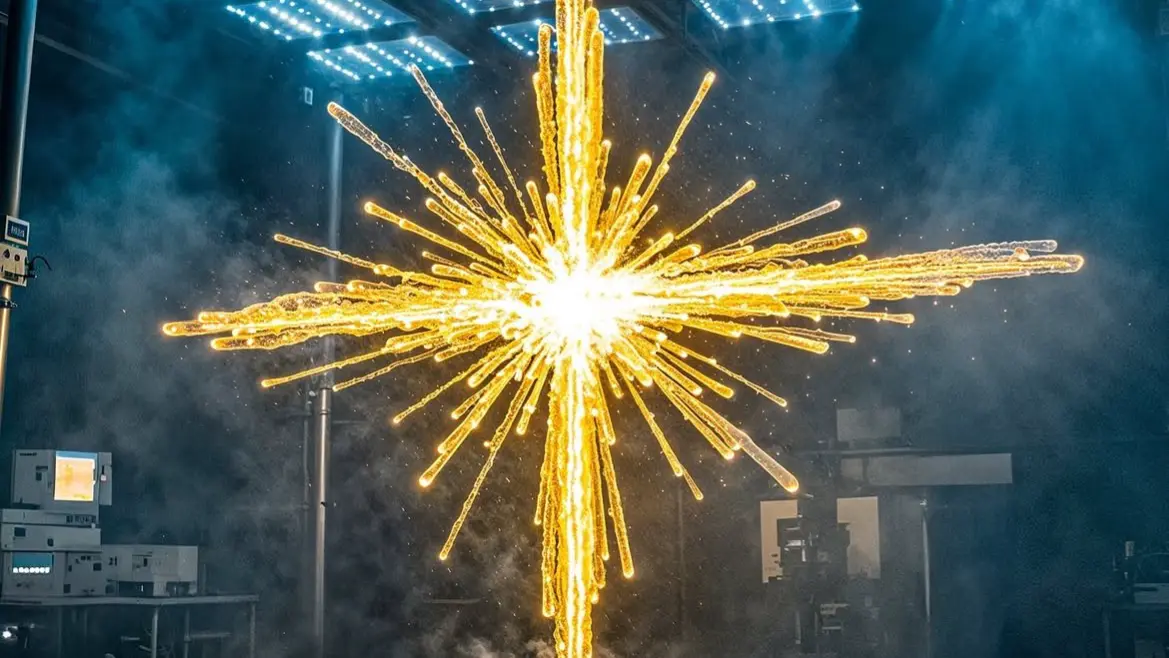
Science News: A team of Italian scientists have successfully managed to ‘freeze’ light while asserting that it can behave like a supersolid. This has resulted in a major breakthrough in field of quantum physics.
According to a study titled ‘A supersolid made using photons’ published in the Nature Journal, it has been revealed that supersolids represent a distinct phase of matter that merges the frictionless flow of superfluids with a structured arrangement.
In the past, supersolids have only been produced in Bose–Einstein condensates, which is a state of matter where separate atoms or subatomic particles are cooled to near absolute zero.
How Did Italian Scientists Freeze Light
Typically, when a liquid freezes, its molecules slow down and organize into a solid structure. However, in this experiment, researchers worked with temperatures close to absolute zero, where unusual quantum effects emerge. Absolute zero is the lowest possible temperature, at 0 Kelvin (K), -273.15°C, or -459.67°F.
Advertisement
At this temperature, atoms have minimal energy, and matter exhibits strange behaviors, such as forming Bose-Einstein condensates. While scientists can't achieve absolute zero precisely, they can reach temperatures incredibly close to it in controlled laboratory settings.
Advertisement
"This is only the beginning of understanding supersolidity," Italy-based physicist Antonio Gianfate wrote in their research summary.
What is Supersolid
Supersolids are a distinctive phase of matter that merge the frictionless flow of superfluids with an orderly structure. Until now, they have only been created using condensates of ultracold atoms. The discovery of the supersolid state in photons opens up a new avenue for exploring its mysteries, according to a report in Nature journal.