
M87: Astronomers Trace 3,000-Light-Year 'Cosmic Blowtorch' To Its Source | WATCH
M87 is an active titan that dwarfs our local neighbor. It is constantly pulling in surrounding gas and dust while firing immense jets of energy from its poles. Despite its power, the exact point where these jets originate and the specific physics that fuel their launch remain some of the greatest unsolved mysteries in modern astrophysics.
- Science News
- 4 min read

;'%3e%3cpath%20d='m8,15.99c4.41,0,7.99-3.58,7.99-7.99S12.41,0,8,0,0,3.59,0,8s3.58,7.99,7.99,7.99Z'%20style='stroke:%23fff;%20stroke-miterlimit:10;%20stroke-width:.02px;'/%3e%3cpath%20d='m3.08,3.37l3.82,5.11-3.84,4.15h.87l3.37-3.64,2.72,3.64h2.94l-4.04-5.39,3.58-3.87h-.86l-3.1,3.35-2.5-3.35h-2.94Zm1.27.64h1.35l5.97,7.99h-1.35l-5.97-7.99Z'%20style='fill:%23fff;'/%3e%3c/g%3e%3c/svg%3e)


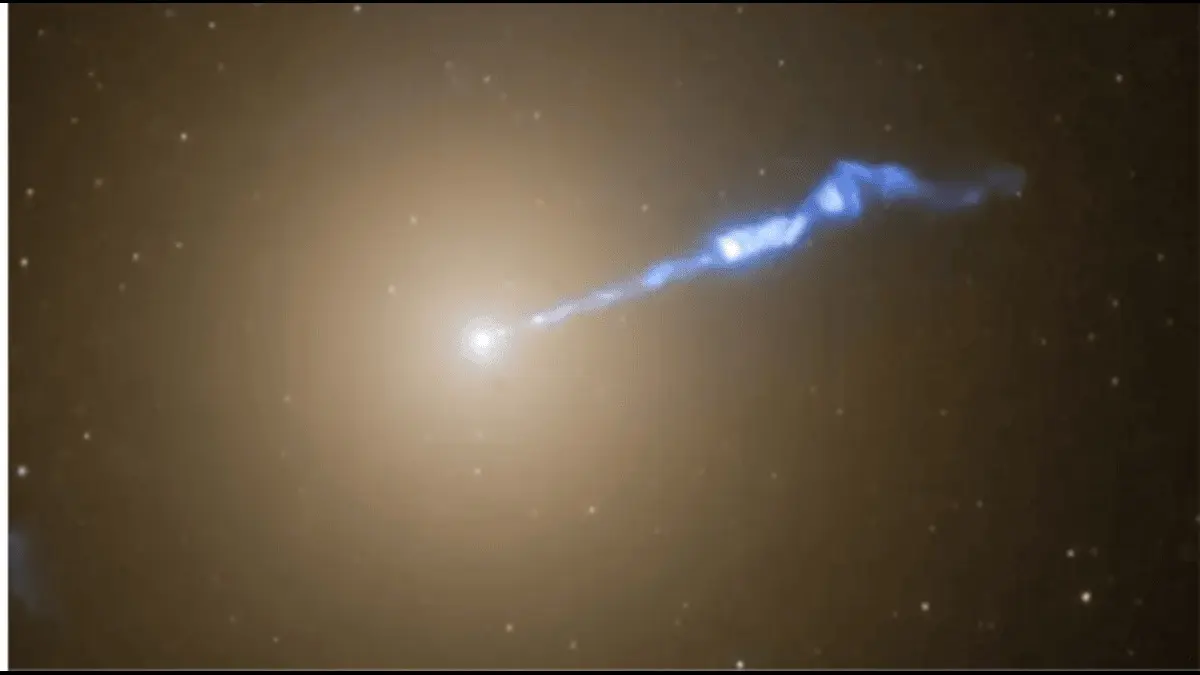
New Delhi: Astronomers, by leveraging the power of the Event Horizon Telescope, have successfully traced a massive, 3,000-light-year-long "cosmic blowtorch" back to its origin at M87, the iconic supermassive black hole that provided humanity’s first-ever direct image.
This breakthrough allows scientists to pinpoint exactly where these intense jets of charged particles begin, offering a rare glimpse into the mechanics of how black holes can launch matter across the universe at nearly the speed of light. It’s a major step forward in decoding one of the most powerful and mysterious phenomena in deep space.
M87- a gargantuan black hole
Located approximately 55 million light-years away at the center of the Messier 87 galaxy, M87 is a gargantuan black hole with a mass roughly 6.5 billion times that of our Sun. This cosmic giant made history in April 2019 when the Event Horizon Telescope (EHT) collaboration released the first-ever direct visual evidence of a black hole’s shadow, based on data painstakingly gathered in 2017.
In contrast to the Milky Way’s relatively quiet central black hole, Sagittarius A, which is only about 4 million times the mass of the Sun, M87 is an active titan that dwarfs our local neighbor. It is constantly pulling in surrounding gas and dust while firing immense jets of energy from its poles. Despite its power, the exact point where these jets originate and the specific physics that fuel their launch remain some of the greatest unsolved mysteries in modern astrophysics.
Advertisement
To pull this all together, astronomers used a high-tech method called Very Long Baseline Interferometry (VLBI) to analyze fresh observations from 2021. By combining data from a global network of telescopes, they were able to peer into the "shadow" of the black hole, that famous golden ring of super-heated matter, and finally bridge the gap between the ring and the jet. This crucial connection revealed exactly where the jet erupts from the black hole's surroundings, effectively pinpointing the "spark" that ignites this massive cosmic engine.
Key piece to the puzzle
Team leader Saurabh of the Max Planck Institute for Radio Astronomy (MPIfR) said in a statement, "This study represents an early step toward connecting theoretical ideas about jet launching with direct observations." He added, "Identifying where the jet may originate and how it connects to the black hole's shadow adds a key piece to the puzzle and points toward a better understanding of how the central engine operates."
Advertisement

Through advanced modeling of the supermassive black hole, researcher Saurabh identified missing radio emissions that appeared in the 2021 data but were absent in earlier observations. These emissions were traced back to a highly compact zone situated less than a tenth of a light-year from the black hole itself. This specific region has been identified as the true foundation of the M87 jet, aligning perfectly with the southern arm of a secondary jet previously detected via radio waves.
Team member Hendrik Müller of the National Radio Astronomy Observatory (NRAO) said, "We have observed the inner part of the jet of M87 with global VLBI experiments for many years, with ever-increasing resolution, and finally managed to resolve the black hole shadow in 2019," as per space.com.
Static snapshots to "movies"
Moving forward, the Event Horizon Telescope team is setting its sights on even more ambitious goals. By capturing higher-resolution data, they hope to transition from static snapshots to "movies" that track the jet’s movement and internal structure in real-time. These detailed observations will allow scientists to see exactly how these massive jets interact with their surroundings, revealing how a single supermassive black hole can fundamentally alter the growth and evolution of an entire galaxy.
The team's results were published on Wednesday (Jan. 28) in the journal Astronomy & Astrophysics.