
NASA's Artemis II Crew Returns After Shattering Human Spaceflight Records in Epic 10-Day Lunar Odyssey
NASA’s Artemis II mission broke several records. This includes Christina Koch becoming the first woman to fly around the Moon, Victor Glover making history as the first person of color to travel around the Moon, Jeremy Hansen of Canada becoming the first non-American astronaut to fly around the Moon
- Science News
- 5 min read

;'%3e%3cpath%20d='m8,15.99c4.41,0,7.99-3.58,7.99-7.99S12.41,0,8,0,0,3.59,0,8s3.58,7.99,7.99,7.99Z'%20style='stroke:%23fff;%20stroke-miterlimit:10;%20stroke-width:.02px;'/%3e%3cpath%20d='m3.08,3.37l3.82,5.11-3.84,4.15h.87l3.37-3.64,2.72,3.64h2.94l-4.04-5.39,3.58-3.87h-.86l-3.1,3.35-2.5-3.35h-2.94Zm1.27.64h1.35l5.97,7.99h-1.35l-5.97-7.99Z'%20style='fill:%23fff;'/%3e%3c/g%3e%3c/svg%3e)


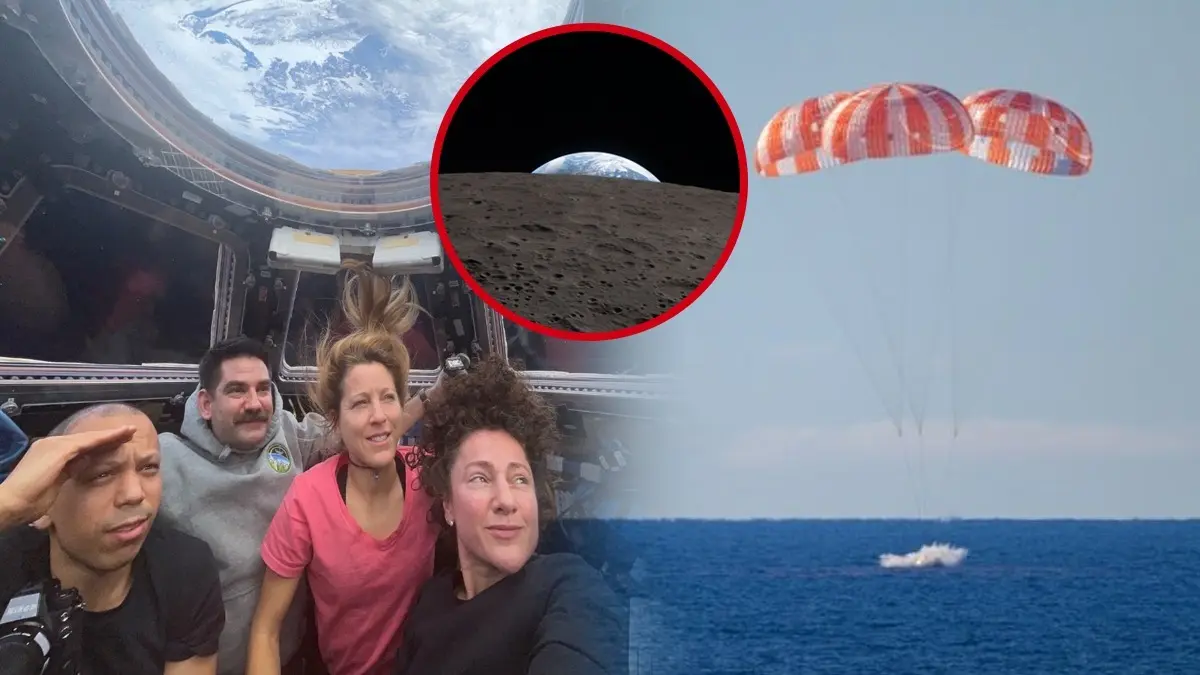
San Diego, California: In a triumphant splashdown off the coast of San Diego at 5:07 p.m. PDT, NASA’s Artemis II mission marked the dawn of a new era in human space exploration. Four astronauts -- NASA’s Reid Wiseman, Victor Glover, and Christina Koch, along with Canadian Space Agency astronaut Jeremy Hansen -- returned to Earth after a record-breaking journey that took them farther from our planet than any humans in history, rewrote the books on lunar travel, and delivered a string of historic firsts more than five decades after the last Apollo mission.
The crew’s nearly 10-day voyage aboard the Orion spacecraft lasted nine days, one hour, and 31 minutes -- a meticulously executed test flight that pushed the boundaries of deep-space human exploration and set the stage for future crewed landings under the Artemis program.
Farthest Humans Ever from Earth
The most jaw-dropping milestone came on April 6, when the Artemis II crew reached a staggering 252,756 miles from Earth -- the greatest distance any human beings have ever traveled from their home planet. To put that in perspective, that’s more than ten times the circumference of Earth at the equator (roughly 24,901 miles). NASA confirmed the record surpassed the previous benchmark set by Apollo 13 in 1970 by 4,111 miles, proving once again that humanity’s reach into the cosmos continues to expand.
Historic Firsts for a New Generation of Astronauts
Artemis II wasn’t just about distance -- it was about diversity and breaking barriers in space.
Advertisement
Christina Koch became the first woman to fly around the Moon. The veteran NASA astronaut and engineer shattered more than 50 years of precedent, becoming the first non-white-American-male to complete a lunar trajectory. Mid-mission, Koch also earned the nickname “space plumber” after quickly diagnosing and fixing a malfunctioning $23 million toilet on the spacecraft, showcasing the ingenuity required for long-duration deep-space missions.
Victor Glover made history as the first person of color to travel around the Moon. Serving as pilot, the U.S. Navy veteran was at the controls during critical phases of the flight. From the far side of the Moon, Glover witnessed a breathtaking solar eclipse, with the lunar surface illuminated only by a glowing halo against the blackness of space.
Advertisement
“Humans probably have not evolved to see what we’re seeing,” he later reflected. “It is truly hard to describe,” he said.
Jeremy Hansen of Canada became the first non-American astronaut to fly around the Moon, a proud milestone for the Canadian Space Agency and international partnership in space exploration.
Together with commander Reid Wiseman, the crew represented a new chapter in human spaceflight — one that looks dramatically different from the all-white, all-male Apollo crews of the 1960s and 1970s.
A Distant View of the Moon: 4,000 Miles Above the Far Side
Unlike the Apollo missions, which skimmed just under 100 miles above the lunar surface, Artemis II flew at a much higher altitude of roughly 4,000 miles above the Moon’s far side. At their closest approach on April 6, the crew came within 4,067 to 4,070 miles of the lunar surface. From this unique vantage point, the astronauts captured sweeping views of lunar terrain that only robotic probes had previously imaged, offering fresh perspectives for both science and inspiration.
One photograph has already captured the world’s imagination: the now-iconic “Earthset” image. It shows our small, fragile blue Earth appearing to set behind the vast gray curve of the Moon, separated by the void of space. Observers have drawn immediate parallels to the legendary “Earthrise” photo taken by Apollo 8 in 1968, calling it a defining image for the Artemis generation.
A Fiery, Record-Setting Return to Earth
The journey home proved to be one of the most demanding phases of the mission. During atmospheric re-entry, the Orion capsule screamed toward Earth at speeds exceeding 30 times the speed of sound, with the heat shield enduring temperatures of around 3,000 degrees Fahrenheit -- roughly half the surface temperature of the Sun.
The heat shield had been a point of serious concern following unexpected erosion during the uncrewed Artemis I flight in 2022. Drawing hard lessons from past tragedies like the Challenger and Columbia disasters, NASA engineers opted for a steeper, shorter re-entry trajectory to minimize risk. The gamble paid off.
“A textbook entry and a textbook touchdown,” NASA officials declared after the flawless splashdown.
Looking Ahead
With Artemis II successfully completed, NASA and its international partners are one giant leap closer to returning humans to the lunar surface -- this time to stay. The mission not only tested the Orion spacecraft and Space Launch System in deep space with a crew aboard but also demonstrated that the next generation of explorers is ready to push humanity’s footprint farther into the solar system than ever before.
As the crew stepped off their recovery ship, smiles wide and eyes still reflecting the wonder of deep space, one message rang clear: Artemis II didn’t just break records -- it redefined what’s possible when humanity reaches for the Moon once again.