
NASA Unveils $20-Billion 3-Phase Step-By-Step Plan To Build Permanent Moon Base
NASA has announced a multi-phase roadmap within its Artemis program to establish a permanent human presence on the Moon, focusing on robotic missions to scout the lunar south pole by 2029. Key components include Lunar Terrain Vehicles, MoonFall drones, and collaborative contracts with private firms.
- Science News
- 3 min read

;'%3e%3cpath%20d='m8,15.99c4.41,0,7.99-3.58,7.99-7.99S12.41,0,8,0,0,3.59,0,8s3.58,7.99,7.99,7.99Z'%20style='stroke:%23fff;%20stroke-miterlimit:10;%20stroke-width:.02px;'/%3e%3cpath%20d='m3.08,3.37l3.82,5.11-3.84,4.15h.87l3.37-3.64,2.72,3.64h2.94l-4.04-5.39,3.58-3.87h-.86l-3.1,3.35-2.5-3.35h-2.94Zm1.27.64h1.35l5.97,7.99h-1.35l-5.97-7.99Z'%20style='fill:%23fff;'/%3e%3c/g%3e%3c/svg%3e)


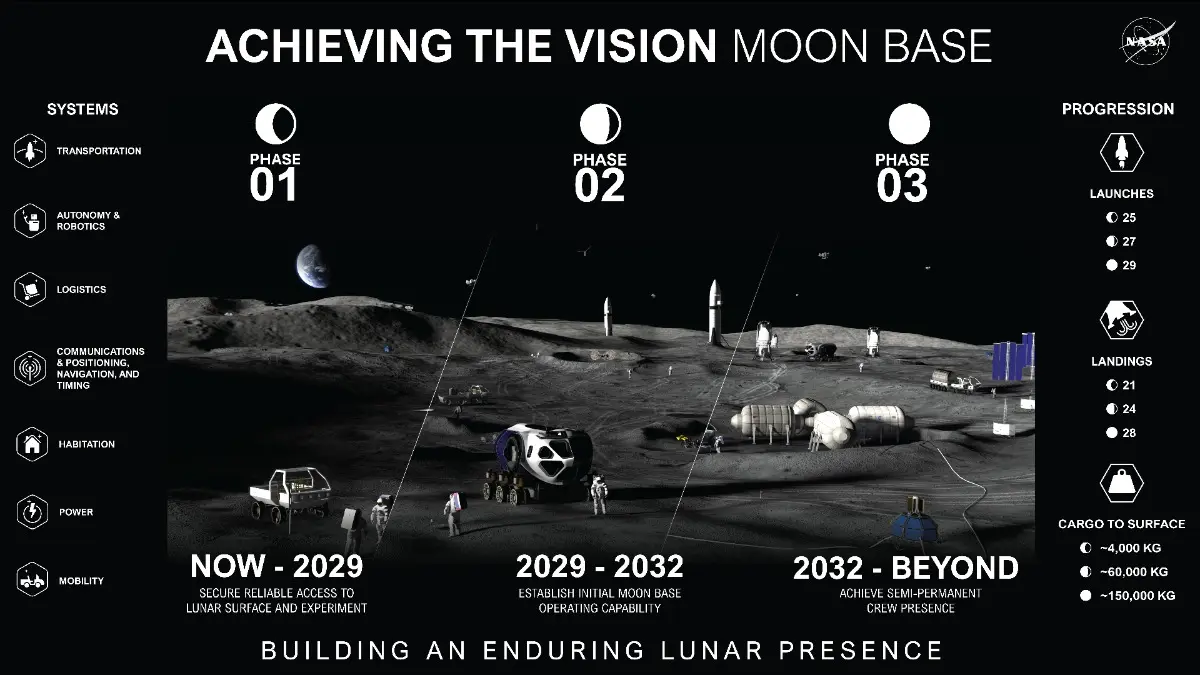
New Delhi: The NASA has unveiled an ambitious multi-phase roadmap to establish a permanent human presence on the Moon, detailing plans for robotic landers, hopping drones, lunar vehicles and long-term habitats near the Moon’s south pole as part of its Artemis programme.
According to NASA, the Moon Base project will begin with a rapid series of robotic missions between now and 2029 aimed at scouting the lunar south pole, testing technologies and preparing the surface for future astronaut missions. The agency plans to carry out up to 25 missions, including 21 lunar landings, as it works towards building a sustainable lunar outpost.
NASA Administrator Jared Isaacman revealed a $20 billion plan for a permanent lunar base, featuring rovers and drones for experiments to adapt to the moon's environment. The goal includes landing astronauts by 2028, marking humanity's first outpost on another celestial body.
As part of the first phase, NASA plans to deploy autonomous Lunar Terrain Vehicles (LTVs), robotic cargo systems and four “MoonFall” drones capable of hopping across difficult terrain and permanently shadowed craters believed to contain water ice. The drones, inspired by NASA’s Ingenuity Mars helicopter, will help map hazardous regions and identify suitable locations for future infrastructure.
Advertisement
NASA has also announced fresh contracts with private space firms to support the project. Blue Origin will provide cargo landers to transport equipment to the lunar surface, while companies such as Astrolab and Lunar Outpost are developing lunar rovers designed for both crewed and autonomous missions. Firefly Aerospace has been selected to help develop spacecraft capable of deploying the MoonFall drones.
The U.S. space agency said on Tuesday it had awarded Astrolab $219 million and Lunar Outpost $220 million to build and deliver lunar terrain vehicles. Blue Origin was awarded a $188 million contract to deliver the rovers to the moon's surface using its uncrewed cargo lunar lander, Mark 1.
Advertisement
The contracts are part of NASA's broader Artemis program, which aims to expand humanity's footprint in space and support future deep-space exploration.
The agency said the lunar base will eventually include power grids, communications systems, mobility networks and semi-permanent habitat modules designed to support astronauts for extended stays on the Moon. NASA aims to gradually transition from short-duration missions to continuous operations by the early 2030s.
NASA officials described the Moon Base as a key stepping stone for future human missions to Mars, with the lunar south pole chosen due to its potential water-ice reserves and long periods of sunlight suitable for solar power generation.
The announcement comes amid intensifying competition with China, which is also pushing ahead with plans to land astronauts on the Moon by 2030 and establish its own long-term lunar research station.