
NASA Webb Maps Uranus' Upper Atmosphere, Reveals First Vertical View
For the first time, an international team of astronomers has mapped the vertical structure of Uranus’ upper atmosphere, depicting how temperature and charged particles change with altitude across the planet.
- Science News
- 3 min read

;'%3e%3cpath%20d='m8,15.99c4.41,0,7.99-3.58,7.99-7.99S12.41,0,8,0,0,3.59,0,8s3.58,7.99,7.99,7.99Z'%20style='stroke:%23fff;%20stroke-miterlimit:10;%20stroke-width:.02px;'/%3e%3cpath%20d='m3.08,3.37l3.82,5.11-3.84,4.15h.87l3.37-3.64,2.72,3.64h2.94l-4.04-5.39,3.58-3.87h-.86l-3.1,3.35-2.5-3.35h-2.94Zm1.27.64h1.35l5.97,7.99h-1.35l-5.97-7.99Z'%20style='fill:%23fff;'/%3e%3c/g%3e%3c/svg%3e)


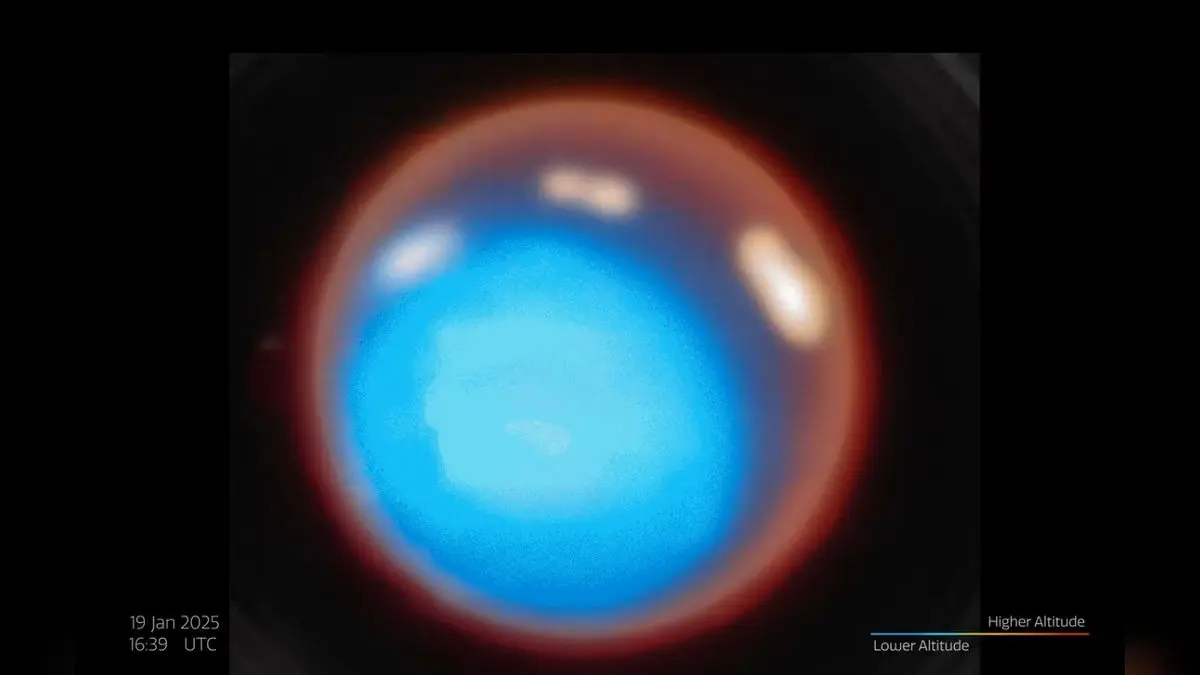
Washington: For the first time, an international team of astronomers has mapped the vertical structure of Uranus’ upper atmosphere, depicting how temperature and charged particles change with altitude across the planet.
Using Webb’s Near-Infrared Spectrograph (NIRSpec) Integral Field Unit, researchers observed Uranus for nearly a full 15-hour rotation on January 19, last year. The data then allowed them to map temperatures and ion densities up to 5,000 kilometres above the planet’s visible clouds.
The study, led by Paola Tiranti of Northumbria University in the United Kingdom, used these observations obtained from the James Webb Space Telescope to track the temperature and density of ions in Uranus' ionosphere, extending up to 5,000 kilometres, and the faint molecular glow above the ice giant’s cloud tops
The ionosphere is a region where the atmosphere becomes ionised and interacts strongly with the planet’s magnetic field.
Advertisement
The findings, published in Geophysical Research Letters, offer an elaborate view yet of how the planet’s auroras form and how energy circulates through its upper atmosphere.
“This is the first time we’ve been able to see Uranus’ upper atmosphere in three dimensions,” Tiranti said. “With Webb’s sensitivity, we can trace how energy moves upward through the planet’s atmosphere and even see the influence of its lopsided magnetic field," she added.
Advertisement
Taking to social media platform X, NASA Webb Telescope's official page shared the first vertical view of Uranus’s ionosphere, revealing auroras shaped by its tilted magnetic field.
The team found that atmospheric temperatures reach their highest levels between 3,000 and 4,000 kilometres above the clouds, while ion densities peak closer to 1,000 kilometres. The measurements also showed distinct variations across different longitudes, related to the unusual geometry of Uranus' magnetic field.
Uranus' magnetosphere is considered one of the most unusual in the Solar System. Its magnetic axis is tilted from the planet’s rotation axis, causing auroras to move across the surface in complex patterns. Webb’s observations detected two bright auroral bands near the magnetic poles, along with a darker zone between them marked by reduced emission and ion density. Comparable dark regions have previously been observed at Jupiter, where magnetic geometry shapes the flow of charged particles.
The data also confirm that Uranus’ upper atmosphere has continued to cool over the past three decades, extending a trend first observed in the early 1990s. Researchers measured an average temperature of around 426 kelvins (approximately 150 degrees Celsius), lower than figures reported by earlier ground-based telescopes and spacecraft.
“Uranus’ magnetosphere is one of the strangest in the Solar System,” Tiranti said. “It’s tilted and offset from the planet’s rotation axis, which means its auroras sweep across the surface in complex ways. Webb has now shown us how deeply those effects reach into the atmosphere. By revealing Uranus’s vertical structure in such detail, Webb is helping us understand the energy balance of the ice giants. This is a crucial step towards characterising giant planets beyond our Solar System," Tiranti said.
The research provides fresh insight into how ice-giant planets distribute heat and energy in their upper layers, scientists stated.