
NASA’s Image Of The Day Captures Icy Hudson River As New York Sees Record Breaking Cold Spell
NASA’s Landsat 8 captures ice-covered stretches of the Hudson River as extreme winter weather grips New York in January.
- Science News
- 2 min read

;'%3e%3cpath%20d='m8,15.99c4.41,0,7.99-3.58,7.99-7.99S12.41,0,8,0,0,3.59,0,8s3.58,7.99,7.99,7.99Z'%20style='stroke:%23fff;%20stroke-miterlimit:10;%20stroke-width:.02px;'/%3e%3cpath%20d='m3.08,3.37l3.82,5.11-3.84,4.15h.87l3.37-3.64,2.72,3.64h2.94l-4.04-5.39,3.58-3.87h-.86l-3.1,3.35-2.5-3.35h-2.94Zm1.27.64h1.35l5.97,7.99h-1.35l-5.97-7.99Z'%20style='fill:%23fff;'/%3e%3c/g%3e%3c/svg%3e)


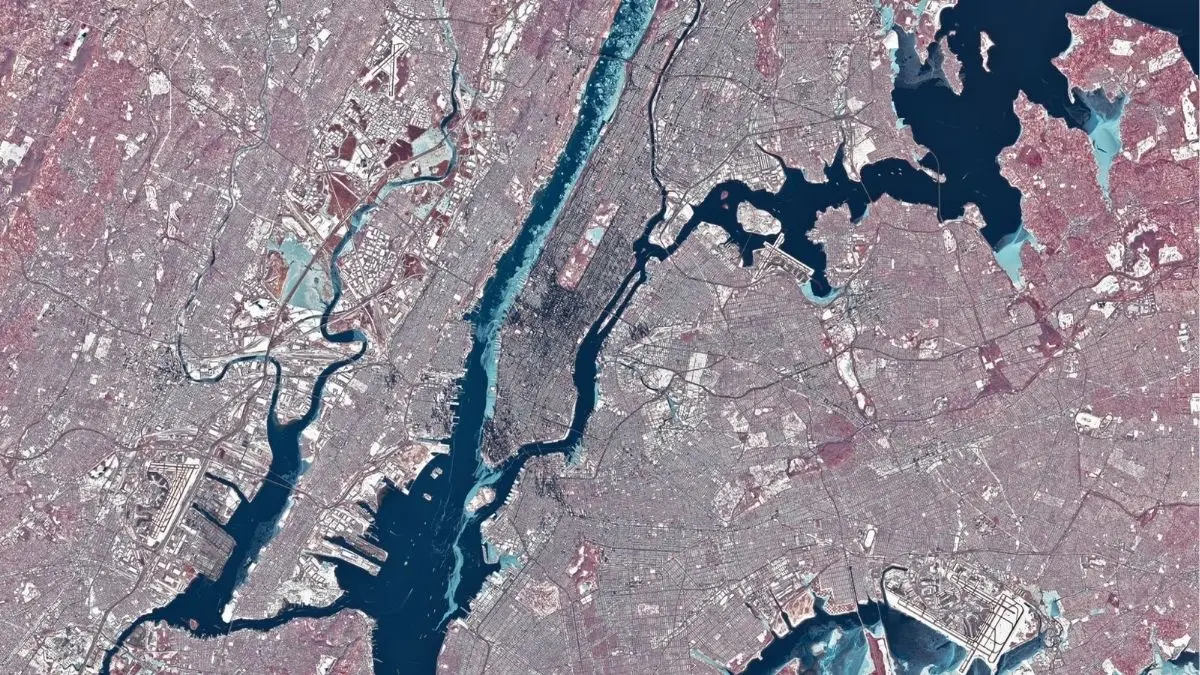
New Delhi: A surge of Arctic air sweeping across the northeastern United States in late January has left parts of the Hudson River locked in ice, underscoring the severity of winter conditions gripping New York.
Satellite imagery captured around midday on 28 January by the Operational Land Imager aboard NASA’s Landsat 8 reveals swathes of ice lining Manhattan’s western waterfront. The image, rendered in representational colour, shows ice in pale blue, contrasting sharply with darker open water, while surrounding vegetation appears in deep red tones.
Researchers say much of the ice visible along Manhattan likely drifted south from upriver sections of the Hudson. In those northern stretches, weaker tidal currents and lower salinity levels allow water to freeze more easily. By contrast, the faster-flowing, brackish water closer to the river’s mouth near New York City typically resists freezing, though prolonged cold can still push ice floes downstream.
The satellite view captures the Hudson’s dynamic tidal system, which continuously shifts ice along one of the busiest waterways in the United States. While the lower river often remains partially navigable, heavy ice formation can disrupt marine traffic, complicate ferry operations and pose risks to waterfront infrastructure.
Advertisement
Seasonal freezing of the Hudson is not unusual during extended cold spells, though its intensity varies widely from year to year. Scientists and city officials increasingly rely on satellite monitoring to track ice movement, providing crucial data for navigation safety and offering insights into how extreme weather is reshaping urban waterways.
Though temperatures have since shown signs of moderation, the frozen stretches of the Hudson stand as a stark illustration of winter’s reach into one of the world’s most densely populated coastal cities.