
NASA’s Webb Telescope May Have Detected the Universe’s Oldest Star Formed After Big Bang
NASA's James Webb Space Telescope may have detected the universe's oldest stars, believed to have formed shortly after the Big Bang. Located in the galaxy LAP1-B, about 13 billion light-years away, these candidate Population III stars emit intense ultraviolet light and lack heavy elements. Further observations are planned to confirm their nature and implications for cosmic evolution.
- Science News
- 2 min read

;'%3e%3cpath%20d='m8,15.99c4.41,0,7.99-3.58,7.99-7.99S12.41,0,8,0,0,3.59,0,8s3.58,7.99,7.99,7.99Z'%20style='stroke:%23fff;%20stroke-miterlimit:10;%20stroke-width:.02px;'/%3e%3cpath%20d='m3.08,3.37l3.82,5.11-3.84,4.15h.87l3.37-3.64,2.72,3.64h2.94l-4.04-5.39,3.58-3.87h-.86l-3.1,3.35-2.5-3.35h-2.94Zm1.27.64h1.35l5.97,7.99h-1.35l-5.97-7.99Z'%20style='fill:%23fff;'/%3e%3c/g%3e%3c/svg%3e)


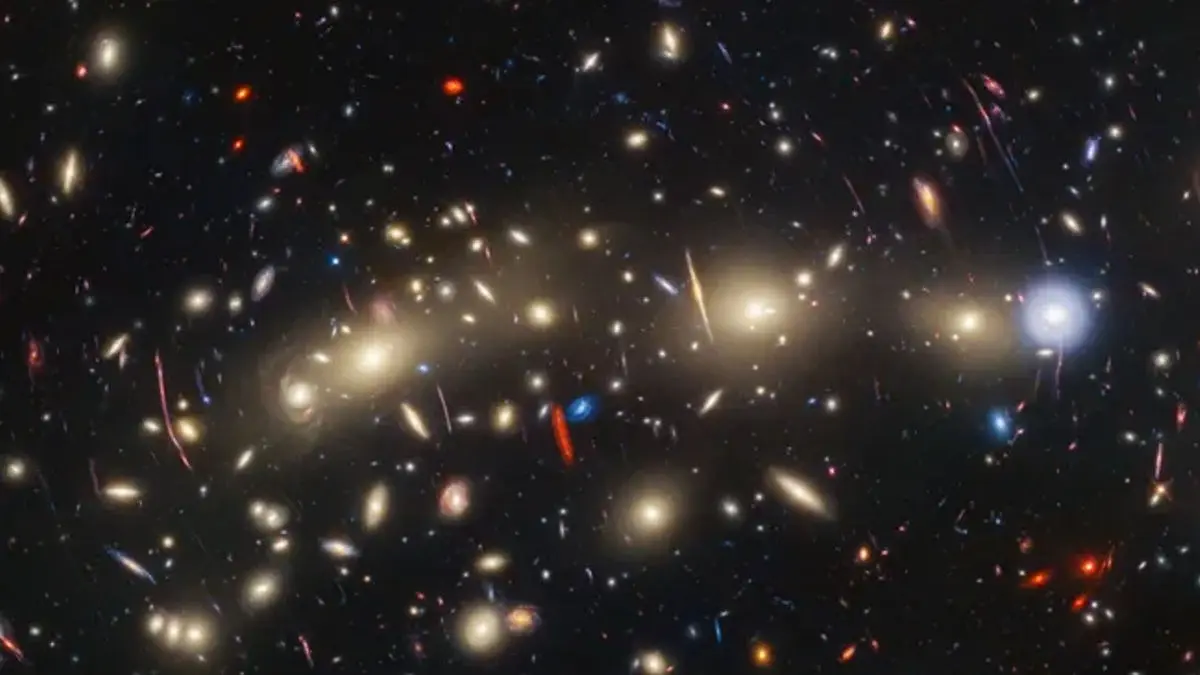
New Delhi: In a groundbreaking development that could reshape our understanding of the early cosmos, NASA’s James Webb Space Telescope (JWST) may have identified the universe’s oldest stars - ones that formed shortly after the Big Bang. If confirmed, this would mark humanity’s first glimpse of Population III stars, the theorized first generation of stars made almost entirely of hydrogen and helium.
According to the latest research, these ancient stars are found in a distant galaxy named LAP1-B, located some 13 billion light-years from Earth. This means the light received today began its journey when the universe was only a fraction of its current age - just a few hundred million years after the Big Bang.
Scientists believe the candidate Population III stars meet several key theoretical predictions:
They emit exceptionally intense ultraviolet light due to their massive sizes and high temperatures. Their chemical signature is nearly pristine, lacking heavy elements found in later generations of stars.
Gravitational lensing - where a massive foreground galaxy cluster magnifies light from LAP1-B - helped Webb’s instruments detect these faint ancient signals.
Advertisement
Why It Matters:
Population III stars have long been a missing piece in the cosmic puzzle. Cosmological models predict that these stars were the first to ignite after the Big Bang - forming from primordial gas and producing the first heavy elements that later generations of stars and galaxies would inherit. Detecting them would validate decades of theoretical work and provide unprecedented insight into the “cosmic dawn”, the era when the universe first lit up.
Scientific Reactions:
Eli Visbal, an astrophysicist involved in the research, noted that only the combination of Webb’s unmatched sensitivity and strong gravitational lensing made this detection possible. He emphasized that this could be the first direct observation of Population III stars - a milestone long sought by astronomers.
Advertisement
Looking Ahead:
The team plans further observations to confirm the nature of these stars. If these early results hold up under additional scrutiny, Webb could soon reveal more about how and when the first stars formed, providing key insights into the evolution of galaxies and the early universe itself.