
'No Ambulance, No Hospital...', Captain Shubhanshu Shukla Explains How Astronauts Survive Medical Emergencies in Space?
Indian astronaut Shubhanshu Shukla explained on X how medical emergencies are handled in space, where there are no hospitals or ambulances.
- Science News
- 3 min read

;'%3e%3cpath%20d='m8,15.99c4.41,0,7.99-3.58,7.99-7.99S12.41,0,8,0,0,3.59,0,8s3.58,7.99,7.99,7.99Z'%20style='stroke:%23fff;%20stroke-miterlimit:10;%20stroke-width:.02px;'/%3e%3cpath%20d='m3.08,3.37l3.82,5.11-3.84,4.15h.87l3.37-3.64,2.72,3.64h2.94l-4.04-5.39,3.58-3.87h-.86l-3.1,3.35-2.5-3.35h-2.94Zm1.27.64h1.35l5.97,7.99h-1.35l-5.97-7.99Z'%20style='fill:%23fff;'/%3e%3c/g%3e%3c/svg%3e)


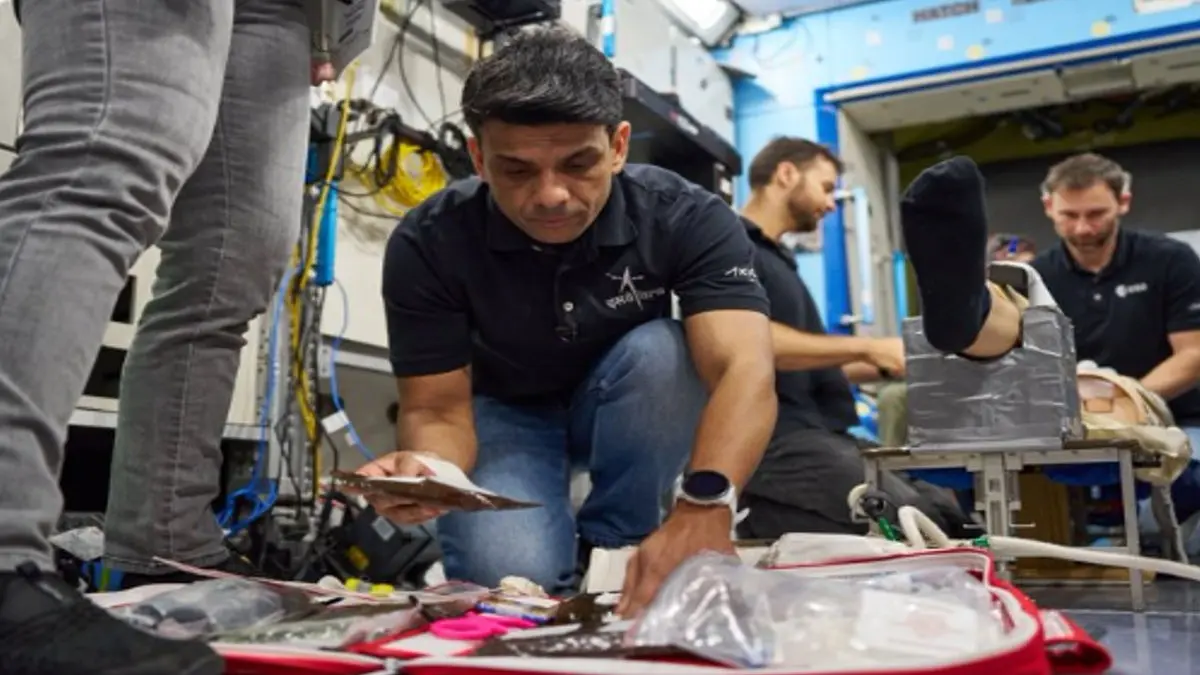
Indian Astronaut Shubhanshu Shukla recently took to X to share an interesting piece of information on how medical emergencies are handled in space.
“There’s no ambulance in space. No hospital. No ER. So how do astronauts survive medical emergencies? How we do CPR is going to blow your mind!!!!” he wrote.

On the International Space Station (ISS) that astronauts prepare to be doctors, nurses, and first responders all at once. Their patients are usually mannequins that repeatedly “go into cardiac arrest,” giving crews endless practice at CPR, mouth-to-mouth resuscitation, and firing up an automated external defibrillator (AED), he explained.
He further stated that treating patients in zero gravity comes with challenges unimaginable on Earth.
"If blood pressure crashes and veins collapse, astronauts use intraosseous infusion—injecting life-saving medicine straight into bone marrow, where vessels remain open and ensure fast absorption."
He also shared his favourite fun fact: Performing CPR in space. On Earth, chest compressions mean pushing down with force. In microgravity, both the patient and the rescuer would just float away. The solution is almost acrobatic: astronauts flip upside down, plant their feet against the station’s ceiling, and push off with their legs to deliver compressions—like doing upside-down wall push-ups to save a life.
Advertisement
Shukla’s first journey to the ISS was historic not only for India but also for future human spaceflight. Launched aboard SpaceX’s Falcon 9 on June 25 as part of Axiom Mission 4 (Ax-4), he docked on June 26 and spent nearly 20 days in orbit. During his stay, he carried out over 60 scientific experiments, including studies on space radiation biology and microalgae-based oxygen systems.
His return on July 15 marked a major milestone in India’s space exploration, offering crucial lessons for the upcoming Gaganyaan mission. Beyond science, Shukla’s firsthand stories reveal the extraordinary resilience and innovation required to keep humans alive in the most hostile environment imaginable.
Advertisement
In space, survival is not just about technology—it’s about creativity, courage, and preparation. And sometimes, it looks like performing CPR upside down.