
Northern Lights To Light Up Skies! Can India See the Solar Storm’s Aurora This Weekend?
A massive coronal hole in the Sun’s atmosphere is unleashing solar winds, potentially sparking G1 geomagnetic storms and vibrant auroras on October 11-12, 2025. The post-autumn equinox Russell-McPherron effect could boost visibility. Could northern India catch a rare glimpse under clear skies?
- Science News
- 3 min read

;'%3e%3cpath%20d='m8,15.99c4.41,0,7.99-3.58,7.99-7.99S12.41,0,8,0,0,3.59,0,8s3.58,7.99,7.99,7.99Z'%20style='stroke:%23fff;%20stroke-miterlimit:10;%20stroke-width:.02px;'/%3e%3cpath%20d='m3.08,3.37l3.82,5.11-3.84,4.15h.87l3.37-3.64,2.72,3.64h2.94l-4.04-5.39,3.58-3.87h-.86l-3.1,3.35-2.5-3.35h-2.94Zm1.27.64h1.35l5.97,7.99h-1.35l-5.97-7.99Z'%20style='fill:%23fff;'/%3e%3c/g%3e%3c/svg%3e)


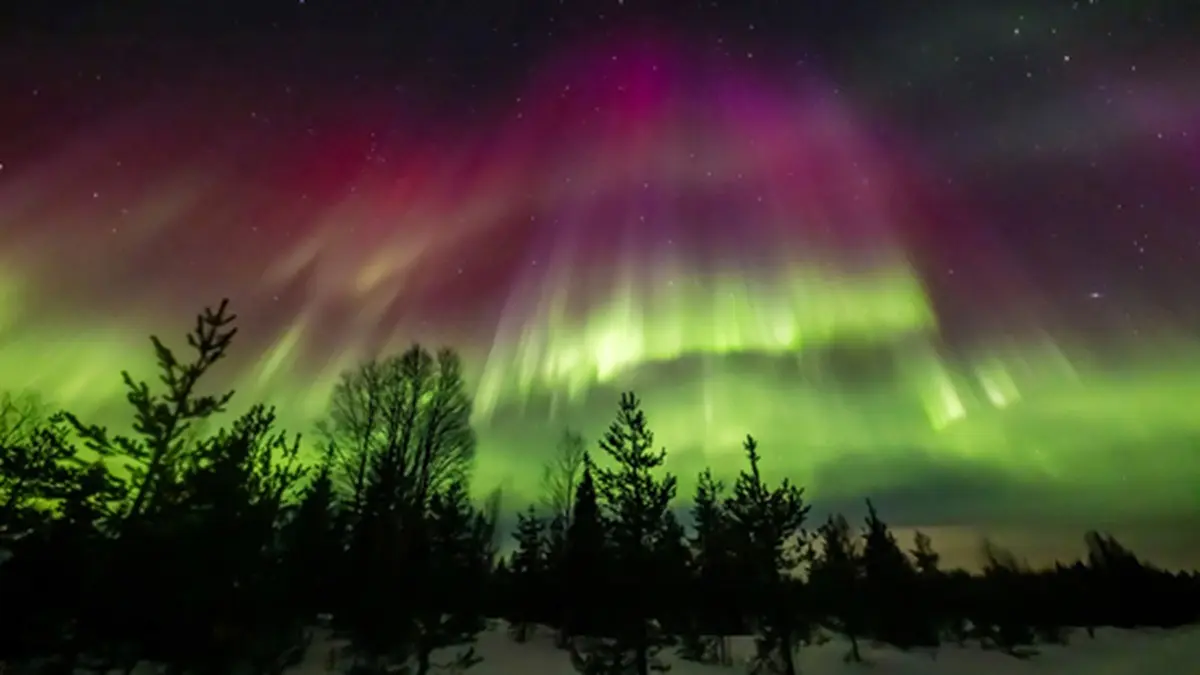
A significant opening in the Sun's outer atmosphere, known as a coronal hole, is presently aligned with Earth, unleashing a surge of rapid solar wind that may lead to geomagnetic disturbances and vibrant aurora displays over the coming days.
This high-velocity stream is anticipated to reach our planet from late Saturday through Sunday, October 11-12, 2025, as per predictions from NOAA's Space Weather Prediction Center and the U.K. Met Office.
Geomagnetic unrest could begin escalating late on October 11, peaking between 5 a.m. and 5 p.m. EDT (0900-1700 GMT) on October 12.
Recent forecasts suggest visibility could extend to about 12 U.S. states, including Washington, Montana, North Dakota, Minnesota, Wisconsin, Michigan, New York, Vermont, New Hampshire, Maine, Idaho, and South Dakota, especially under clear skies.
Advertisement
With the timing shortly after the autumn equinox, even modest activity might amplify, increasing opportunities for broader aurora sightings due to seasonal factors.
Recurring Coronal Hole and Its Evolution
This coronal hole isn't new; it's a returning feature from the previous month, previously resembling a butterfly or avian shape. These solar structures can endure for extended periods, recurring approximately every 27 days with the Sun's rotation cycle.
Advertisement
A fresh coronal hole has recently rotated into Earth's view, contributing to the ongoing fast solar wind effects. Coronal holes represent zones where the Sun's magnetic field expands outward, enabling solar wind to escape more readily into space.
Upon arrival at Earth, this wind engages with our magnetosphere, channeling charged particles along magnetic lines to the polar areas. These particles excite atmospheric gases like oxygen and nitrogen, producing the luminous auroral phenomena.
Seasonal Enhancement for Aurora Viewing
The weekend's setup favors aurora enthusiasts, as the post-autumn equinox period aligns Earth's orientation to facilitate stronger solar wind interactions with our magnetic field.
This boost, termed the Russell-McPherron effect, occurs because the tilt of Earth's magnetic field during equinoxes creates "cracks" that allow more solar wind penetration, resulting in heightened geomagnetic activity and more frequent auroras.
The effect essentially aligns the interplanetary magnetic field to have a more effective southward component, enhancing storm potential twice yearly around the equinoxes.
Forecast Details and Storm Intensity
According to NOAA's updated outlook, the Kp index—a measure of global geomagnetic disruption from 0 (calm) to 9 (severe)—is expected to hit a maximum of 5, indicating G1 minor storm conditions. Higher Kp values expand aurora visibility beyond typical polar zones.
The U.K. Met Office echoes this, noting initial quiet conditions shifting to unsettled or active levels with possible G1 intervals, driven by coronal hole winds arriving on October 12.
Aurora chances remain at baseline early on but could rise, offering views in high-latitude spots like northern Scotland or Antarctica. For real-time updates, check NOAA's Aurora Dashboard or similar tools