
Scientists Discover the Most Massive Blackhole At The Centre Of Cosmic Horseshoe
Astronomers discover a 36-billion-solar-mass black hole, the largest ever detected at the Centre of Cosmic Horseshoe, challenging standard models of black hole growth and galaxy evolution.
- Science News
- 3 min read

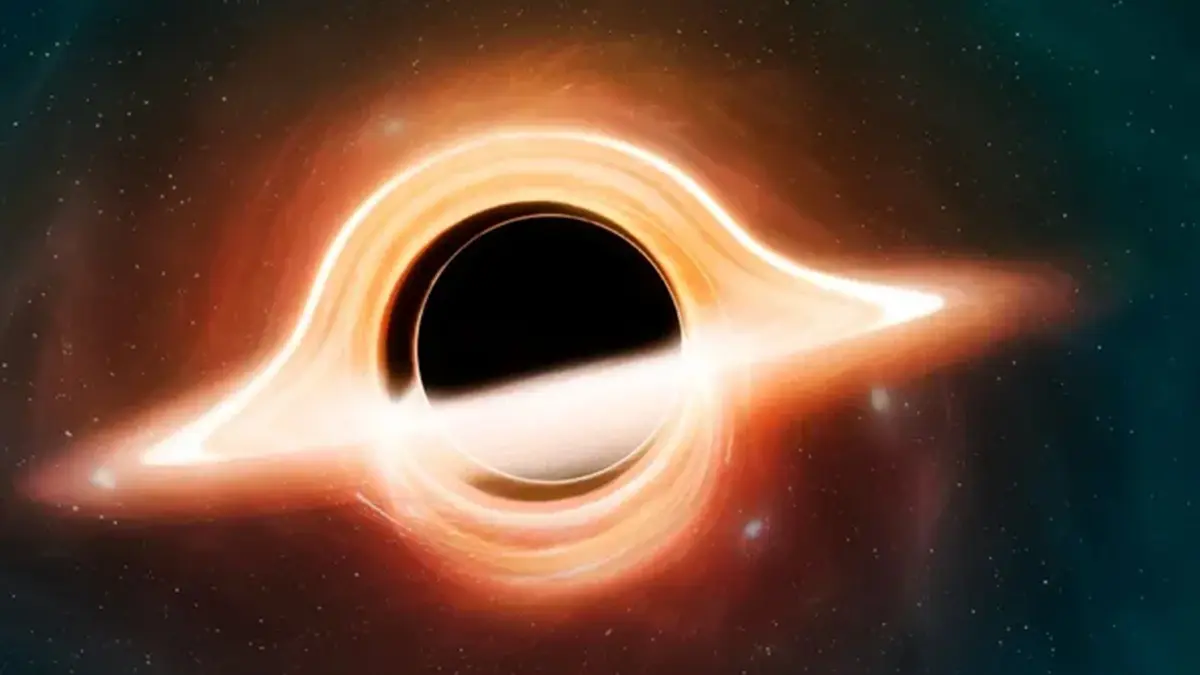
New Delhi: The astronomers have confirmed a surprising discovery, saying that they have identified the most massive black hole ever detected, residing at the centre of the Cosmic Horseshoe, a galaxy located around 5 billion light-years away. According to information, the colossal black hole weighs an astonishing 36 billion times the mass of our Sun, challenging our understanding of the universe's most extreme objects.
The Cosmic Horseshoe is a spectacular example of gravitational lensing, where the immense mass of a foreground galaxy warps the light of a distant background galaxy, creating a horseshoe-shaped Einstein ring. The phenomenon, predicted by Albert Einstein's theory of general relativity, acts as a cosmic magnifying glass, allowing astronomers to study distant galaxies in unprecedented detail. The foreground galaxy, LRG 3-757, is one of the most massive galaxies ever observed, hundreds of times more massive than our Milky Way.
Newly Discovered Black Hole Is Dormant
As per the scientists, the newly discovered black hole is dormant, meaning it is not actively accreting material or emitting intense radiation. The astronomers stated that its presence is revealed by its gravitational pull on surrounding stars and light. By combining gravitational lensing with stellar kinematics, researchers were able to measure the black hole's mass with remarkable precision. "We detected the effect of the black hole in two ways — it is altering the path that light takes as it travels past the black hole, and it is causing the stars in the inner regions of its host galaxy to move extremely quickly," said Thomas Collett, study author and professor at the University of Portsmouth.
The ultramassive black hole's discovery challenges the standard model of black hole growth and galaxy evolution. According to the MBH-Sigma Relation, a fundamental rule in astrophysics, the mass of a black hole is tightly linked to the velocity dispersion of stars in its host galaxy. However, the Cosmic Horseshoe's black hole defies this expectation, suggesting that something unusual occurred during its formation. "This is amongst the top 10 most massive black holes ever discovered, and quite possibly the most massive," Collett said.
Advertisement
Reshaping Future Of Black Hole Research
The discovery of the Cosmic Horseshoe black hole offers a unique opportunity to study the structure and evolution of the universe's most massive galaxies. As astronomers continue to explore the cosmos, they may uncover more secrets about the formation and growth of supermassive black holes. "What is particularly exciting is that this method allows us to detect and measure the mass of these hidden ultramassive black holes across the universe, even when they are completely silent," said Carlos Melo, study lead author and PhD candidate at the Universidade Federal do Rio Grande do Sul in Brazil.
The scientists asserted that the discovery of the Cosmic Horseshoe black hole opens up new avenues for research, challenging our understanding of the universe's most extreme objects. The future observations with advanced telescopes, such as the Euclid Space Telescope and the Extremely Large Telescope, will help uncover more massive black holes and shed light on the mysteries of galaxy evolution. "We're seeing the end state of galaxy formation and the end state of black hole formation," Collett said.