
Artemis 1: Orion leaves Moon's orbit; heads back home for splashdown on December 11
Orion has left Moon's orbit and begun its journey back to Earth, NASA said. The Artemis 1 mission will end with Orion's splashdown in Pacific Ocean on Dec 11.
- Science News
- 2 min read

;'%3e%3cpath%20d='m8,15.99c4.41,0,7.99-3.58,7.99-7.99S12.41,0,8,0,0,3.59,0,8s3.58,7.99,7.99,7.99Z'%20style='stroke:%23fff;%20stroke-miterlimit:10;%20stroke-width:.02px;'/%3e%3cpath%20d='m3.08,3.37l3.82,5.11-3.84,4.15h.87l3.37-3.64,2.72,3.64h2.94l-4.04-5.39,3.58-3.87h-.86l-3.1,3.35-2.5-3.35h-2.94Zm1.27.64h1.35l5.97,7.99h-1.35l-5.97-7.99Z'%20style='fill:%23fff;'/%3e%3c/g%3e%3c/svg%3e)


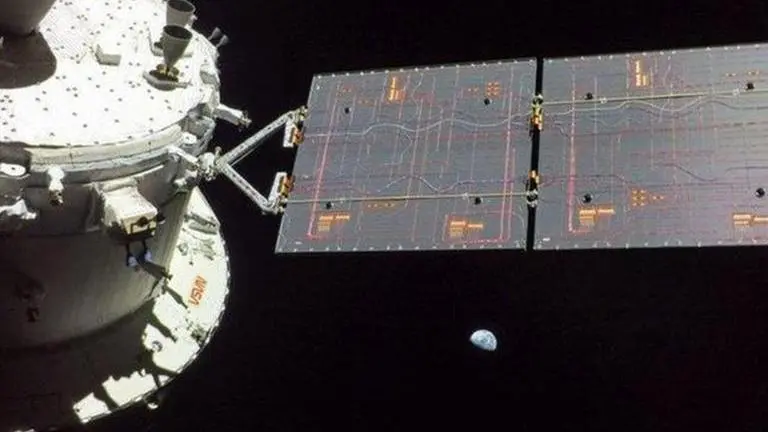
The Orion spacecraft has left the Moon’s orbit beginning its journey back to Earth, NASA revealed. On December 2, the 16th day into the Artemis 1 mission, engineers fired Orion's main engine for a departure burn at 2:33 am IST which pushed the spacecraft out of the distant retrograde orbit (DRO). Orion spent roughly six days in the DRO, where it circled the Moon in a direction opposite to the Moon's orbit around the Earth.
We've left lunar orbit! @NASA_Orion fired its main engine today to exit distant retrograde orbit and set itself on a course for Earth. The burn is one of two maneuvers we'll make ahead of splashdown on Dec 11. Next up? Return powered fly by on Dec 5. https://t.co/3gPLuhoFxD pic.twitter.com/RHjM2ATsWY
— Jim Free (@JimFree) December 1, 2022
The distant retrograde departure burn is the first of two planned burns required to get Orion out of the DRO and set in on the journey back to Earth. According to NASA, the second burn is planned on December 5 when Orion will fly roughly 127 km above the lunar surface as part of the powered lunar flyby to use the Moon's gravity and swing it to Earth. The journey will end on December 11 when Orion splashes down in the Pacific Ocean.
A step-by-step overview in this #infographic.
— Human Spaceflight (@esaspaceflight) December 1, 2022
It's flight day 16 and @NASA_Orion begins the return toward #Earth with the help of the #EuropeanServiceModule. pic.twitter.com/MIvdg7hlQ4
NASA revealed that Orion is being propelled by the European Service Module which has a modified orbital maneuvering system engine built by Aerojet Rocketdyne. Capable of producing 6,000 pounds of thrust, this engine is tried and tested on 19 space shuttle flights, the first of which began in STS-41G (October 1984) and ended with STS-112 (October 2002).
"Teams also continued thermal tests of the star trackers during their eighth and final planned test", the agency said in an update. The spacecraft is equipped with Star trackers which actually are navigation tools that measure the positions of stars to help it determine its orientation. "In the first three flight days of the mission, engineers evaluated initial data to understand star tracker readings correlated to thruster firings", it said further.
Advertisement
Artemis 1 halfway through completion
Artemis 1 launched on November 16 and with that began NASA's quest to land astronauts on the Moon again. The ultimate aim, however, is to establish permanent bases on the Moon and use the lunar surface as a test bed to prepare for missions to Mars. Artemis 1 is an uncrewed mission that is meant to test the new Space Launch System (SLS) rocket [which performed exceptionally well, per NASA], the Orion spacecraft and the ground control systems before astronauts are launched to the Moon.