
Astronomers locate new super-Earth lingering in habitable zone of its star; Read more
The exoplanet is dubbed Ross 508b, orbits a star named Ross 508 and has a mass around four times greater than our planet.
- Science News
- 2 min read

;'%3e%3cpath%20d='m8,15.99c4.41,0,7.99-3.58,7.99-7.99S12.41,0,8,0,0,3.59,0,8s3.58,7.99,7.99,7.99Z'%20style='stroke:%23fff;%20stroke-miterlimit:10;%20stroke-width:.02px;'/%3e%3cpath%20d='m3.08,3.37l3.82,5.11-3.84,4.15h.87l3.37-3.64,2.72,3.64h2.94l-4.04-5.39,3.58-3.87h-.86l-3.1,3.35-2.5-3.35h-2.94Zm1.27.64h1.35l5.97,7.99h-1.35l-5.97-7.99Z'%20style='fill:%23fff;'/%3e%3c/g%3e%3c/svg%3e)


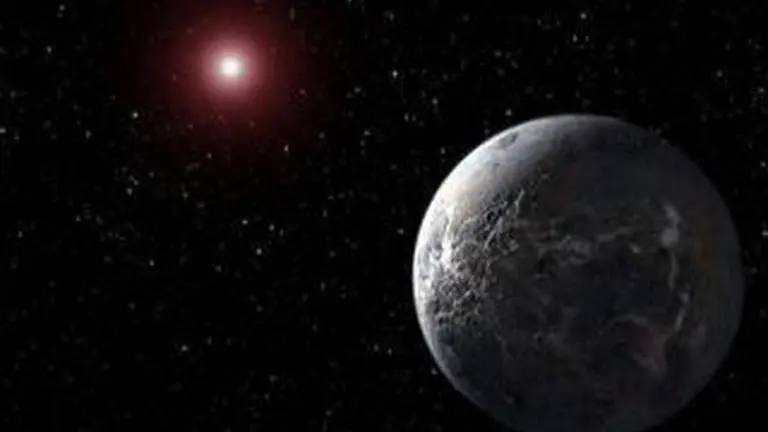
The long list of exoplanets just got lengthier as astronomers have discovered a new rocky world located approximately 36.5 light-years away from the Earth. Dubbed Ross 508b, the exoplanet orbits a star named Ross 508 and has a mass around four times greater than our planet. Another reason why this discovery is exciting is that astronomers have identified this rocky planet as a super-Earth as it resides in the habitable zone of its star.
According to Science Alert, the exoplanet was found through a new survey using the National Astronomical Observatory of Japan's (NAOJ) Subaru Telescope in Hawaii. It is also special because it demonstrated the efficacy of new techniques to locate exoplanets around dim stars, the experts noted in their study soon to be published in Publications of the Astronomical Society of Japan.
Is the planet really habitable?
Before diving into the habitability aspects of the newly-found exoplanet, let us first understand what habitability means. Scientists call a planet habitable if it resides at an appropriate distance from its star, receives just the right amount of sunlight and water exists in a liquid state. However, a planet located in the habitable zone does not necessarily mean that the planet has conditions for life. Notably, Mars is one such planet that exists near the habitable zone, also called the Goldilock zone in our solar system. Although no signs of life have been found on the red planet, scientists have confirmed that it once hosted oceans and might have allowed life to thrive.
It is worth noting, that the star Ross 508 is a red dwarf star, meaning it has a lower level of energy and radiation being emitted from it. What's more, is that the planet Ross 508b completes one orbit around the sun in just 10 days but still receives solar radiation just 1.4 times received by Earth. Currently, scientists have found no proof that Ross 508b has scope for life or has an atmosphere. However, they are confident that NASA's Transiting Exoplanet Survey Satellite (TESS) must have gathered sufficient data over the same ever since it was directed toward the star in April this year. After analysing observations by TESS, scientists aim to confirm if the exoplanet really is habitable.