
Updated 5 October 2020 at 04:44 IST
Astrophysicists publish one of the most accurate measurements total matter in universe
US astrophysicists have derived one of the most accurate measurements of the total amount of matter and dark energy in the observable universe. Read more here:
- Science News
- 2 min read

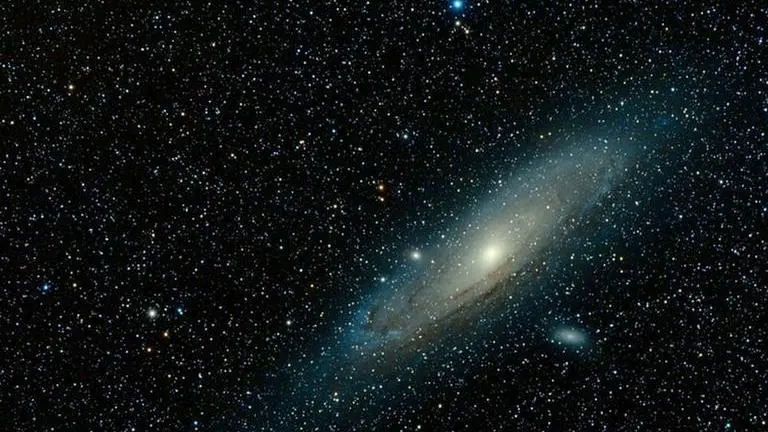
US astrophysicists have derived one of the most accurate measurements of the total amount of matter in the universe. In a recent study published in the Astrophysical Journal, researchers have said that matter accounts for only 31.5 percent of the universe while the remaining 68.5 percent is dark energy. Give or take 1.3 percent, the energy is a mysterious force that is responsible for the accelerated expansion of the universe.
The dark energy was first inferred by the observations of distant supernovae in the late 1990s, as per reports. Mohamed Abdullah, a University of California, Riverside astrophysicist and the paper's lead author, is reported to have said that all the matter in the observable universe amounts to 66 billion trillion times the mass of Sun.
At least 80 percent of this matter is called dark matter because of its unknown nature. However, as per reports, it could have some undiscovered subatomic particle. The newest measurements of the universe were in line with the previously-derived values by other teams using varying cosmological techniques.
Advertisement
'Largest 3D map' of the entire universe
In a separate breakthrough discovery, astrophysicists released the “largest 3D map” of the entire universe that has produced a “complete story of the expansion of the universe”. More than four million galaxies along with the ultra-bright, energy-packed quasars have been analysed by hundreds of scientists from over 30 institutions under the project that was launched at least two decades ago called “Sloan Digital Sky Survey”.
Advertisement
As per the official statement, the data for this survey was collected from an optical telescope dedicated to the project located in New Mexico, United States.
The latest six-year-long survey of the SDSS called “the extended Baryon Oscillation Spectroscopic Survey” (eBOSS) included over 100 astrophysics with most of them being from EPFL (Ecole polytechnique fédérale de Lausanne) and was initiated by Jean-Paul Kneib who heads EPFL’s Astrophysics Laboratory.
Image: Representative/Unsplash
Published By : Aanchal Nigam
Published On: 5 October 2020 at 04:44 IST