
Australia begins work on world's most powerful telescopes for cosmic study and alien hunt
The first array of the observatory is being constructed in western Australia's Wajarri country where 1,31,072 antennas will be installed to study the universe.
- Science News
- 2 min read

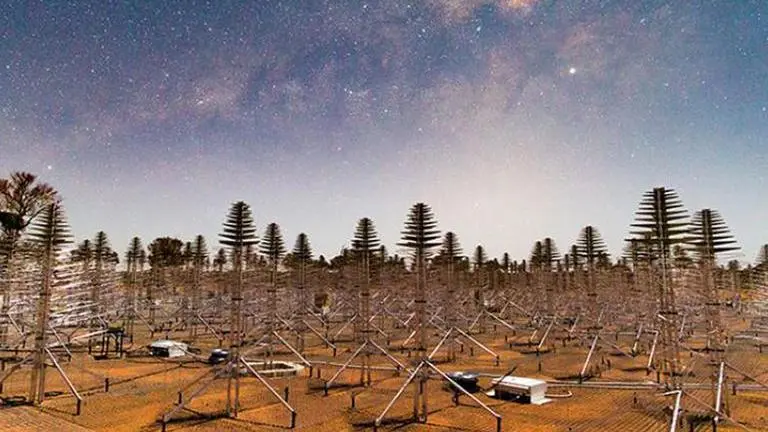
The work for developing the world’s most powerful radio telescope array has begun in western Australia two years after the country became part of the Square Kilometre Array Observatory (SKAO) Convention. The work has commenced in Western Australia's Wajarri country where 1,31,072 tree-like antennas will be installed as part of the SKA-Low array. The SKAO will comprise of two arrays and the second will be constructed in South Africa's Karoo region comprising 197 antennas as part of SKA-Mid.
According to Australia's Department of Industry, Science and Resources, the SKA is being supported by 15 countries and is a project to build the world’s most capable radio telescopes.
More about the SKAO
The radio telescopes being developed as the SKAO will be the world's most powerful and will see scientists from Australia, South Africa, Italy and the Netherlands collaborate for a wide range of studies including investigations of dark energy and search for aliens. These extremely sensitive telescopes will answer questions such as, why is the universe expanding? does Albert Einstein's theories on gravity hold relevance in most extreme areas of the universe? What did the young universe like and how does life outside Earth look like if it exists elsewhere?
The Department of Industry, Science and Resources revealed that over 1,000 engineers and scientists in 20 countries have contributed to the observatory's design and that the telescopes are already performing cutting-edge scientific work and making significant discoveries.
Advertisement
Explaining the sensitivity of the antennas, Danny Price, a researcher at the Curtin Institute of Radio Astronomy, said that they can detect a mobile phone in the pocket of an astronaut on Mars. "More excitingly, if there are intelligent societies on nearby stars with technology similar to ours, the SKA could detect the aggregate ‘leakage’ radiation from their radio and telecommunication networks – the first telescope sensitive enough to achieve this feat", he further said per The Guardian.
Sarah Pearce, SKA-Low’s director, said that the next-generation observatory would "define the next fifty years for radio astronomy" and would lift the veil from the mysteries of the birth and death of galaxies thus enhancing our understanding of the universe.