
Chandrayaan-3 at Rs 600cr vs Luna-25 at Rs 16,000cr: How India manages cheap space trips
Union Minister Jitendra Singh showcased Chandrayaan-3's triumph at a modest Rs. 600 crore, underscoring India's prowess in economical space missions.
- Science News
- 3 min read

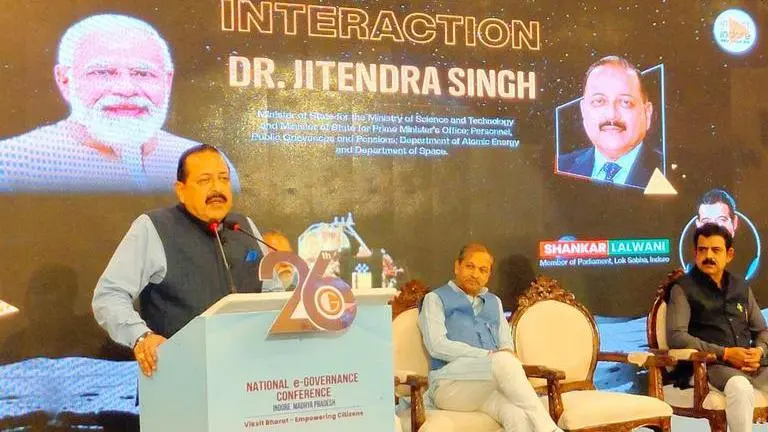
Chandrayaan-3 exemplifies India's prowess in cost-effective space missions, Union Minister Jitendra Singh highlighted while speaking at an event on Saturday, August 26. Talking about how Chandrayaan-3 cost around Rs 600 crore while the Russian spacecraft Luna-25 cost Rs 16,000 crore to make, the minister spoke of Prime Minister Narendra Modi's initiatives that has boosted research and development and create public-private partnerships in the nation.
'Success at minimal cost'
"Chandrayaan-3 has proven India's capability for cost-effective space missions," said Jitendra Singh, Union Minister of State for Space, during an interactive session in Indore. He highlighted that India's space missions are intentionally designed to be economically efficient. In remarkable contrast, the Russian moon mission, which failed, incurred a cost of Rs 16,000 crore, while Chandrayaan-3 achieved its objectives at a cost of about Rs 600 crore. Singh drew a parallel with Hollywood films centred around Moon and Space Missions, which often surpass the Rs. 600 crore mark.
"We have learned to compensate for costs through our skills," said Singh. He added: "Questions will arise, how? We made use of gravitational forces. The spacecraft made about 20 orbits of the earth, each rising in a parabola until it escaped and was captured by the Moon's gravity, and it made 70-80 revolutions around the moon before landing at the designated spot."
PM's initiatives to promote research and development
Singh further discussed the initiation of the "Anusandhan National Research Foundation" Bill, championed by Prime Minister Narendra Modi, which allocates Rs 50,000 crore over five years to facilitate private sector participation in R&D. He said a public-private partnership (PPP) arrangement, targeting a research fund infusion of ₹36,000 crore from the private sector and ₹14,000 crore from the government, positioning it as a transformative move.
Advertisement
Reflecting on PM Modi's policy, Singh said corporations can now allocate 10% of their CSR budget for research and development, an initiative that even the US and other nations ‘might envy’, deeming it a ‘game-changer’. He emphasised the importance of collaborative synergy between the public and private sectors, asserting that success in the geopolitical race requires unified efforts rather than isolated endeavours.
Collaborative synergy: Public and private sectors
Calling for collective synergy, Jitendra Singh said, 'We have to get rid of this mutual scepticism between the public and private sectors. We can never emerge successful in the geopolitical race by working in silos,” the minister said.
Advertisement
"We have to remove the idea that the government will and should do everything. The countries that have achieved development did not do so by depending solely on their government. If today NASA sends rockets for the US, the maximum contribution to such missions is made by private agencies and the industry," he said. Stating that no government can provide a ‘Sarkari Naukri’ (government job) to every individual, the minister said, "A responsible government creates job opportunities, as PM Modi has done."
"From 350 startups (in 2014), we now have over one lakh startups. Startups have sprung up even in governance technology, which nobody could have imagined earlier. Under the Mudra scheme, easy loans of Rs. 10-20 lakh are made available to the youth, without mortgage. So, a whole environment has been created to trigger innovation," he concluded.