
Chandrayaan-3: Moon lander mates with ISRO's LVM3 rocket as launch nears
ISRO's Chandrayaan-3 orbiter will launch aboard the LVM3 rocket from Sriharikota between July 12-19, ISRO chairman S Somanath had said.
- Science News
- 3 min read

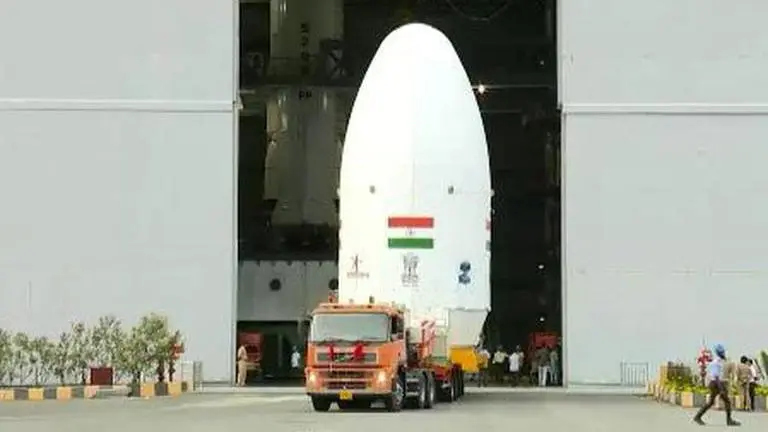
ISRO's Chandrayaan-3 orbiter has been mounted atop its launch vehicle, the LVM3 rocket, ahead of the highly-anticipated launch later this month. On Wednesday, the agency announced that the spacecraft was moved into the vehicle assembly building at the Satish Dhawan Space Center in Sriharikota, the mission's launch site. Late last month, sources from within ISRO said that the launch is scheduled for July 13, and the same was confirmed last week by ISRO chairman S Somanath. He also said that the launch window will last till July 19.
— ISRO (@isro) July 5, 2023
Built at a cost of around Rs 600 crore, Chandrayaan-3 is aimed to demonstrate ISRO's end-to-end capability to safely land and operate a rover on the lunar surface. Owing to ISRO's method of taking a fuel-efficient path to the Moon, Chandrayaan-3 is likely to take a few weeks to reach its destination, similar to Chandrayaan-2, which launched on July 22 in 2019 and took 48 days.
Chandrayaan-2 Vs Chandrayaan-3

(The integrated Lander Module and Propulsion Module of Chandryaan-3; Image: ISRO)
Chandrayaan-3 is a follow-on mission of its predecessor and it is different from it in several aspects. Explaining the difference between the two, Somanath explained that the legs of the Lander Module (LM) have been made stronger, and more fuel has been added along with new sensors and a Lander Hazard Detection Avoidance Camera (LHDAC). ISRO has also added the 'Laser Doppler VelociMeter' instrument to measure the spacecraft's velocity during touchdown.
Advertisement
Besides, Chandrayaan-3 does not have an orbiter as mission teams will use the one launched during Chandrayaan-2, which is still functional. This mission instead includes a Propulsion Module (PM), which will carry the LM to the lunar orbit, about 100 km above the lunar surface, and use its Spectro-polarimetry of HAbitable Planet Earth (SHAPE) instrument to study the spectral and Polari-metric measurements of Earth from the lunar orbit. Similar to Chandrayaan-2, the new mission also includes a 26 kg rover that will be carried by the LM (1,752 kg). Both the components have a life span of 14 Earth days or 1 lunar day, ISRO said.
After landing on the South Pole of the Moon, the LM and rover will inspect the thermal properties of the Moon along with its seismic activities, and plasma (ions and electrons) density near the surface to understand the overall lunar dynamics.
Advertisement
Notably, only three nations-- the US, China and the USSR -- have succeeded in making a soft landing on the Moon. If Chandrayaan-3 is successful, India will become the fourth country to achieve the milestone.