
Updated 22 November 2022 at 22:01 IST
China gears up to launch new crew members to fully assembled Tiangong space station
China has rolled out the Long March 2F rocket onto the launch pad for its next manned mission to the recently assembled Tiangong space station.
- Science News
- 3 min read

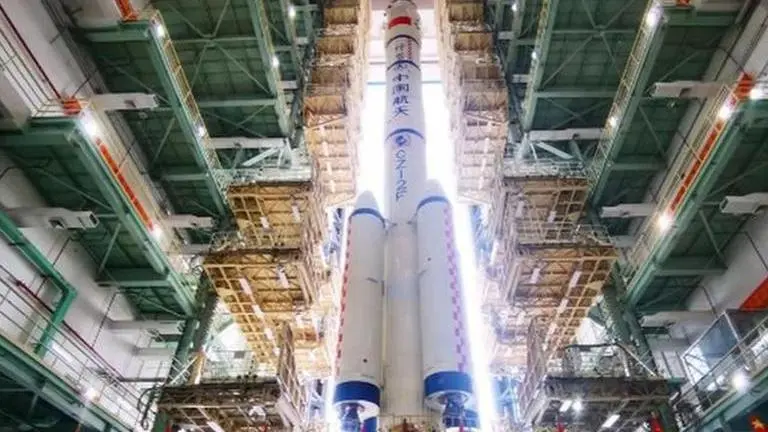
China has rolled out the Long March 2F rocket onto the launch pad for its next manned mission to the Tiangong space station. The orbital outpost’s assembly was completed with the docking of the third and final module Mengtian on November 1.
The upcoming mission will see three Taikonauts board the Shenzhou 15 spacecraft that will launch from the Jiuquan Satellite Launch Center in the Gobi desert in inner Mongolia.
While the exact timing and date of the launch have not been specified, the rocket is likely to take off at the end of November, per Space.com.
According to the China Manned Space Agency (CMSA), the rocket was rolled out to the launch pad on November 21 and it would follow the November 11 launch when the Tianzhou 5 cargo capsule was launched with supplies for three Taikonauts currently aboard Tiangong.
Advertisement

(The Long March 2F rocket at the launch pad; Image; CMSA)
Notably, China is also yet to reveal the identities of the crew members who would take over Tiangong’s control from the existing crew. The space station, according to China’s plan, is supposed to last at least ten years and a team of three residents would spend six months each while carrying out a wide range of experiments in microgravity.
Advertisement
The previous crew is part of the Shenzhou 14 mission which oversaw the assembly of two modules and they are expected to return in December. The Tiangong space station is composed of three modules – Tianhe (core), Wentian and Mengtian. Out of these Wentian is currently the largest and heaviest spacecraft China has ever built and also the world's heaviest self-propelled spaceship as it measures 17.9 metres in length and weighs 23 tons.
Concerns around Chinese rocket launches
The uncontrolled entry of rocket debris is the biggest concern around the missions launched by China. NASA, on multiple occasions, said that China has been reluctant in sharing the trajectory of the falling rocket parts which pose a serious threat to populated areas. The same concern might arise again if Beijing refuses to share orbital information with the international community.
Earlier this month, a 20-ton debris from the Long March 5B rocket crashed near the Philippines. This is because the rockets being used by China are non-reusable and each part gets spent after launch. However, a Chinese expert at the recent Zhuhai Airshow in southern China revealed that they will now build a reusable rocket booster instead of an expendable Long March 9 heavy-lift rocket.
Published By : Harsh Vardhan
Published On: 22 November 2022 at 22:01 IST