
China's rocket booster goes rogue again, likely to fall on Earth after July 24 launch
China's rocket booster is part of the Long March-5B Y3 rocket, which was used to launch the Wentian module of the Chinese space station on July 24.
- Science News
- 2 min read

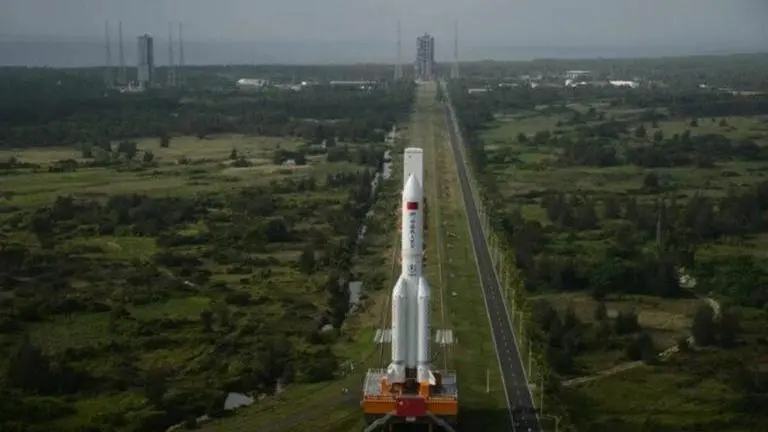
A booster from China's Long March-5B Y3 rocket, which was used to launch the second module of the Chinese space station on July 24, is likely to fall on Earth. According to astronomer Jonathan McDowell at the Harvard-Smithsonian Center for Astrophysics, the rocket booster stage weighs 21 tonnes and is floating freely in the low-Earth orbit. He tweeted that the core stage was not actively deorbited although it is not clear when or when the spent rocket would crash.
Two objects cataloged from the CZ-5B launch: 53239 / 2022-085A in a 166 x 318 km x 41.4 deg orbit, 53240 / 2022-085B in a 182 x 299 km x 41.4 deg orbit. Orbital epoch of ~1200 UTC confirms that the inert 21t rocket core stage remains in orbit and was not actively deorbited.
— Jonathan McDowell (@planet4589) July 24, 2022
A report by Space.com says that the Space Command or the 18th Space Defense Squadron of the US military, which tracks falling debris, also has not issued any alerts about the potential crash. Regarding the disposal of used rocket boosters, McDowell said that the US launch providers do a better job at disposing of the upper stage "and China on average a worse one".
He also said that while rocket parts do burn up during in the Earth's atmosphere during re-entry, fragments measuring 30 metres might end up crashing on the ground at hundreds of kilometres per hour.
"self destruct" is not meaningful. It will break up, but past experience shows that a bunch of 30-metre-long metal fragments will end up crashing into the ground at a few hundred km/hr.
— Jonathan McDowell (@planet4589) July 24, 2022
Notably, this is not the first time China failed to dispose of a rocket stage as a 23-ton core stage Long March booster crashed into the Indian ocean. The debris was part of the rocket that launched the Tianhe module of China's under-construction space station Tiangong.
Advertisement
China launches second module of Tiangong
The Chinese space station would consist of three modules, two of which have been launched, the latest being on July 24. About 15 hours after the launch at 11:53 AM IST, the second module named Wentian docked with Tianhe. Weighing 23 tonnes, Wentian is heavier than any other module and will be joined by the third module Mengtian, which is targeted for launch in October this year.
Once completed, the Tiangong will become the first standalone space station installed by a country. Meanwhile, several US companies such as Axiom Space and Blue Origin are also working together to develop a private space station, which would eventually replace the International Space Station (ISS) which has been operational for three decades.