
Cygnus spacecraft heads to ISS with ovarian cells and much more on Nov 6; WATCH live
The Cygnus spacecraft will carry over 3,700 kg cargo for NASA which includes ovarian cells extracted from cows and equipment for human tissue printing research.
- Science News
- 3 min read

;'%3e%3cpath%20d='m8,15.99c4.41,0,7.99-3.58,7.99-7.99S12.41,0,8,0,0,3.59,0,8s3.58,7.99,7.99,7.99Z'%20style='stroke:%23fff;%20stroke-miterlimit:10;%20stroke-width:.02px;'/%3e%3cpath%20d='m3.08,3.37l3.82,5.11-3.84,4.15h.87l3.37-3.64,2.72,3.64h2.94l-4.04-5.39,3.58-3.87h-.86l-3.1,3.35-2.5-3.35h-2.94Zm1.27.64h1.35l5.97,7.99h-1.35l-5.97-7.99Z'%20style='fill:%23fff;'/%3e%3c/g%3e%3c/svg%3e)


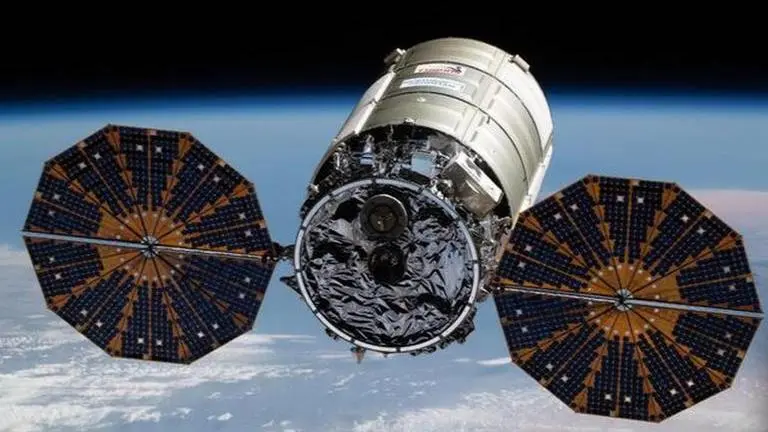
The Cygnus spacecraft will carry several experiments to the International Space Station (ISS) on November 6, Sunday, as part of the 18th Northrop Grumman resupply services mission for NASA. The spacecraft named The SS Sally will lift off at 4:20 pm aboard the company’s Antares rocket from the Mid-Atlantic Regional Spaceport at NASA’s Wallops Flight Facility in Virginia. Cygnus will be carrying loads of experiments amounting to over 3,700 kg which includes studying ovarian cells extracted from cows and advancing human tissue printing research.
How to watch the launch?
The launch will be aired live starting at 4 pm on NASA’s official YouTube channel and official website. You can also tune in to the agency’s official social media handles for live updates.
What is the Cygnus spacecraft carrying to the ISS?
Among the payload of Cygnus includes the OVOSPACE experiment that will study the ovarian cells of cows to better understand the effect of microgravity on bovine cell cultures. NASA says this research that could improve fertility treatments on Earth and help prepare for future human settlement in space since a long-term stay in outer space has ill effects on one’s fertility.
“This threatens the goal of establishing permanent or extended settlements beyond Earth,” scientist Mariano Bizzarri said in an official statement. “Deregulation of the reproductive functions also may pose additional health risks. Our results could improve understanding of egg development and identify targets for countermeasures and treatments to protect reproductive potential on space missions," Bizzarri added.
Advertisement
Another crucial experiment is the BioFabrication Facility (BFF) which will be installed aboard the ISS. It is making a return trip to the orbiting lab as it successfully printed a partial human knee meniscus and a large volume of human heart cells during its first trip to space in 2019.
According to NASA, it aims to find out if cells 3D printed in microgravity have better quality than those printed on the ground. The ultimate goal, however, is to use 3D bioprinting technologies to solve the problem of organ shortages for patients in need of transplants by printing replacement organs and tissues.
Advertisement
The payload also includes the Plant Habitat-03 which would assess how plants adapt to microgravity and ultimately help to develop plants better suited for use on future missions to provide food and other services. Cygnus will also carry the first satellite from Zimbabwe--ZIMSAT-1-- and the first from Uganda named PEARLAFRICASAT-1. In addition to Japan's satellite TAKA, those from the African nations make up the BIRDS-5 constellation of CubeSats that will perform multispectral observations of Earth using a commercial off-the-shelf camera and demonstrate a high-energy electronic measuring instrument.