
D-dimer Test: Find out what is the normal range of this protein in our bodies
As the world is still battling COVID-19, researchers are studying D-dimer test reports in COVID-19 patients to understand how the protein impacts the virus.
- Science News
- 2 min read

;'%3e%3cpath%20d='m8,15.99c4.41,0,7.99-3.58,7.99-7.99S12.41,0,8,0,0,3.59,0,8s3.58,7.99,7.99,7.99Z'%20style='stroke:%23fff;%20stroke-miterlimit:10;%20stroke-width:.02px;'/%3e%3cpath%20d='m3.08,3.37l3.82,5.11-3.84,4.15h.87l3.37-3.64,2.72,3.64h2.94l-4.04-5.39,3.58-3.87h-.86l-3.1,3.35-2.5-3.35h-2.94Zm1.27.64h1.35l5.97,7.99h-1.35l-5.97-7.99Z'%20style='fill:%23fff;'/%3e%3c/g%3e%3c/svg%3e)


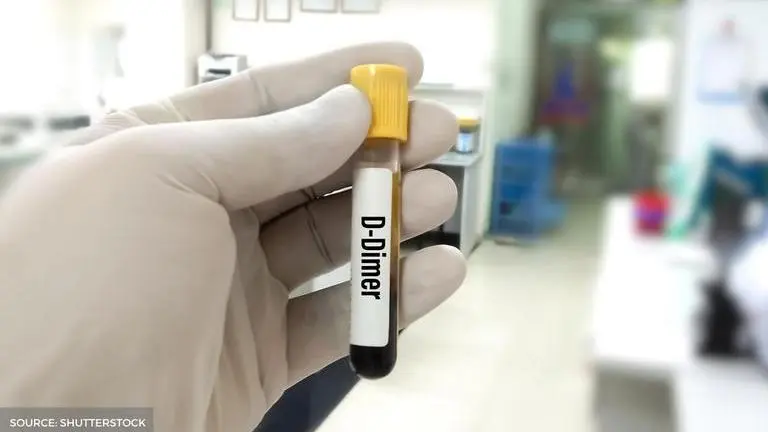
Recently internet users have been talking about the D-dimer test. For those who don’t know what D-dimer is, it is a ‘fibrin degradation product.’ According to a report in news-medical.net, D-dimer has been used to measure and assess clot formations in patients bodies. Amidst the ongoing pandemic, patients are showing elevating D-dimer levels. Read on to find out what is D-dimer normal range?
What is D-dimer normal range?
D-Dimer meaning
The report in news-medical.net states that the liver is responsible for producing important proteins which are involved in the coagulation process, one such protein is fibrinogen. One fibrinogen molecule is made of three pairs of polypeptide chains which is a linear chain of amino acids.

Source: Shutterstock
How is D-dimer related to COVID-19?
For research purposes, the D-dimer levels of several hospitalized COVID-19 patients were tested. It was done to determine if a biomarker like D-dimer could help in predicting the patient's outcome in relation to COVID-19. A normal D-dimer range is less than 0.50. A positive D-Dimer range is 0.50 or greater. According to a study on ncbi.nlm.nih.gov called "Association between D-Dimer levels and mortality in patients with coronavirus disease 2019 (COVID-19): a systematic review and pooled analysis", published in Journal de Medicine Vasculaire, it was found that out of total 274 patients, the 113 who did not survive, had D-dimer levels that were higher at a median of 4.6 µg/mL. Out of the remaining surviving 161 patients, the D-dimer levels had averaged at 0.6 µg/mL.
The above mentioned study was conducted in China. More research needs are done in this area. The study further mentioned that patients with severe COVID-19 have a higher level of D-dimer than those with the non-severe disease. D-dimer greater than 0.5 μg/ml is associated with a severe infection in patients with COVID-19.
Advertisement
What roles do biomarkers play in identifying COVID-19?
The report in news-medical.net mentioned that it is estimated that 10-15% of COVID-19 patients will experience critical forms of these diseases. These might likely progress into severe pneumonia, hypoxia, and even respiratory failure. About 5% of these severe COVID-19 cases tend to decline even further to acute respiratory distress syndrome (ARDS) or even multiple organ failure (MOF). To improve the early identification of COVID-19, so as to lessen the damage the virus can cause to our bodies, many researchers are trying to identify reliable biomarkers.