
DART's collision into asteroid threw 1 million kg of debris into space after impact
DART mission by NASA was a smashing success as it managed to tweak Dimorphos' orbit offering hope that Earth has a chance against incoming asteroids.
- Science News
- 2 min read

;'%3e%3cpath%20d='m8,15.99c4.41,0,7.99-3.58,7.99-7.99S12.41,0,8,0,0,3.59,0,8s3.58,7.99,7.99,7.99Z'%20style='stroke:%23fff;%20stroke-miterlimit:10;%20stroke-width:.02px;'/%3e%3cpath%20d='m3.08,3.37l3.82,5.11-3.84,4.15h.87l3.37-3.64,2.72,3.64h2.94l-4.04-5.39,3.58-3.87h-.86l-3.1,3.35-2.5-3.35h-2.94Zm1.27.64h1.35l5.97,7.99h-1.35l-5.97-7.99Z'%20style='fill:%23fff;'/%3e%3c/g%3e%3c/svg%3e)


It has been almost three months since we celebrated the success of NASA's Double Asteroid Redirection Test (DART) mission which intentionally rammed into an asteroid. The mission included a spacecraft that collided with a space rock named Dimorphos which is orbiting a bigger asteroid named Didymos at a speed of over 22,000 km per hour. DART was a smashing success as it managed to tweak Dimorphos' orbital period by approximately 33 minutes, offering hope that Earth has a chance against any approaching asteroid capable of causing another mass extinction.
IMPACT SUCCESS! Watch from #DARTMIssion’s DRACO Camera, as the vending machine-sized spacecraft successfully collides with asteroid Dimorphos, which is the size of a football stadium and poses no threat to Earth. pic.twitter.com/7bXipPkjWD
— NASA (@NASA) September 26, 2022
Aftermath of DART's collision
The #DARTMission investigation team discussed early results from DART’s impact at #AGU22, revealing that the spacecraft altered Dimorphos' orbit by ~33 mins & displaced over 2 millions lbs of rock into space - enough to fill 6 or 7 rail cars.
— NASA Asteroid Watch (@AsteroidWatch) December 15, 2022
Learn more: https://t.co/7TPbZJjj84 pic.twitter.com/p3wTQHROfJ
Apart from the confirmed data gathered so far, scientists are revealing additional findings about the aftermath of DART's collision. Mission scientists revealed during the American Geophysical Union's annual conference in Chicago this week, that the collision threw at least one million kg and as much as ten million kg of debris into space after the impact. Having a diameter of 560 feet (170 meters), Dimorphos has an estimated mass of 5 billion kg, the collision knocked out 0.2% of its material if the higher estimates are correct, Space.com reported.
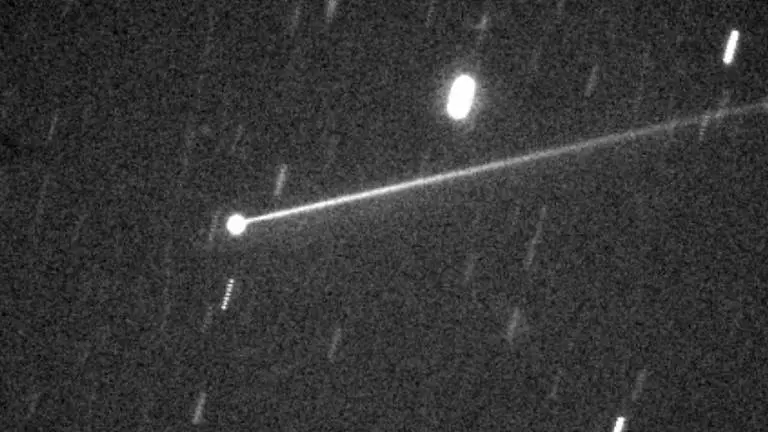
Ever since the impact, NASA and its partner -- the Italian Space Agency (ASI) -- have released dozens of images and clips showing moments before and after the historic collision. The Earth-based Southern Astrophysical Research (SOAR) Telescope in Chile also captured the aftermath which showed a debris trail from the asteroid measuring 10,000 km.

(Debris trail left by DART; Image: NOIRLab)
Advertisement
ASI's Light Italian Cubesat for Imaging of Asteroids (LICIACube), which was released from DART 15 days before the collison also passed through the impact location and beamed pictures of the obliterated Dimorphos.
Here are the pictures taken by @LICIACube of the world's first planetary defense mission.
— Argotec (@Argotec_Space) September 27, 2022
This is exactly where the #NASA #DartMission ended.
An incredible emotion, the beginning of new discoveries.
Thanks to those who made it possible.@ASI_spazio @mediainaf #LICIACube pic.twitter.com/uPqOXH3azs
🔴La missione #DART di #NASA, cui l’Italia ha partecipato con #LICIACube, cubesat di @ASI_spazio , realizzato da @Argotec_Space e il cui team scientifico è stato coordinato da @mediainaf è tra i “2022 Breakthrough of the Year”. I dettagli qui➡️https://t.co/zSchinbp9T pic.twitter.com/zUcg8bJMz9
— Agenzia Spaziale ITA (@ASI_spazio) December 16, 2022
DART was purely a technology demonstration mission which would drive the development of technologies needed for planetary defence. While many scientists suggest nuking an incoming asteroid to save Earth as a viable option, DART mission has proved that changing the asteroid's course would also be enough to avoid a catastrophe. Scientists currently continue to study the target asteroids to determine how big a spacecraft must be to divert an asteroid. This understanding would be enhanced with the European Space Agency's (ESA) HERA mission which will study the asteroid system up close after its launch in 2024.