
Earth & Moon spotted from 13 million km away by Europe's farthest photographer in space
Earth and the Moon were captured in a single frame by the Italian Space Agency's LICIACube spacecraft which launched with NASA's DART in 2021.
- Science News
- 2 min read

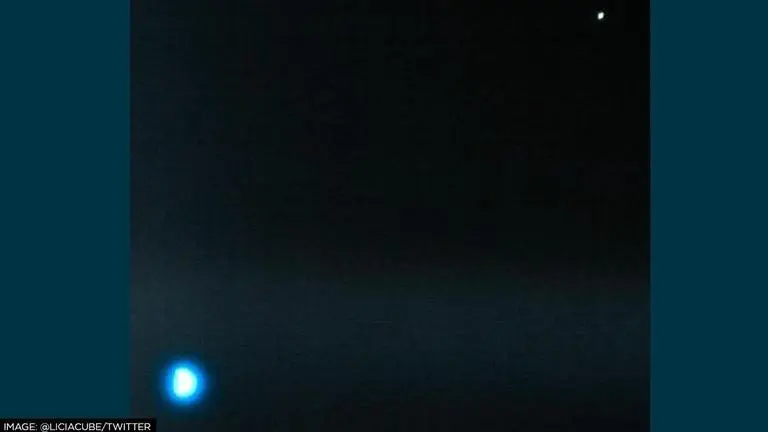
The Italian Space Agency-made LICIACube (Light Italian CubeSat for Imaging of Asteroids) satellite has sent an enthralling picture of the Earth from 13 million km away. This picture is said to have been captured by the CubeSat before witnessing the impact of NASA’s DART (Double Asteroid Redirection Test) spacecraft with an asteroid moonlet named Dimorphos.
LICIACube was launched into space while being attached to DART on November 24 in 2021 to photograph the events that transpire after the latter rams Dimorphos. However, the mission teams turned the CubeSat's camera to photograph Earth accompanied by its nearest celestial neighbour, the Moon.
🌟 The #Earth and the #Moon seen by #LICIACube
— LICIACube (@LICIACube) October 2, 2022
Before witnessing the impact of #DARTmission on #Dimorphos, the Italian satellite turned its instruments on our planet and its satellite.
An interplanetary #selfie full of charm, to wish you a happy Sunday. pic.twitter.com/NbKD88uDIR
In the picture above, the Earth can be seen as an irregularly shaped bright blue blob of light next to another irregular figure which is the Moon. LICIACube, ever since DART's collision with Dimorphos on September 27, has sent a few pictures of the aftermath showing the damage caused to the space rock.
Here are the first images taken by #LICIACube of #DARTmission impact on asteroid #Dimorphos.
— LICIACube (@LICIACube) September 27, 2022
Now weeks and months of hard work are now starting for scientists and technicians involved in this mission, so stay tuned because we will have a lot to tell! pic.twitter.com/kVz1WmcsL7
NASA's DART aces its mission
At 4:44 am IST on September 27, DART collided with Dimorphos, the target asteroid located 11 million km away, at a speed of over 22,500 km per hour. Measuring 160 metres across, Dimorphos orbits the 780-metre-wide Didymos and they are separated by a distance of around one km.
Advertisement
Launched on November 24 last year, DART is a demonstration mission to test the kinetic impactor technology with an intention to artificially change an asteroid's orbit. This technology has an unprecedented application as it will be used for planetary defense in case an asteroid comes hurtling toward our planet. The goal of the mission is to determine how much DART's impact alters the asteroid’s velocity, and this would be confirmed after the European Space Agency (ESA) sends its HERA mission in 2024.
"This is an exciting time, not only for the agency but in space history and in the history of humankind, quite frankly," Lindley Johnson, NASA's planetary defense officer, said in a news conference ahead of the collision test. ”This demonstration is extremely important to our future here on Earth".