
Updated 22 April 2022 at 20:14 IST
ESA astronaut in space successfully operates rover on Earth using new techniques
ESA astronaut, Luca Parmitano, aboard ISS was operating the rover while it was surveying and collecting rock samples in a mock lunar environment.
- Science News
- 2 min read

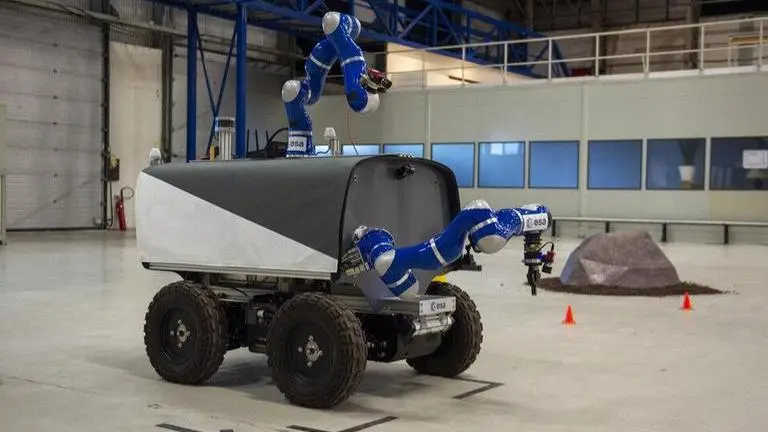
In a major technological advancement, an astronaut from the International Space Station (ISS) successfully controlled a rover on Earth. The European Space Agency (ESA) said that this was done using a technique that would help astronauts in orbit handle rovers while they explore planetary bodies. "This is the first time that an astronaut in space managed to control a robotic system on the ground in such an immersive, intuitive manner," Aaron Pereira of the German Aerospace Center (DLR) said.
If man’s best friend is a dog, then in the future astronauts’ closest companions might well be rovers.@SciRobotics covers work by @ESA & @DLR on #astronauts in orbit controlling #rovers exploring planetary bodies, tested by @astro_luca on @SpaceStation https://t.co/ZbfJD1fTbD pic.twitter.com/hncFJZx7ZF
— ESA Technology (@ESA_Tech) April 21, 2022
Idea behind the Analog-1 experiment

(Image: ESA)
The new technology is being tested under the Analog-1 experiment which first began in 2019. The simple idea behind developing this technology is to allow astronauts to remain in the comfort of their spacecraft parked in orbit of the moon or Mars while the rover treads in dangerous locations.
It was astronaut Luca Parmitano aboard the ISS, who was operating the Interact rover while it was surveying and collecting rock samples in a mock lunar environment in a facility in Valkenburg, the Netherlands. ESA revealed that the test lasted for two hours and the engineers overcame a two-way signal delay averaging more than 0.8 seconds. In the results of the test published in Science Robotics journal, the scientists revealed that they used a technique called teleoperation.
Advertisement
The experts noted that limited bandwidth video quality and the operator's feeling of immersion are impaired in space communications due to poor lighting conditions. They, however, said that this perception can be restored through the 'haptic interface', which would allow the operator to handle the rover more safely and precisely. What's exciting, is that this would even allow the operator to feel the weight of the rocks grasped by the rover or properties of the regolith such as cohesion, internal friction, and density.
"The main limitation of the work done so far is that our indoor analog lunar environment lacks realism. So this summer will see the second part of Analog-1 take place on the volcanic slopes of Mount Etna in Italy", Thomas Krueger from ESA said.
Advertisement
Published By : Harsh Vardhan
Published On: 22 April 2022 at 20:14 IST