
Updated 23 August 2022 at 16:20 IST
ESA releases water map of Mars suggesting new landing locations for astronauts
ESA has released a map of Mars showing the mineral distribution that resulted from the interaction of water with rocks on the red planet.
- Science News
- 3 min read

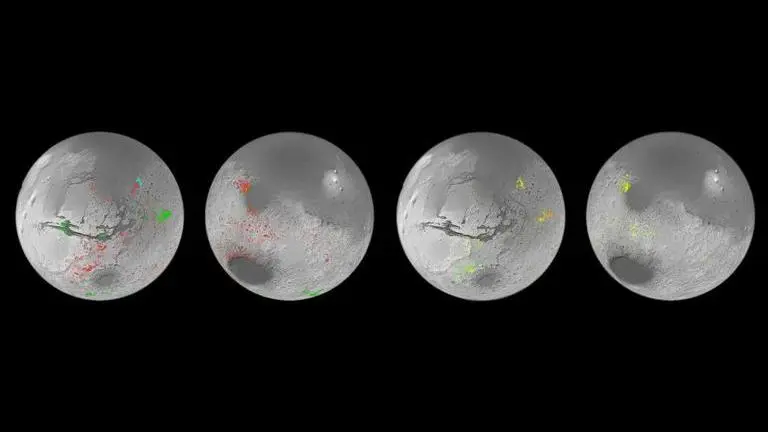
The European Space Agency (ESA) has released a new map of Mars which reveals the red planet’s mineral deposits resulting from its watery past. The agency says that this map would prove invaluable for future exploration as it would provide suitable landing locations for astronauts. Moreover, the aqueous minerals scattered around some of these locations would be extremely useful for science operations.
🆕 A new map of #Mars is changing the way we think about the planet’s watery past, and showing where we could land in the future
— ESA Science (@esascience) August 22, 2022
👉https://t.co/xIc8KPAPxM #ExploreFarther pic.twitter.com/Z3XwHVotph
What does the map reveal?
According to ESA, the map, which was created through spectral imaging by Europe’s Mars Express and NASA’s Mars Reconnaissance Orbiter, reveals regions that have aqueous minerals formed from rocks that were chemically altered by water. Most of the Martian rocks have now transformed into clay and salts and there are regions of such aqueous minerals in much higher numbers than previously thought.
Scientists previously believed that there were no more than a thousand mineral outcrops on Mars but the map has uncovered hundreds of thousands of such regions in one of the oldest areas of Mars.
“This work has now established that when you are studying the ancient terrains in detail, not seeing these minerals is actually the oddity,” John Carter, Institut d’Astrophysique Spatiale (IAS), said in an official statement.
Advertisement
Significance of the map
ESA says that the map has caused a paradigm shift in scientists’ understanding of the Martian past and it is clear now that water played a huge role in shaping the planet’s geology. After making these new discoveries, the experts are now trying to answer whether Mars had perennial water or it just saw shorter and more intense periods.
As part of this mapping campaign the clay-rich site of Oxia Planum was discovered. Studying clays can help unlock the planet’s past #climate & investigate whether life once began on #Mars. As such, Oxia Planum was selected as @ESA_MarsRover landing site 📷https://t.co/YuOzvb3R1o pic.twitter.com/bvA4R7hCxQ
— ESA Science (@esascience) August 22, 2022
“The evolution from lots of water to no water is not as clear cut as we thought, the water didn’t just stop overnight. We see a huge diversity of geological contexts so that no one process or simple timeline can explain the evolution of the mineralogy of Mars,” Carter said. “That’s the first result of our study. The second is that if you exclude life processes on Earth, Mars exhibits a diversity of mineralogy in geological settings just as Earth does”.
Advertisement
Further talking about the map's significance, the experts said that it provides candidate landing sites on Mars for reasons such as the presence of water molecule-bearing aqueous minerals. This could prove beneficial for the extraction of water and its usage on human bases. The second reason, as per ESA, is that they are perfect sites to investigate whether life once began on Mars.
Published By : Harsh Vardhan
Published On: 23 August 2022 at 16:09 IST