
Updated 10 September 2022 at 23:33 IST
ESA shares riveting video of Tarantula Nebula made using James Webb Space Telescope; WATCH
ESA has shared a new video offering an opportunity to dive into the Tarantula Nebula, which was recently photographed by the James Webb Space Telescope.
- Science News
- 2 min read

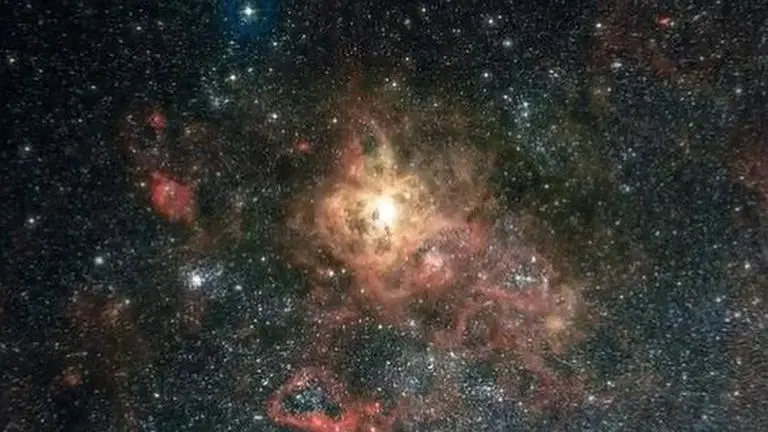
Just a few days after the James Webb Space Telescope delivered the clearest image of the Tarantula nebula, a video has surfaced offering a riveting view of the star factory from a new perspective. Named the Tarantula Nebula (formally called 30 Doradus), the photographed structure is located in the Large Magellanic Cloud which lies around 1,60,000 light-years away. The video was shared by the European Space Agency (ESA), one of the developers of the Webb telescope, offering an opportunity to dive into the stellar nursery.
🎥 Fall into the spider's web in this new video from NASA/ESA/CSA James #Webb Space Telescope which zooms into 30 Doradus, nicknamed the Tarantula Nebula 🕷 👉 https://t.co/wiDso3seDM #JWST pic.twitter.com/X3eT6W3ZwE
— ESA (@esa) September 10, 2022
The views in the video are a result of observation using three Webb instruments-- the Near-Infrared Camer (NIRCam) and the Near-Infrared Spectrograph (NIRSpec) and the Mid-Infrared Instrument (MIRI). These instruments, which are extremely sensitive to infrared, allow the telescope to easily peer through thick cosmic dust, as compared to the Hubble telescope which is relatively weaker in similar terms.

(Webb telescope's view of the Tarantula Nebula using MIRI; Image: NASA/ESA/CSA/STScI)

(Webb telescope's view of the Tarantula Nebula using NIRCam; Image: NASA/ESA/CSA/STScI)
Advertisement
More about the historic image
This Webb caught a giant space tarantula! 🕸️ Take a moment to stare into thousands of never-before-seen young stars in the Tarantula Nebula. @NASAWebb reveals details of the structure and composition of the nebula, as well as background galaxies: https://t.co/DZePgDpPEH pic.twitter.com/aSmPDqgKTE
— NASA (@NASA) September 6, 2022
The region of the nebula shown in the image is from an area that stretches 340 light-years across and features an entire cluster of newly formed stars never observed before. This cluster is composed of sparkling blue stars which represent an active star-forming region in the lower part of the image and next to it is a cavity that has been formed from the radiation being thrown out by these young stars.
In addition to this, Webb has also captured a young star emerging from a pillar of dust, thanks to NIRSpec, and according to astronomers, this star is not as old as it was initially thought to be. They also say that the Tarantula Nebula would help them answer what the universe was like in its initial stages.
Advertisement
"Webb will provide astronomers the opportunity to compare and contrast observations of star formation in the Tarantula Nebula with the telescope’s deep observations of distant galaxies from the actual era of cosmic noon", says NASA.
Published By : Harsh Vardhan
Published On: 10 September 2022 at 23:32 IST