
ESA unveils ambitious project to slash greenhouse gas emissions due to rocket launches
ESA, along with its partner, the French space agency CNES introduced the HYGUANE project to encourage green-hydrogen usage for rocket launches.
- Science News
- 2 min read

;'%3e%3cpath%20d='m8,15.99c4.41,0,7.99-3.58,7.99-7.99S12.41,0,8,0,0,3.59,0,8s3.58,7.99,7.99,7.99Z'%20style='stroke:%23fff;%20stroke-miterlimit:10;%20stroke-width:.02px;'/%3e%3cpath%20d='m3.08,3.37l3.82,5.11-3.84,4.15h.87l3.37-3.64,2.72,3.64h2.94l-4.04-5.39,3.58-3.87h-.86l-3.1,3.35-2.5-3.35h-2.94Zm1.27.64h1.35l5.97,7.99h-1.35l-5.97-7.99Z'%20style='fill:%23fff;'/%3e%3c/g%3e%3c/svg%3e)


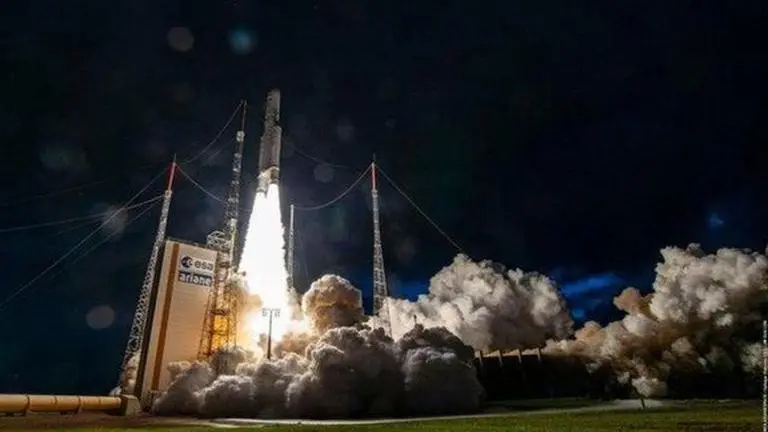
The European Space Agency (ESA), on June 28, revealed that it has partnered with the French space agency CNES to initiate a project named HYGUANE (HYdrogène GUyanais A Neutralité Environnementale). Aimed at slashing greenhouse gas emissions due to rocket launches, the project will see a pilot plant installed at Europe's spaceport in French Guiana. ESA says that this plant would produce 130 tons of green hydrogen, which would power rockets and thus reduce the use of conventional fuels.
#EuropeSpacePort going green with hydrogen plan to slash CO2 emissions by several thousand tons per year @Ariane6 @Ariane5 https://t.co/r1zshC4KGN pic.twitter.com/9dfvtFRWN9
— Ariane 6 (@Ariane6) June 28, 2022
HYGUANE's primary goal would be to replace “grey” hydrogen, which is produced by a widely used but energy-intensive industrial process called methanol steam reforming, with “green” hydrogen-- produced by water electrolysis from renewable energy. In addition to this, the hydrogen eco-system to be introduced by this project would also introduce the transport of people and goods through hydrogen-fuelled vehicles and start the trend of using hydrogen fuel cells for energy storage.

(ESA's spaceport in French Guiana; Image: ESA)
"HYGUANE will put us well ahead of COP21 and European Green Deal emissions objectives," Daniel Neuenschwander, ESA Director of Space Transportation said in a statement. "The number of launches is growing rapidly, so now is the right time to invest. A green hydrogen system will support environmental sustainability, stabilise costs and protect Spaceport operations from energy supply disruption."
Advertisement
Rocket launches would damage the ozone layer, study warns
A recent study conducted by the U.S. National Oceanic and Atmospheric Administration (NOAA) has warned that the carbon emissions due to rocket launches would damage the ozone layer and change atmospheric circulation patterns. Published in the Journal of Geophysical Research Atmospheres, the study revealed that the rocket launch rates have tripled in recent decades and they are the only direct source of human-produced aerosol pollution above the troposphere, which is 6.5-9.5 km above the Earth's surface.
What's more, the authors of the study estimate that around 1,000 tons of rocket soot exhaust are emitted annually and at this rate, annual temperatures in the stratosphere would increase by 0.5-2° Celsius. "The bottom line is that projected increases in rocket launches could expose people in the Northern Hemisphere to increased harmful UV radiation", lead author Christopher Maloney, a research scientist working in NOAA’s Chemical Sciences Laboratory said in an official statement.