
Updated 15 August 2022 at 17:10 IST
ESA's Gaia spacecraft predicts future of our Sun; Here's how long before it 'dies'
ESA recently revealed its Gaia database which included information about millions of sun-like stars and their properties like surface temperature, size & mass.
- Science News
- 3 min read

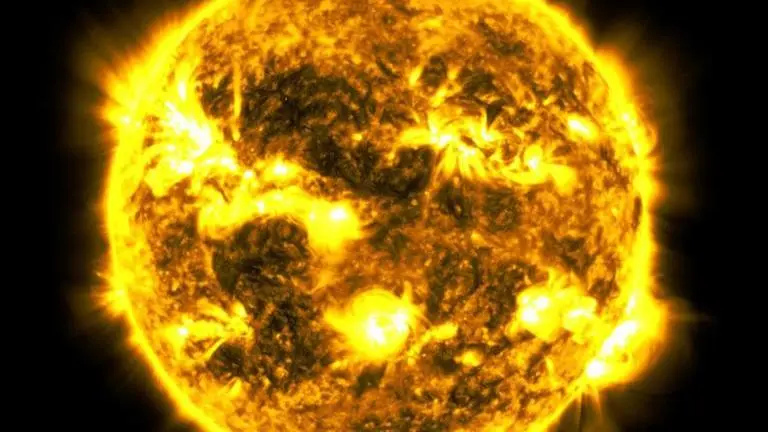
Our sun, which is currently in its comfortable middle age, was formed around 4.57 billion years ago and has since undergone a long process of evolution. According to astronomers, this evolutionary process will continue for billions of more years before the sun’s fuel runs out and it starts turning into a red-giant star. Thanks to the European Space Agency’s (ESA) Gaia telescope, we now know how the sun would behave at what stage of its life and when it would enter its last phase.
Wish you could look into the future? 🔮
— ESA Science (@esascience) August 11, 2022
Thanks to star-mapping mission @ESAGaia we can, to see how our Sun is going to evolve in the future 💫
Find out more👉https://t.co/qRYF1A3J9Y #ExploreFarther pic.twitter.com/LmUfOgJn1M
The sun's current status
According to ESA, the sun is currently in its middle age and is rather stable as it continues fusing hydrogen into helium to keep itself alive. We already know a bit about the history of our sun as it came into existence through the general process of star formation. This process begins when turbulence starts within thick dust and gas clouds scattered across a particular region in space which then gives birth to knots within those clouds.
When the gas and dust of these knots gain sufficient mass, they collapse and start heating and eventually evolve into stars. As for the future of the sun, it involves turning into a red giant star, according to Gaia data. These predictions were made through the observations by ESA's Gaia which released a database of the intrinsic properties of hundreds of millions of stars in June this year.
This database includes information about the stars and their properties such as how hot they are, how big they are, and what masses they contain.
Advertisement

(Illustration of different types of stars and their evolutionary phases; Image: ESA)
The sun's future
After going well past its middle age, the sun will swell into a red giant star after its fuel runs out and the fusion process stops. A star keeps itself alive through nuclear reactions which occur during the fusion of hydrogen in its core. When the sun turns into a red giant star, its surface temperature would significantly reduce.
Advertisement
Interestingly, astronomers estimate that our sun will reach its maximum temperature around eight billion years from its formation period and turn into a red giant between 10-11 billion years of its age.
It is after this stage that the sun will reach its final few years before turning into a dim white dwarf star. "If we don't understand our own Sun – and there are many things we don't know about it – how can we expect to understand all of the other stars that make up our wonderful galaxy", astronomer Orlagh Creevey from Observatoire de la Côte d’Azur in France said in an official statement. Scientists also believe that studying other sun-like stars is the key to understanding our universe better.
Published By : Harsh Vardhan
Published On: 15 August 2022 at 16:39 IST