
Updated 14 August 2022 at 20:55 IST
ESO shares new image of golden starburst galaxy brimming with newly formed stars
ESO revealed that the new photograph features the starburst galaxy NGC 4303, also known as Messier 61 using the Very Large Telescope based in Chile.
- Science News
- 2 min read

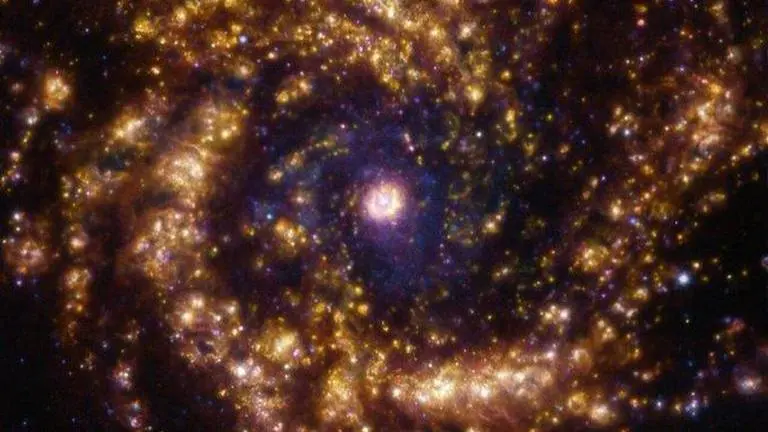
The European Southern Observatory (ESO) recently shared a picture of the spiral galaxy NGC 4303, also known as Messier 61, which is observed by astronomers as it is a laboratory of star formation. According to ESO, this galaxy is one of the largest galactic members of the Virgo Cluster and is categorised as a starburst galaxy. These types of galaxies are the ones that undergo a high rate of star formation, higher than the rate observed in other types of galaxies.
Our latest Picture of the Week features the spiral galaxy NGC 4303, observed with the MUSE instrument at our VLT. Clouds of ionised oxygen, hydrogen and sulphur are shown in blue, green and red, signalling ongoing star formation.
— ESO (@ESO) August 1, 2022
🔗 https://t.co/zjmxkKYUri
Credit: @ESO /PHANGS pic.twitter.com/fswK0HETHE
In the picture above, different areas and elements in the galaxy are represented by different colours. "Gas clouds of ionised oxygen, hydrogen and sulphur are shown in blue, green and red, signalling ongoing star formation", ESO said in a statement.
The process of star formation begins when clouds of dust and cold gas gather and collapse. ESO explains that the energetic radiation from newly born stars will heat and ionise the surrounding remaining gas. This ionised gas will then shine representing the rigorous process of star formation as seen in the above image. The whirlpool of gold featured in the picture is the direct traces of newly born stars.
Explaining the process of imaging this galaxy, ESO said that the golden glow is a result of combining observations taken at different wavelengths of light with the Multi-Unit Spectroscopic Explorer (MUSE) instrument on ESO’s Very Large Telescope (VLT) in Chile. It further revealed that this imaging was part of the Physics at High Angular resolution in Nearby GalaxieS (PHANGS) project which aims at photographing galaxies at all wavelengths.
Advertisement
Observing star formation
Last week, the ESO shared another dazzling image of a star-forming region churning out stars from thick dust clouds. Named Lupus 3, this region is known for producing new stars after the gas and dust get concentrated in a region and collapse. "This image was created from images taken using the VLT Survey Telescope and the MPG/ESO 2.2-metre telescope and is the most detailed image taken so far of this region", ESO said about the image below.
ESO #Flashback: This dense cloud is a star-forming region called Lupus 3, where dazzlingly hot stars are born from collapsing gas and dust.
— ESO (@ESO) August 1, 2022
🔗 https://t.co/gTTbFCMyzR
Credit: @ESO / R. Colombari pic.twitter.com/fluubWCc5z
Published By : Harsh Vardhan
Published On: 14 August 2022 at 20:55 IST