
Updated 21 August 2022 at 20:38 IST
ESO's telescope captures enthralling cosmic dance after collision of two massive galaxies
ESO's Very Large Telescope has captured the clearest image of the galaxy NGC 7727 which was formed after the collision of two smaller galaxies.
- Science News
- 2 min read

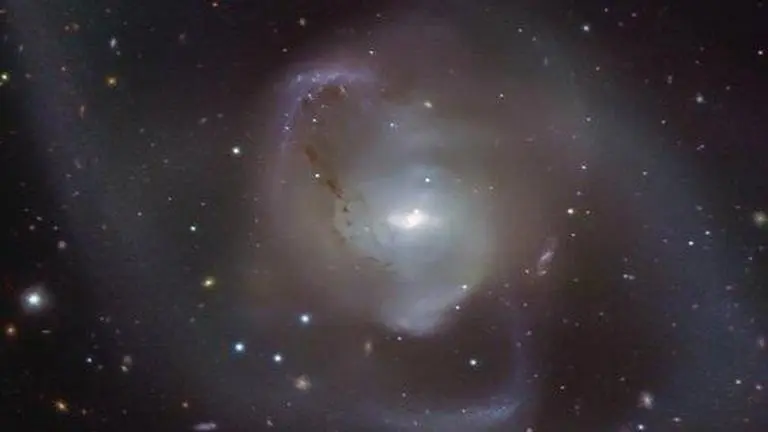
The European Southern Observatory's Very Large Telescope (ESO's VLT) has managed to capture a spectacular picture of the aftermath of two galaxies that collided with each other. This collision, which took place around a billion year ago, is said to have birthed a new galaxy named NGC 7727 which now has the closest pair of supermassive black holes ever found at its center. According to ESO, the two black holes "are destined to coalesce into an even more massive black hole".
1/ Our VLT has imaged the result of a spectacular cosmic collision — the galaxy NGC 7727. This giant was born from the merger of two galaxies. At its centre lies the closest pair of supermassive black holes ever found.
— ESO (@ESO) August 16, 2022
Full story: 🔗 https://t.co/AXSKjDKzuc
Details 👇 pic.twitter.com/S8XUXTXdy7
What did the VLT see?
ESO says that this image taken using the VLT's FOcal Reducer and low dispersion Spectrograph 2 (FORS2) instrument shows the main body of the galaxy and the faint 'tails' around it in much more detail. The 'tails' being referred to here are the streaks of gas and dust that are spinning around the galaxies to form the disordered and asymmetrical NGC 7727. However, when two galaxies bump into each other, the individual stars do not individually collide since the distance between them is very large.
The image also shows two bright points at the center of the galaxy which consists of the original two galactic cores which have not one but two supermassive black holes. Astronomers estimate that the black hole pair is about 89 million light-years away from Earth, in the constellation of Aquarius, and is the closest one known to date. Interestingly, these black holes are around 1,600 light-years apart and will merge 250 million years from now. "When the black holes merge they will create an even more massive black hole", ESO said in a statement.
6/ The core of NGC 7727 consists of the original two galactic cores, each hosting a supermassive black hole — the closest pair of supermassive black holes to us.
— ESO (@ESO) August 16, 2022
Credit: @ESO /Voggel et al. pic.twitter.com/tHqUpgpwzK
Interestingly, similar is the fate of the supermassive black hole in the Milky Way's galactic center, as it will collide with its counterpart in the Andromeda galaxy in a few billion years. ESO recently released the picture of the supermassive black hole in our galaxy which lies approximately 27,000 light-years away from our planet.
Advertisement
This black hole is four million times more massive than the sun and was the second such entity to get directly photographed. The first was the black hole in the galaxy Messier 87 which lies 55 million light-years from Earth and is 6.5 billion times more massive than the sun.
📢 Breaking news: Meet the Black Hole at the Centre of our Galaxy! Astronomers have unveiled the 1st image of the supermassive black hole at the centre of the Milky Way. The image was produced by a global research team @ehtelescope 📷EHT Collaboration pic.twitter.com/xcB3qt4La4
— ESO (@ESO) May 12, 2022
Published By : Harsh Vardhan
Published On: 21 August 2022 at 20:38 IST