
Evidence of dark matter dating back to 12 billion years ago discovered for the first time
Japan's Nagoya University-led study revealed that the discovery of the mysterious dark matter was detected around galaxies that existed 12 billion years ago.
- Science News
- 3 min read

;'%3e%3cpath%20d='m8,15.99c4.41,0,7.99-3.58,7.99-7.99S12.41,0,8,0,0,3.59,0,8s3.58,7.99,7.99,7.99Z'%20style='stroke:%23fff;%20stroke-miterlimit:10;%20stroke-width:.02px;'/%3e%3cpath%20d='m3.08,3.37l3.82,5.11-3.84,4.15h.87l3.37-3.64,2.72,3.64h2.94l-4.04-5.39,3.58-3.87h-.86l-3.1,3.35-2.5-3.35h-2.94Zm1.27.64h1.35l5.97,7.99h-1.35l-5.97-7.99Z'%20style='fill:%23fff;'/%3e%3c/g%3e%3c/svg%3e)


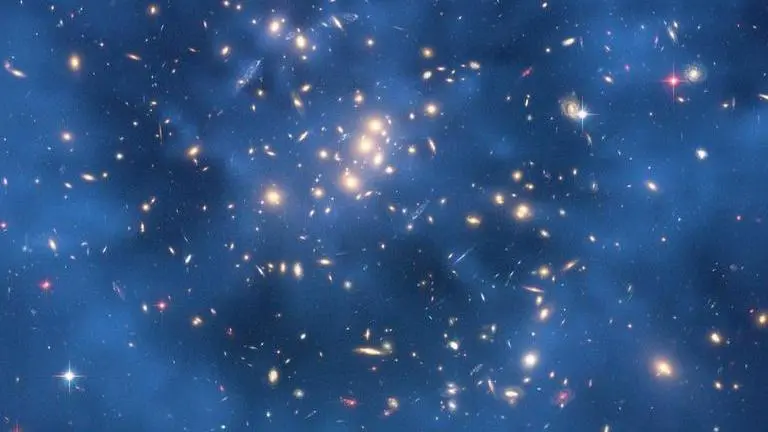
An international team of researchers led by Japan's Nagoya University has discovered traces of dark matter surrounding galaxies located about 12 billion light-years away. In their findings published in the journal Physical Review Letters, the experts claim that this is the earliest evidence of dark matter and suggested that the fundamental rules of cosmology may have been entirely different when the universe was born around 13.7 billion years ago.
The study also says that most of the previously conducted studies cannot analyse dark matter beyond 8-10 billion years ago, which leaves a questionable window of time between the said period and the birth of the universe.
Defining dark matter
NASA defines dark matter as the invisible substance that makes up most of the universe’s mass and creates its underlying structure. The existing theories also suggest that dark matter is the cosmic glue that holds together massive entities such as stars and galaxy clusters together as they fill the space in between the said entities. It is also believed that dark matter's gravity drives normal matter such as gas and dust to collect and build up into stars and galaxies.
According to scientists, dark matter makes up about 27% of the universe that we cannot see, whereas the rest is composed of dark energy (about 68%). Whatever's left, roughly 5%, is the matter that we can see in the observable universe.
Advertisement
The historic discovery
The latest discovery of dark matter resulted after Nagoya University experts collaborated with the University of Tokyo, the National Astronomical Observatory of Japan, and Princeton University to study the microwaves released from the Big Bang itself.
The teams used the Subaru Hyper Suprime-Cam Survey (HSC) and identified 1.5 million lens galaxies that were seen as they were 12 billion years ago, using visible light. It is worth noting that objects such as planets and galaxies are seen as they were when the light first emerged from them and reached us. For example, the sun's light takes around eight minutes to reach us, meaning we see the sun as it was eight minutes ago. Similarly, a galaxy located 12 billion light-years away is seen as it was 12 billion years ago.
Advertisement
The lens galaxies being referred to above are the galaxies that bend the light emerging from a source behind them and magnify it. NASA says that dark matter can be detected by observing how galaxy clusters that contain dark matter, bend and distort the light of more-distant galaxies located behind them.
As for the microwaves mentioned above, they were used to measure how the dark matter around the extremely distant lens galaxies distorted the microwaves. "I was happy that we opened a new window into that era 12 billion years ago, things were very different. You see more galaxies that are in the process of formation than at the present; the first galaxy clusters are starting to form as well," Hironao Miyatake from Nagoya University said.