
Explainer: Why does Elon Musk's SpaceX Starship rocket matter?
The original trial was slated for Monday, which was delayed after a booster valve froze. SpaceX has said that it has learnt a lot from the trial.
- Science News
- 5 min read

;'%3e%3cpath%20d='m8,15.99c4.41,0,7.99-3.58,7.99-7.99S12.41,0,8,0,0,3.59,0,8s3.58,7.99,7.99,7.99Z'%20style='stroke:%23fff;%20stroke-miterlimit:10;%20stroke-width:.02px;'/%3e%3cpath%20d='m3.08,3.37l3.82,5.11-3.84,4.15h.87l3.37-3.64,2.72,3.64h2.94l-4.04-5.39,3.58-3.87h-.86l-3.1,3.35-2.5-3.35h-2.94Zm1.27.64h1.35l5.97,7.99h-1.35l-5.97-7.99Z'%20style='fill:%23fff;'/%3e%3c/g%3e%3c/svg%3e)


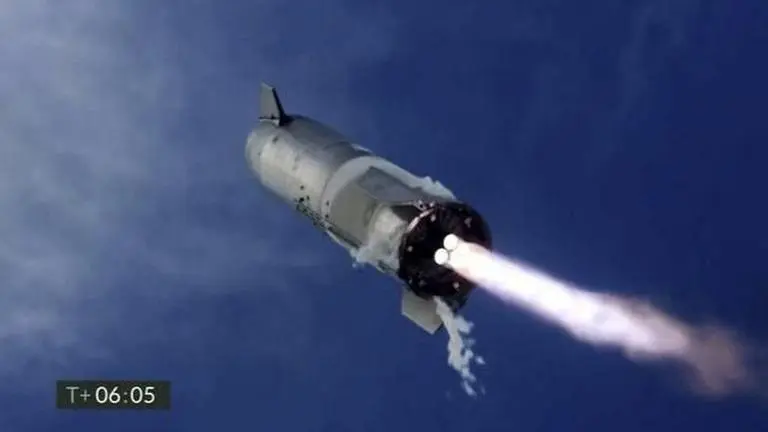
SpaceX's biggest rocket, Starship, conducted its first trial on Thursday, April 20. According to a statement from SpaceX, "Starship experienced a rapid unscheduled disassembly before stage separation." The original trial was slated for April 17, which was delayed after a booster valve froze. SpaceX has said that it has learnt a lot from the trial. So, what does Starship matter?
Well, space exploration has long been a fascinating endeavour for humanity, and with the advent of commercial space companies, new possibilities have emerged for pushing the boundaries of human space travel. Among these companies, SpaceX, founded by entrepreneur Elon Musk in 2002, has emerged as a leading force in the space industry, with its ambitious vision of making humanity a multi-planetary species. Central to SpaceX's vision is its ambitious spacecraft, the Starship, which holds significant importance for NASA, the United States' national space agency, as well as for the future of human space exploration.
Here is what you need to know about Starship
The Starship is a fully reusable spacecraft designed to carry both crew and cargo to a variety of destinations, including Earth orbit, the Moon, Mars, and beyond. It is a fully stainless-steel spacecraft with a distinctive sleek design, measuring approximately 50 meters in length and 9 meters in diameter. It is designed to be versatile and modular, with the ability to carry a variety of payloads, including satellites, scientific instruments, and humans, to various destinations in space.
One of the key reasons why the Starship is important for NASA is its potential to significantly reduce the cost of space exploration. Traditional spacecraft, such as NASA's Space Shuttle, were only partially reusable, with the majority of the spacecraft being discarded after each mission. This led to high costs associated with building new spacecraft for each mission. In contrast, the Starship is designed to be fully reusable, with the ability to land back on Earth after each mission. This reusability factor has the potential to significantly lower the cost of accessing space and conducting missions, making space exploration more cost-effective and sustainable in the long run.
Advertisement
Moreover, the Starship's payload capacity is significantly higher than any other spacecraft currently in operation, with the ability to carry up to 150 metric tons to low Earth orbit (LEO). This makes it a highly capable spacecraft for delivering large payloads, such as scientific instruments and space telescopes, to space. This increased payload capacity opens up new possibilities for conducting cutting-edge scientific research and exploration, including studying the origins of the universe, searching for extraterrestrial life, and understanding the mysteries of the cosmos.
In addition to its cost-effectiveness and payload capacity, the Starship's versatility and modularity are also of great significance to NASA. The spacecraft is designed to be adaptable and can be configured for various missions, from crewed missions to the International Space Station (ISS) to lunar landings and interplanetary missions. This flexibility allows NASA to use the Starship for a wide range of purposes, including scientific research, technology demonstrations, and human exploration of other celestial bodies, such as the Moon and Mars.
Advertisement
Furthermore, the Starship has the potential to play a crucial role in NASA's Artemis program, which aims to land astronauts on the Moon and establish a sustainable human presence on the lunar surface. NASA has already awarded SpaceX a contract to provide lunar lander services for the Artemis program, and the Starship is expected to be a key component of this effort. With its ability to carry both crew and cargo to the Moon, the Starship could provide a cost-effective and reliable means of transportation for NASA's lunar missions, enabling the agency to achieve its ambitious goals of human exploration of the Moon and beyond.
However, it is worth noting that the development of the Starship has not been without challenges. SpaceX has faced setbacks, including failed prototype tests and technical issues, which are inherent to the development of cutting-edge space technology. Nevertheless, the company has persisted in its efforts, constantly iterating and improving the design of the Starship, demonstrating SpaceX's determination to push the boundaries of space exploration.
The Starship's potential significance for NASA goes beyond its technical capabilities. The partnership between SpaceX and NASA also highlights the evolving landscape of space exploration, with increasing involvement of commercial space companies in government space programs. NASA's collaboration with SpaceX on the Starship program exemplifies the agency's efforts to leverage private sector innovation and expertise to advance its exploration goals, while also fostering competition and driving down costs.
Furthermore, the success of the Starship could have broader implications for the future of space exploration beyond NASA. If SpaceX's vision of making humanity multi-planetary becomes a reality, the Starship could serve as a stepping stone for future human missions to destinations like Mars, opening up new frontiers for human civilization. The Starship's potential to enable interplanetary travel could revolutionize the way we explore and settle other celestial bodies, paving the way for future generations to expand the horizons of human existence.