
Giant 'potentially hazardous' asteroid 1994 PC1 flies safely by Earth
NASA updated that the 3,400-foot (1-kilometer) asteroid will get no closer than 5 lunar distances during its closest approach to our planet.
- Science News
- 3 min read

;'%3e%3cpath%20d='m8,15.99c4.41,0,7.99-3.58,7.99-7.99S12.41,0,8,0,0,3.59,0,8s3.58,7.99,7.99,7.99Z'%20style='stroke:%23fff;%20stroke-miterlimit:10;%20stroke-width:.02px;'/%3e%3cpath%20d='m3.08,3.37l3.82,5.11-3.84,4.15h.87l3.37-3.64,2.72,3.64h2.94l-4.04-5.39,3.58-3.87h-.86l-3.1,3.35-2.5-3.35h-2.94Zm1.27.64h1.35l5.97,7.99h-1.35l-5.97-7.99Z'%20style='fill:%23fff;'/%3e%3c/g%3e%3c/svg%3e)


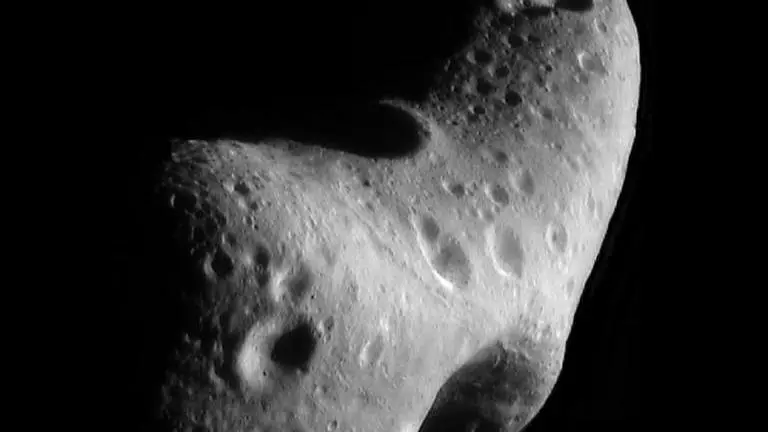
A gigantic hazardous asteroid 1994 PC1 approximately the size of the Empire State Building passed close to the Earth's orbit on Tuesday afternoon, although it maintained a safe distance so as to not hit the habitable planet, according to NASA asteroid watch. The asteroid passed at a distance of 1.2 million miles or 1.9 million kilometres, at about five times the distance between the Earth and Moon and hence averting a mega-disaster. Another asteroid will similarly pass the Earth in this vicinity on July 3. 7482 (1994 PC1) measured at a diameter of about 1km and is classified as an Apollo asteroid by NASA.
Near-Earth #asteroid 1994 PC1 (~1 km wide) is very well known and has been studied for decades by our #PlanetaryDefense experts. Rest assured, 1994 PC1 will safely fly past our planet 1.2 million miles away next Tues., Jan. 18.
— NASA Asteroid Watch (@AsteroidWatch) January 12, 2022
Track it yourself here: https://t.co/JMAPWiirZh pic.twitter.com/35pgUb1anq
At distance of below 0.05 astronomical units or 7.5 million km from Earth
Asteroid 1994 PC1 came at a distance of below 0.05 astronomical units or 7.5 million km from Earth, a distance which is considered hazardous by astronomers. The celestial object made its closest approach yet for the next 200 years as it passed apparently 1 million miles from Earth, but safely. While it made the encounter, Italy's Virtual Telescope Project, which is based in Rome, hosted a Livestream starting at 3 p.m. EST (2000 GMT) for the viewers.
At the time of streaming, the asteroid 7482 (1994 PC1) was almost at its closest approach to the Earth: 1 million miles or 1.6 million kilometers. "The Virtual Telescope Project will show it live online, just at the fly-by time, when it will peak in brightness," the live stream page mentioned, according to the project founder Gianluca Masi.
@NASA watches the skies every night to continuously find, track, and monitor near-Earth objects (#NEOs), and all data on newly-discovered asteroids are publicly available: https://t.co/ocjetQM9X4
— NASA Asteroid Watch (@AsteroidWatch) January 12, 2022
Just another day for NASA's #PlanetaryDefense Coordination Office. pic.twitter.com/FrjNOPD8bP

Astronomers captured asteroid (7482) 1994 PC1 during a flyby of Earth in 1997. The space rock appears as a trail due to its very fast apparent motion. [Credit: Sormano Astronomical Observatory in Italy]
Advertisement
Center for Near-Earth Object Studies (CNEOS), managed by NASA at the agency's Jet Propulsion Laboratory in California estimated that the asteroid’s closest path with that of the Earth was at 4:51 p.m. EST (2151 GMT). NASA updated that the 3,400-foot (1-kilometer) asteroid will get no closer than 5 lunar distances during its closest approach to our planet.
According to the space administration, the average distance from Earth to the moon, 1 lunar distance, is about 238,855 miles (384,400 km), and the comets and asteroids that come within 1.3 astronomical units (120.9 million miles, or 194.5 million km) qualify as near-Earth objects (NEOs). However, as the gigantic asteroid made its flyby, there were no impending threats to worry the humans.