
Gottfried Kirch discovered the 'Great Comet of 1680' on this day in 1680
The comet was first observed by the German astronomer, Gottfried Kirch in the seventeenth century as it trailed towards the sun in close perihelion
- Science News
- 2 min read

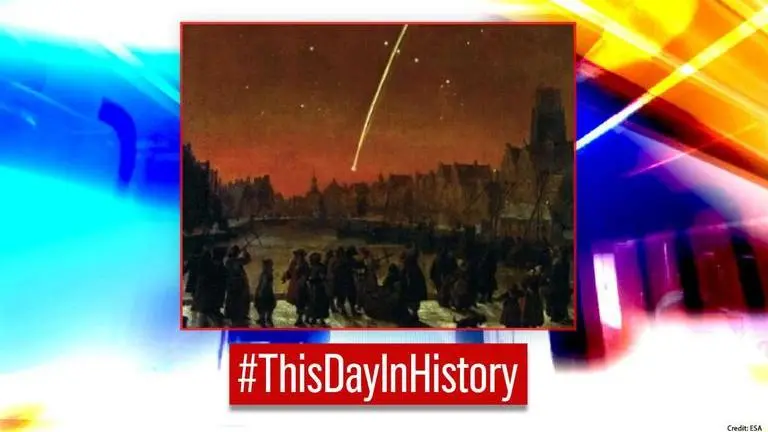
On this day November 14, a comet, known as the Kirch's Comet or the Great Comet of 1680-1681 A.D, C/1680 V1 was discovered. Like the comet ISON, the Comet Kirch was one of the brightest spotted that approached fast towards the sun and disintegrated. The comet was first observed by the German astronomer, Gottfried Kirch in the seventeenth century as it trailed towards the sun in close perihelion. The bright object was spotted in the sky by a group of sungazers -- Kreutz group in Rotterdam, Netherlands. However, Kirch became the first person to discover the comet using a telescope.
Going by the cometary trajectory, the object was first identified as two separate comets in late 1680 and early 1681. However, the comet reached its brilliance with its tail extended 70 degrees, coming further closer to the sun covering the sixteenth part of its diameter at only about 540,000 miles. Comet orbited the sun at the speed of 1,200,000 miles an hour, and its long tail was depicted in a painting by Lieve Versheier. The Kirch's comet lit up the night-time skies, and was even briefly visible in broad daylight according to NASA, and had a remarkably similar orbit to that of Comet ISON. The C/1680 V1 (Kirch), was also known as Newton’s comet as it became the first comet to be discovered via a telescope.
Advertisement

[In 1680, Kirch's comet lit up the nighttime skies and was even briefly visible in broad daylight with a remarkably similar orbit to that of Comet ISON. Credit: NASA]
Observed #OTD by German astronomer Gottfried Kirch, the Great Comet of 1680! Follow the comet's progress among the constellations in this 1681 star chart. #DibnerLibraryDC #constellations #comets https://t.co/VZjpPqNW1g pic.twitter.com/O7t1rCHG1y
— SmithsonianLibraries (@SILibraries) November 14, 2017
New collection entry: Comet C/1680 V1 over Augsburg, Germany in a copper engraving by Jacob Koppmeir ca. 1680. https://t.co/Jo3DyeJtbW pic.twitter.com/HevSahLX1p
— Maik Meyer (@skymorph) November 18, 2016
Longitude of ascending node
“C/1680 V1 passed just 0.42AU (~62-million kilometers, or ~39-million miles) from Earth, and just a couple of weeks after that, on Dec 18, 1680, grazed a mere 0.006AU (~900,000km, 550,000miles) from the Sun,” according to a report by Science daily Journal. Unlike the comet ISON, Kirch brightened its thin arcing tail as it raced closer to the sun, but the objects shared "longitude of the ascending node”. Kirch comet stood at 277-degrees while the distance from the sun for ISON was 295-degrees. For a long, scientists assumed ISON would meet the same fate as Kirch that disintegrated into space.
Advertisement
The great comet of 1680 was the first comet to be observed via a telescope. And it was the first comet to appear on an egg. In Rome. Maybe.
— Daniel Bellingradt (@dbellingradt) October 29, 2020
A media event started around these god sent signs on an egg delivered by an inspired hen in Rome when the rumor was printed.
1/2 pic.twitter.com/EGfnOb0fF4
The Great Comet of 1680 pic.twitter.com/7SSeY1NQxE
— Archangel Hammy 🌞🍄🍀🤹🏻♂️🌹🃏readings open!!! (@TetramorphAngel) October 29, 2020
An 1883 woodcut of a two-century old #comet: the "Great Comet" of 1680, sometimes known as "Newton's comet" because he used it to test Kepler's laws of motion. #historyofscience pic.twitter.com/aSzM8LD6G6
— Emily Thomas (@emilytwrites) June 5, 2020
Quick note and sketch of a comet found in a book of astronomical tables: maybe the 'great comet' of 1680? pic.twitter.com/TMPmzV0Q5k
— Marsh's Library (@MarshsLibrary) January 9, 2016