
Halloween special: NASA's Webb telescope treats astro geeks with eerie Pillars of Creation
NASA has released another image of the Pillars of Creation taken using the Webb telescope's MIRI which specialises in detecting cosmic dust.
- Science News
- 2 min read

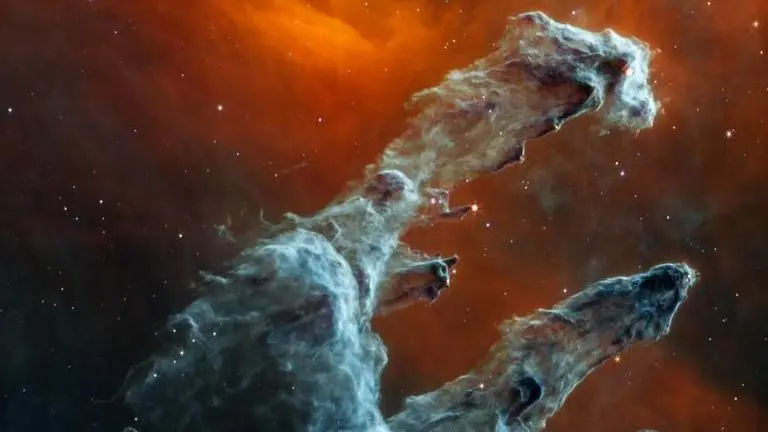
With the festival of Halloween just around the corner, NASA has released another picture of the Pillars of Creation which is rather spooky. Observed using the James Webb Space Telescope’s Mid-Infrared Image (MIRI), the picture details the wide-spanning clouds of dust and gas which run light years in terms of distance. These towering pillars are composed of cosmic dust and gas that sit at the heart of M16, or the Eagle Nebula.
You can’t escape its clutches.
— NASA Hallo-Webb Telescope 🕸🕷🎃 (@NASAWebb) October 28, 2022
Just in time for #Halloween, the Pillars of Creation reach back out like a ghostly hand. The eerie landscape, captured this time by Webb’s mid-infrared instrument (MIRI), spotlights ancient curtains of dust in new detail: https://t.co/Y9QQBf9nYM pic.twitter.com/rumIH8J6rX
The agency explained that Webb presented an eerie view of the iconic cosmic landscape because MIRI is specialised in pinpointing the location of dust. Moreover, the stars aren’t bright enough at these wavelengths to appear and thus the picture is entirely different from the one taken using the Near Infrared Camera (NIRCam).
According to NASA, the Mid-infrared light MIRI is designed for, excels at observing gas and dust in extreme detail. The agency pointed out that the densest areas of dust in the picture are the darkest shades of gray and the red region on the top is the location where the dust is diffuse and cooler. It is also MIRI's feature why there are no background galaxies in the image because the thick region of gas and dust in and around the pillars do not allow the penetration of their distant light. Interestingly, the bright red star at the topmost pillar and the dust shrouding it are larger than the size of our entire solar system.
A new view of the Pillars of Creation
This is what you’ve waited for.
— NASA Hallo-Webb Telescope 🕸🕷🎃 (@NASAWebb) October 19, 2022
Journey with us through Webb’s breathtaking view of the Pillars of Creation, where scores of newly formed stars glisten like dewdrops among floating, translucent columns of gas and dust: https://t.co/5ea1kCzU5x
Here’s your guided tour ⬇️ pic.twitter.com/jFiDDrMUPl
The Pillars of Creation were first imaged by the Hubble Space Telescope and have since been observed by other observatories such as the Spitzer Space Telescope. The latest observations come from Webb which photographed the cosmic landscape using its NIRCam.
Advertisement
If this majestic landscape looks familiar, you may recognize the original. Here, @NASAHubble’s iconic view, taken in visible light, is on the left. Webb “sees” in infrared light invisible to our eyes, allowing it to pierce through the dust and reveal stars galore (right). pic.twitter.com/iZVXOhcuRH
— NASA Hallo-Webb Telescope 🕸🕷🎃 (@NASAWebb) October 19, 2022
While explaining the bright red orbs that lie outside one of the dusty pillars, NASA said when knots with sufficient mass form within the pillars of gas and dust, they begin to collapse under their own gravity, which slowly heats up, and eventually form new stars.