
Updated 14 June 2022 at 21:44 IST
'Highly disappointed' NASA provides update on its failed TROPICS mission with Astra
NASA said that the FAA and Astra will lead the investigations over the mission failure but confirmed halting the launch effort with Astra until then.
- Science News
- 2 min read

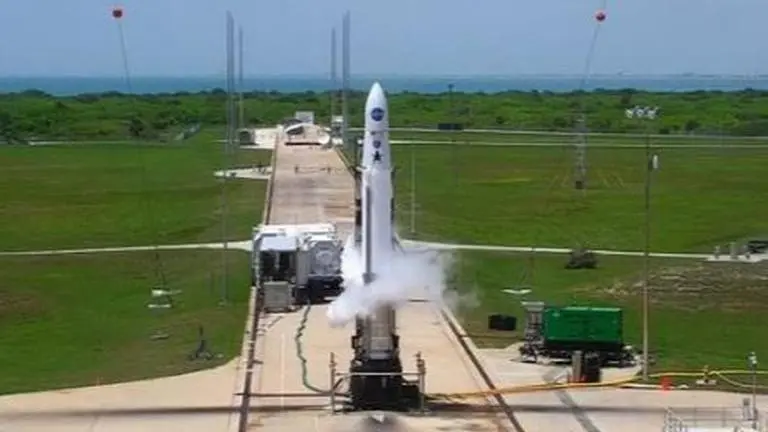
NASA provided an update about its TROPICS mission which failed on June 12 due to a malfunction in launch provider Astra's rocket. The mission lifted off with two weather satellites at 11.13 p.m. (IST) on June 12 from the Cape Canaveral Space Force Station in the rocket named Launch Vehicle 0010 (LV0010). However, the engines of the rocket's second stage died a minute before the planned shutdown and the satellites failed to reach orbit.
LAUNCH!
— Chris Bergin - NSF (@NASASpaceflight) June 12, 2022
Astra launches NASA's TROPICS-1 mission on the LV0010 vehicle from SLC-46 at the Cape.
Overview:https://t.co/0xbsXw8HYZ - by Thomas Burghardt (@TGMetsFan98).
Official NSF/Astra livestream: https://t.co/gOpMFSF0Ht#AstraPartner pic.twitter.com/uq4TADeTNm
While NASA's next move after losing two of its satellites was unclear, the agency later said in a statement, "Despite a loss of the first two of six satellites, the TROPICS constellation will still meet its science objectives with the four remaining CubeSats distributed in two orbits".
Time-Resolved Observations of Precipitation structure and storm Intensity with a Constellation of Smallsats (TROPICS) mission involves the launch of six satellites in three installments.
Looks like they lost it late into the upper stage burn. pic.twitter.com/81xhMyTzfZ
— Chris Bergin - NSF (@NASASpaceflight) June 12, 2022
"With four satellites, TROPICS will still provide improved time-resolved observations of tropical cyclones compared to traditional observing methods", the agency added further.
Advertisement
NASA satellites likely fell into the ocean
While the collaborators are still investigating what caused the early engine shutdown, astronomer Jonathan McDowell estimated that the satellites might have fallen 400 km west of Senegal's capital Dakar." I am now a bit more confident that the debris wouldn't have got quite as far as the African coast", McDowell said in his tweet.
Slight revision: I estimate reentry about 400 km west of Dakar. I am now a bit more confident that the debris wouldn't have got quite as far as the African coast. pic.twitter.com/jpDtYV3LyX
— Jonathan McDowell (@planet4589) June 12, 2022
Astra, which was founded in 2016, suffered another mission failure, making it five out of seven total attempts. Following the incident, NASA expressed its disappointment and said that "these types of missions are important to expand scientific knowledge". The satellites are being launched by the agency to study tropical cyclones, and gain insight into their formation, intensification, and interactions with their environment.
Advertisement
As for the next step, NASA said that the Federal Aviation Administration (FAA) and Astra will lead the investigations over the mission failure and assured to lend expertise but confirmed halting the launch effort with Astra until then.
Published By : Harsh Vardhan
Published On: 14 June 2022 at 21:44 IST