
Hubble telescope photographs two spiral galaxies gravitationally distorting one another
The Hubble telescope, built by NASA and ESA, photographed a pair of spiral galaxies which are warping one another through their gravitational interaction.
- Science News
- 2 min read

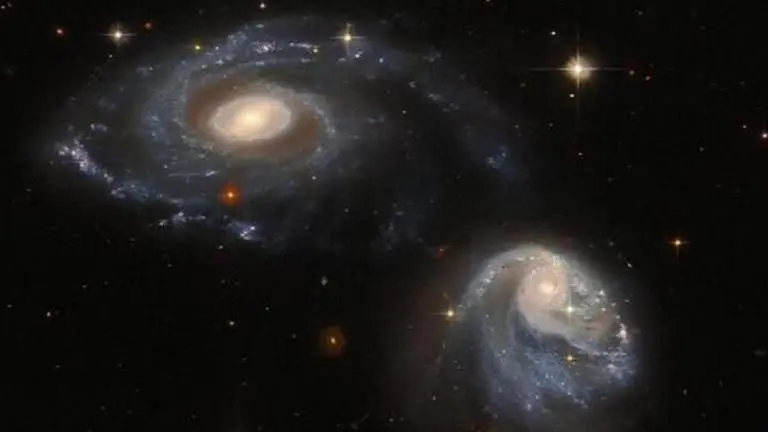
The NASA-ESA Hubble telescope has spotted a pair of spiral galaxies which despite being considerably far apart are causing subtle but huge influence on each other. According to ESA's (European Space Agency) report, these two galaxies together are known as Arp-Madore 608-333 and were captured by Hubble’s Advanced Camera for Surveys (ACS). Through observations, scientists have come to know that these galaxies are warping one another through a mutual gravitational interaction that is disrupting and distorting them both.
📷 This NASA/ESA @HUBBLE_space Telescope image shows a pair of interacting galaxies known as Arp-Madore 608-333. The two are warping one another through a mutual gravitational interaction that is disrupting and distorting both galaxies 👉 https://t.co/aRjUSWpCEh pic.twitter.com/0Q7uOGnvot
— ESA (@esa) October 3, 2022
Captured as part of an effort to build up an archive of interesting targets, these galaxies will be studied in a more detailed form by various ground-based observatories and the James Webb Space Telescope. "To build up this archive, astronomers scoured existing astronomical catalogues for a list of targets spread throughout the night sky," ESA said in a statement. "By doing so, they hoped to include objects that had already been identified as interesting and that would be easy for Hubble to observe no matter which direction it was pointing."
Moving forward, astronomers have plans to study several galaxies, which have previously been observed through Hubble, using the Webb telescope. Launched on December 25 last year, Webb's operational time has been distributed between various institutions and scientific groups who would conduct follow-up studies on objects ranging from exoplanets, asteroids, black holes, comets, nebulae and galaxies.
Recently, NASA shared a picture of another spiral galaxy named IC 5332 which was once a target of the Hubble telescope. Captured using Webb's Mid-Infrared Instrument (MIRI), the image was a follow-up observation that offered a view through the galaxy's thick dust clouds. The images below provide a comparison between the views which were taken in ultraviolet and visible light by Hubble and in infrared by Webb. Infrared has a wavelength longer than visible light due to which it is invisible and can only be felt as heat.
Advertisement
In visible and ultraviolet light, @NASAHubble (left) shows dark regions of dust that separate the spiral arms. Webb (right) is able to peer through that dust in mid-infrared light, instead seeing patterns of gas that echo the arms’ shape. pic.twitter.com/aigQb59kaI
— NASA Webb Telescope (@NASAWebb) September 27, 2022
Meanwhile, Hubble continues to carry out its observations of deep space objects despite being in the final years of its operation. Launched in 1990, Hubble has lasted longer than expected and now NASA is planning to add a few more years to the telescope's lifespan by raising its orbit. Tap here to read all about it.