
Updated 31 July 2022 at 19:42 IST
Hubble telescope shows 'diversity of galaxies' in luminescent image; ESA explains meaning
Hubble telescope's new image, shared by ESA, features three galaxies one of which houses an active galactic nucleus with a massive black hole at the center.
- Science News
- 2 min read

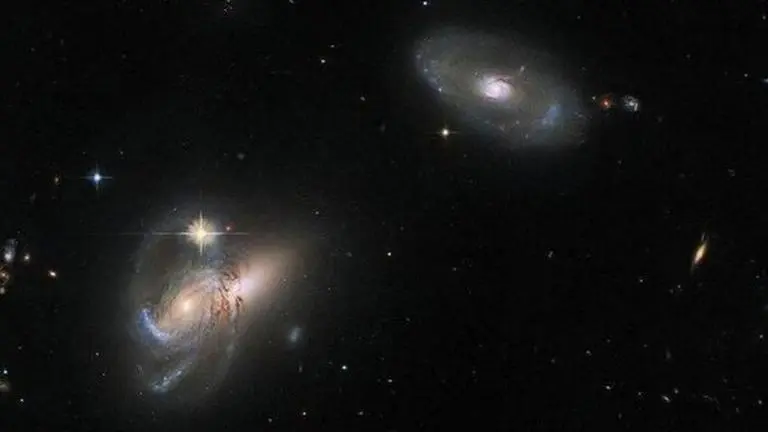
The European Space Agency (ESA) has shared a new image captured by the Hubble Space Telescope showing the 'diversity of galaxies' in a single frame. The image features a total of three galaxies; the first is the LEDA 58109, the lone galaxy lying in the upper right corner. On the lower left, is an active galactic nucleus (AGN) named SDSS J162558.14+435746.4 that partially obscures the galaxy named SDSS J162557.25+435743.5, which can be seen peeking from the right side.
A luminescent image featuring multiple galaxies was our latest Picture of the Week. See it in video format below.
— HUBBLE (@HUBBLE_space) July 29, 2022
More: 🔗 https://t.co/HVJ7Dddgc1
Credit: @esa / @HUBBLE_space / @NASA , W. Keel
Music: Stellardrone - Billions and Billions pic.twitter.com/1V2aF3d80q
An active galactic nucleus is a small region at the centre of some galaxies which has extreme luminosity and emits so much radiation that it can outshine the rest of the galaxy altogether. Scientists say that this radiation is produced by a central supermassive black hole that is devouring material that gets too close to it.
ESA explains that galaxies are generally classified into two categories-- spiral and elliptical. Spiral galaxies are those that have a rotating disc with spiral ‘arms’ that curve out from a dense central region, an example being our own galaxy, the Milky Way. On the other hand, elliptical galaxies are those that have an even and compressed football-like shape and they contain a much greater proportion of older stars than spiral galaxies do.
"The diversity of galaxies in this image alone highlights the complex web of galaxy classifications that exist, including galaxies that house extremely luminous AGNs at their cores, and galaxies whose shapes defy the classification of either spiral or elliptical," ESA said in a statement.
Advertisement
Hubble telescope spies on a lenticular galaxy
This #HubbleTopImage features the lenticular galaxy NGC 1947. It has lost almost all the gas and dust from its signature spiral arms, which used to orbit around its centre.
— HUBBLE (@HUBBLE_space) July 28, 2022
🔗 https://t.co/CBIMSe0TuM
Credit: @esa / @HUBBLE_space / @NASA , D. Rosario
Acknowledgement: L. Shatz pic.twitter.com/Q9fIZVR6YY
Recently, the agency shared an image captured by the Hubble telescope featuring a galaxy neither elliptical nor spiral. Named NGC 1947, this galaxy is a lenticular galaxy that lost almost all the gas and dust from its signature spiral arms. Discovered almost 200 years ago by Scottish astronomer James Dunlop, this galaxy lies around 40 million light-years away from Earth and can be seen only in the constellation Dorado in the southern hemisphere.
Image: ESA
Published By : Harsh Vardhan
Published On: 31 July 2022 at 19:42 IST