
Image from Hubble Space Telescope shows an Intriguing 'Active' Galaxy
An active galactic nucleus (AGN) is a small area at the centre of some galaxies that is much brighter than the galaxy's stars alone would be.
- Science News
- 3 min read

;'%3e%3cpath%20d='m8,15.99c4.41,0,7.99-3.58,7.99-7.99S12.41,0,8,0,0,3.59,0,8s3.58,7.99,7.99,7.99Z'%20style='stroke:%23fff;%20stroke-miterlimit:10;%20stroke-width:.02px;'/%3e%3cpath%20d='m3.08,3.37l3.82,5.11-3.84,4.15h.87l3.37-3.64,2.72,3.64h2.94l-4.04-5.39,3.58-3.87h-.86l-3.1,3.35-2.5-3.35h-2.94Zm1.27.64h1.35l5.97,7.99h-1.35l-5.97-7.99Z'%20style='fill:%23fff;'/%3e%3c/g%3e%3c/svg%3e)


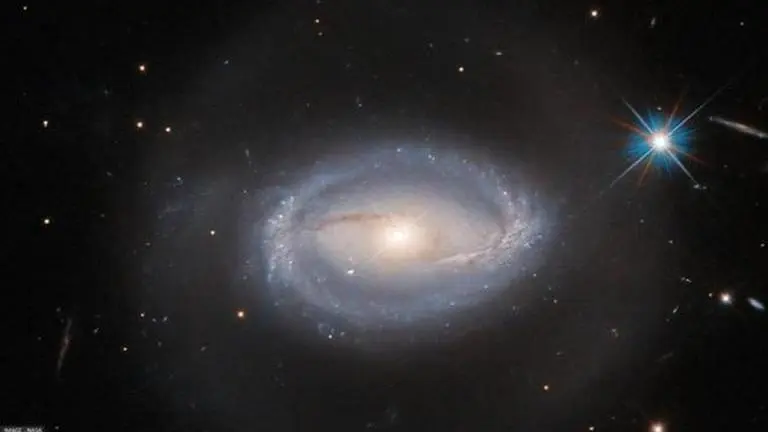
Z 229-15, a celestial object in the constellation Lyra, is visible in the bright image taken by the NASA/ESA Hubble Space Telescope. It is placed about 390 million light-years away from Earth. One of those intriguing celestial objects, Z 229-15 has been classified as an active galactic nucleus (AGN), a quasar, and a Seyfert galaxy at various points in time as per reports from NASA.
Which of these actually contains Z 229-15?
The answer is that it is all of these things at once since there is a large overlap between these three definitions.
An active galactic nucleus (AGN) is a small area at the centre of some galaxies that is much brighter than the galaxy's stars alone would be. The supermassive black hole that is located at the galaxy's centre is the cause of the increased luminosity. Instead of falling directly into a black hole, the material is attracted into a spinning disc and then is irresistibly pulled in that direction.
AGNs are so bright because of the enormous amount of energy that is released across the electromagnetic spectrum when this disc of stuff becomes extremely hot.
Advertisement
Astronomy classification can be difficult - NASA
Quasars are a specific kind of AGN; they are often very bright and very far away from Earth. Z 229-15 is positively local since it is located inside a quasar's range of proximity, which is several hundred million light-years. Yet, Seyfert galaxies are active galaxies that house extremely bright AGNs (quasars) while the remainder of the galaxy is still viewable.
Frequently, an AGN is so luminous that the rest of the galaxy cannot be observed. Z 229-15 is a Seyfert galaxy that, by definition, hosts an AGN because it contains a quasar.
Advertisement
Weather change on Jupiter and Saturn
NASA/ESA Hubble Space Telescope, one of the most powerful telescopes built by the scientific communities, has recorded the changing weather on Jupiter and Uranus in awe-inspiring new images. The telescope, designed to keep an eye on the outer planets of the solar system has also been constantly monitoring the seasonal change and atmospheric switch across the two giant planets by giving a close-up look.
Launched in 2014, Hubble observes the celestial bodies from other spacecraft such as Juno, a Lockheed Martin-built NASA space probe orbiting the planet Jupiter. Hubble also recorded stunning observations for NASA, the European Space Agency, and the Italian Space Agency's Cassini mission to study the planet Saturn. It was also used during the Voyager 1 and 2 probe that took advantage of a rare planetary alignment and studied the outer solar system with all four giant planets in line between 1979 and 1989.